
Michigan has been the foundational state of American trailer manufacturing since 1914, and that history still shows up in the way serious equipment trailers are built today. Michigan made isn't just a label, it points to a long engineering tradition that shaped frames, fit, and hauling practice for the work that contractors rely on every day.
That matters because a trailer isn't useful when it's parked on paper spec sheets. It's useful when a skid steer loads cleanly, a mini-excavator tracks straight, the brakes stay predictable on the road, and the deck still looks square after years of hard use.
Table of Contents
- Why Michigan Made Matters for Your Next Trailer Purchase
- Key Specifications to Evaluate Before Buying
- Features That Separate Premium Trailers
- Compliance and Regulatory Requirements You Must Know
- Maintenance Practices That Extend Trailer Lifespan
- ANTS Trailers as a Michigan Manufacturing Example
- Making Your Final Trailer Decision with Confidence
Why Michigan Made Matters for Your Next Trailer Purchase
A trailer can wear a Made in USA badge and still be built for the lowest possible cost. Michigan made equipment trailers carry a different kind of weight because the state's trailer history goes back to the first Fruehauf semi-trailer, devised in Detroit in 1914, with Fruehauf founded there in 1918 and later collecting more than 1,000 patents through the company's work The Henry Ford archival record. That's not a decorative history lesson, it's the foundation of how the category developed.
Why that history still matters on a jobsite
When a manufacturing region has spent generations building hauling equipment, the lessons don't stay in a museum. They show up in welding habits, frame layout, component selection, and the way a builder thinks about repeated loading cycles. Michigan also hosted major mass-production trailer makers in the mid-20th century, including the Alma Trailer Company, which began production in 1934, and the Covered Wagon Company, which operated in Mount Clemens from 1935 to 1945 and was described as one of the largest travel trailer manufacturers in the United States Promote Michigan's history piece.
Practical rule: the older the manufacturing ecosystem, the easier it is to find people who know why a trailer cracked, bent, or loaded poorly, and how to prevent it next time.
For a buyer, that background matters because trailers are systems, not just frames on axles. A contractor hauling a compact excavator needs consistent ramp geometry, axle placement, and brake behavior, while a forestry crew needs a deck that stays stable under uneven loading. Michigan's trailer tradition has been shaped by those kinds of real-world demands, not just catalog styling.
If you're comparing two similar-looking units, the safer bet is usually the one rooted in a true manufacturing culture, not an assembly story. That doesn't mean every Michigan trailer is automatically right for your work. It means Michigan made gives you a better starting point for judging whether the builder understands hauling as a duty cycle, not a brochure feature.
Key Specifications to Evaluate Before Buying
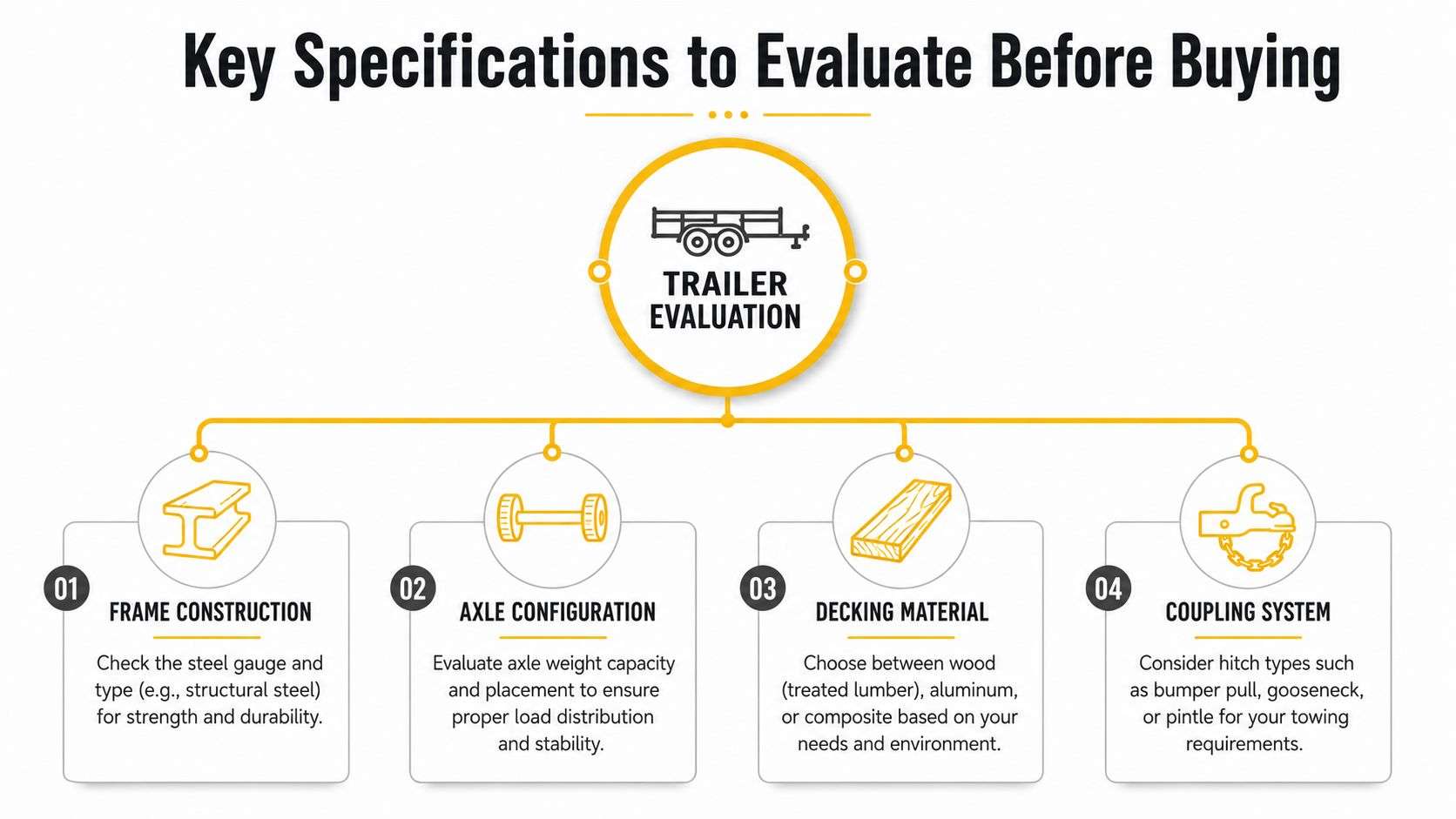
The biggest mistake buyers make is treating a trailer like one solid object instead of a set of working parts that have to stay in balance. Frame, axle package, suspension, and GVWR need to support the same job, or the weakest piece becomes the limit. Michigan-made equipment trailers built for heavy machinery are often engineered in the 7,000- to 15,000-lb GVWR class, with structural packages such as dual 7,000-lb electric-brake axles, 6-leaf slipper springs, ST235/80R16 load-range-E tires, and 7-inch channel main frames Johnson Trailer Co. example.
Frame and running gear need to match the payload
That weight rating is more than a plate on the tongue. The GVWR sets the legal payload envelope, while the axle, brake, and suspension stack determine whether the trailer can handle stopping heat and concentrated machine loads in actual use. A machine with narrow tracks or a heavy front end does not forgive weak running gear, and the trailer will show that weakness fast.
A trailer can sit level and still be undersized where it matters most, especially if the tires or axles do not truly match the claimed rating.
A 15,000-lb-rated platform may use a 7-inch channel frame, 3-inch channel crossmembers on 16-inch centers, and a 12,000-lb dropleg jack to manage tongue loads and torsional stress during loading and transport. That combination tells you something practical. The builder expected real loading stress, not occasional light hauling.
What to verify before you sign
The spec sheet is only the starting point. Check that the frame material, weld quality, tire rating, and axle labels all line up with the advertised capacity. If any one of those pieces looks lighter than the rating suggests, the trailer may still roll down the road, but it will not build confidence on a wet ramp or a rough site.
Deck height and ramp layout matter just as much as raw capacity. A lower load angle reduces the climb at the ramp, which helps equipment roll on with less wheel slip and less chance of hanging up at the transition. For a closer look at that relationship, the drop deck trailer specifications page is a useful reference point.
Features That Separate Premium Trailers
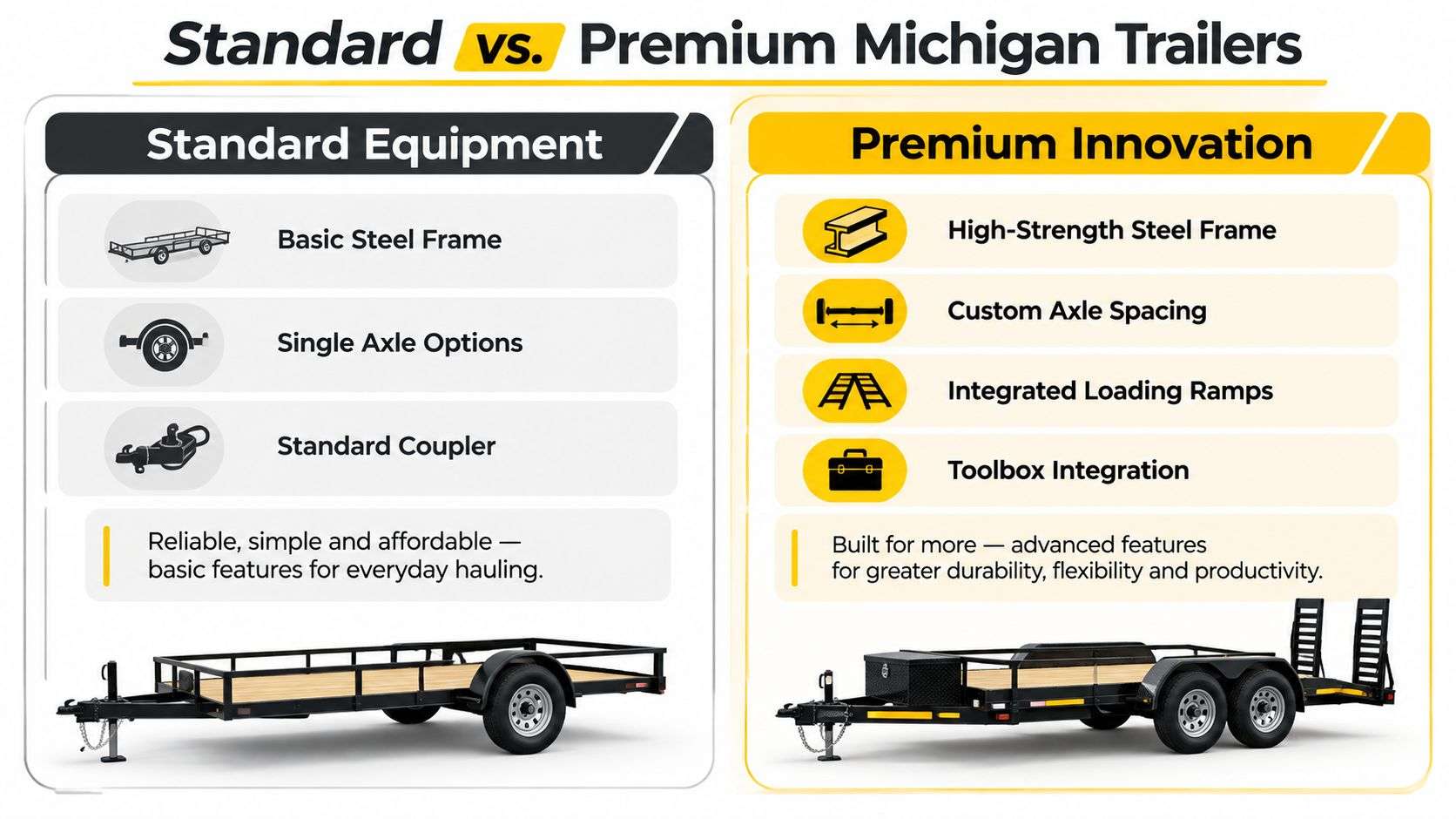
Standard equipment trailers do the basic job. Premium models solve the loading, unloading, and securement problems that slow crews down before the day even starts. The biggest differences usually show up in deck angle, bed movement, and how the trailer helps the operator control the load instead of fighting it.
Low-angle geometry changes how equipment loads
A lower deck angle reduces the climb at the ramp, so equipment does not have to lift its nose as sharply during entry. That helps on uneven ground, where a steep transition can cause wheel slip, undercarriage strike, or a hang-up at the breakover point.
One Michigan-made enclosed drop-deck setup specifies a 3-degree load angle on the bed and 9 degrees on the ramp, with an empty weight of 2,660 lb and a 5,340-lb load capacity ANTS drop-deck example. Read those numbers the way a contractor reads a level. They tell you how much the trailer is doing to help the machine get on and off without drama. On a muddy site or a crowned driveway, that difference is easy to feel.
Active bed control and integrated handling
Some trailers add a kneeling or lowering function that brings the loading point down even farther. That matters most when the machine has low ground clearance, because every inch of extra climb raises the risk of contact, instability, or a hurried load.
Bed control also affects how the trailer behaves once the equipment is halfway on. If the platform stays steady and the transition stays predictable, the operator can keep the load aligned instead of correcting after every bounce. That kind of control is easier on the machine and easier on the crew.
A live-bottom style trailer handles the unloading side in a different way. The bed itself moves material off the trailer, so the operator does not need to stage the dump with separate equipment first. For crews moving loose material, that removes a step from the process and keeps the truck from sitting idle while another machine takes over.
Jobsite insight: if a feature makes loading safer and unloading simpler, it is not decoration. It saves labor and helps avoid damage.
The same drop-deck setup also uses a 78-inch-wide by 13-foot-4-inch enclosed bed and a winch-mount bracket ANTS enclosed deck example. Those details matter because securement and weather protection are part of trailer value too, especially when the cargo is too expensive to leave exposed overnight.
Compliance and Regulatory Requirements You Must Know
A trailer can look road-ready and still fail the first inspection. That's why compliance needs to be checked before the purchase, not after the unit is already on your lot. The basics are familiar, but they're easy to overlook when a trailer seems solid and the salesman is focused on the build.
Start with the road-legal basics
For public-road use, buyers need to confirm proper lighting, reflectors, brake-controller compatibility, and a functional safety-chain setup. Those items sound simple, but a mismatch between tow vehicle and trailer can create a stopping problem even if the trailer itself is well built. The buyer guide for Michigan equipment trailers also warns shoppers to measure load angle, inspect suspension and running gear, verify brake setup, and confirm VIN, title, registration, safety chains, and controller compatibility, which tells you these are common failure points in real purchases ANTS buyer guide.
Paperwork matters as much as hardware
Every state has its own registration thresholds, inspection schedules, and weight-certification rules. If you cross state lines regularly, the cleanest-looking trailer on the lot can still become a headache if the documents don't match the actual build. Make sure the VIN on the trailer matches the title exactly, and confirm that the registration is set up for the states where you'll operate.
The trailer doesn't stop being your responsibility once it leaves the dealer's yard.
Michigan manufacturers may build to high standards, but the burden of legal use still sits with the buyer. That means the final checklist should include lighting, brakes, chains, title, VIN, and tow-vehicle compatibility before you leave with the trailer. If one item is off, you can lose more time fixing paperwork or wiring than you spent choosing the trailer.
Maintenance Practices That Extend Trailer Lifespan
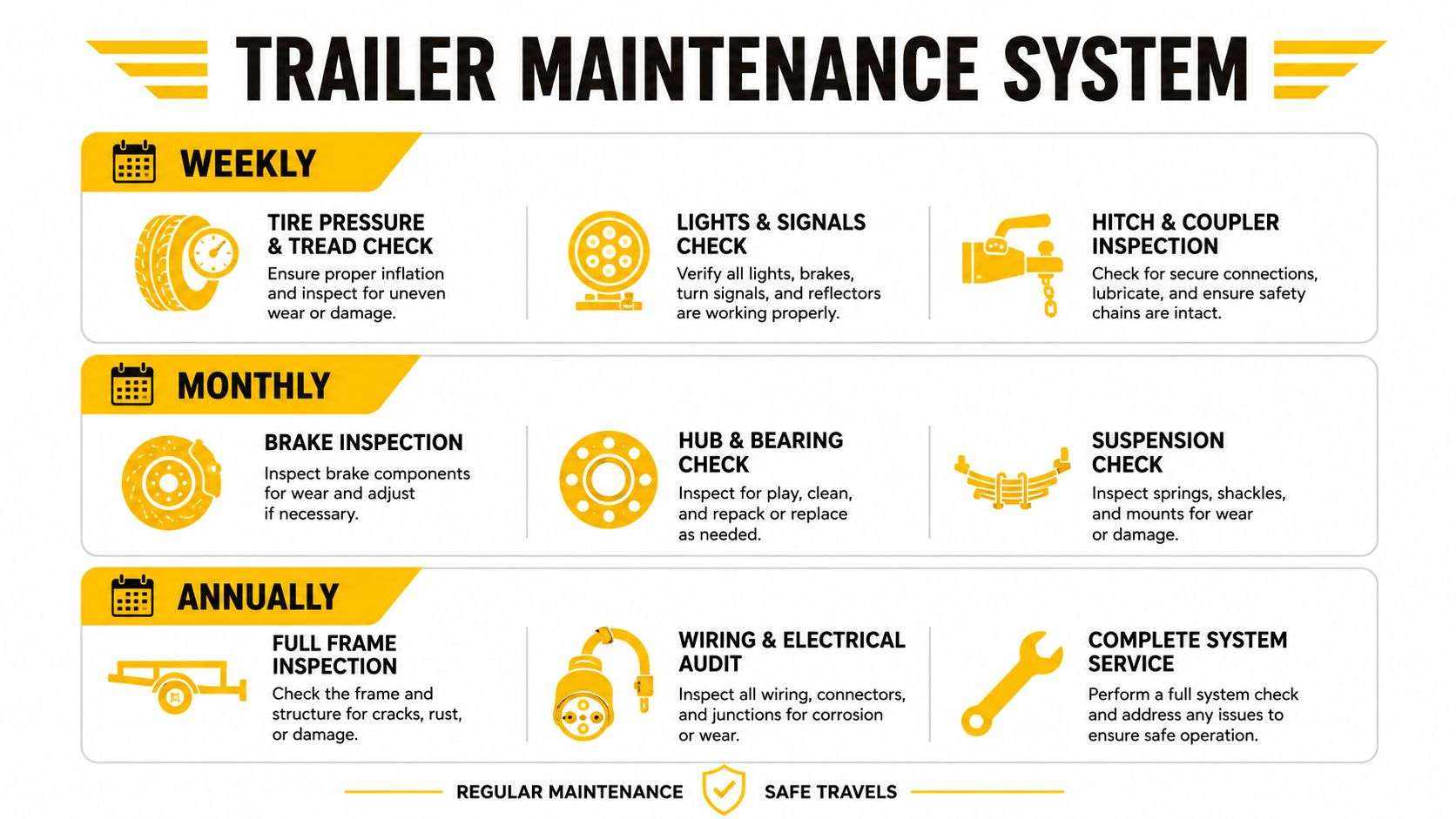
A good trailer doesn't stay good by accident. Daily use on jobsites puts stress into tires, bearings, welds, ramps, and wiring, and the damage usually builds slowly before it becomes obvious. A routine inspection schedule keeps that wear visible while it's still cheap to fix.
Daily and weekly checks that catch problems early
Start each day with tire pressure, tire date codes, brake lights, safety-chain integrity, and a quick look at the frame and welds. Those checks take less time than a roadside failure, and they tell you whether the trailer was parked or used hard the day before. Weekly, grease the zerk fittings on the axle housings and kingpins, inspect tread depth, and check winch straps and tie-down points.
Seasonal service is where many crews fall behind
Before heavy-use season, inspect the suspension for leaf-spring cracks or sagging, test brake engagement and fade under load, check ramp hinges and latch mechanisms, and look underneath for corrosion or stress fractures. Wheel bearings deserve special attention too, because a humming or grinding sound usually means wear is already in motion. Repack or replace them on the manufacturer interval instead of waiting for a roadside warning.
Maintenance truth: the trailer that gets inspected on schedule is the trailer that keeps making money.
A simple seasonal guide can help crews stay consistent, especially when the shop is busy and the trailer only gets attention after something breaks. The seasonal maintenance guide is a helpful reminder to line up inspection work before the busiest stretch starts.
A Michigan-made trailer that's maintained correctly can stay in service for a long time, while neglect turns a capital purchase into a repair cycle. If you want a practical checklist format for planning that routine, this long-lasting work trailers guide is worth keeping nearby.
ANTS Trailers as a Michigan Manufacturing Example
One practical way to judge Michigan made equipment trailers is to look at a builder that connects design choices to real work. ANTS Trailers says its trailers are made in the USA and manufactured in Baraga, Michigan, with a focus on demanding regional jobs and professional-use durability and versatility ANTS heavy-duty trailer page. That matters because the buyer is not choosing a display piece, but a tool that has to hold up when the schedule is tight and the load changes from week to week.
Product details show how the engineering thinking changes
The 14/16 Live Bottom model uses a walking conveyor floor, which moves material directly off the bed without needing separate unloading equipment. It also has the ability to kneel and tilt, which helps when the ground is uneven or when the load needs a lower transfer point. For a crew handling loose material, that changes the workflow in a way that matters on the jobsite.
The 7/12X Drop Deck shows a different side of trailer design. It has an empty weight of 2,660 pounds, a 5,340-pound load capacity, and an enclosed bed measuring 70.5 inches wide by 13 feet 4 inches long. That setup makes sense when equipment needs protection and securement, but the trailer still has to stay easy to place, load, and pull.
For heavier work, the 14/20X Drop Deck uses a 3-degree bed angle and 9-degree ramp angle. A lower angle reduces the climb during loading, which helps when the machine rides low or the site surface is not level. That is the kind of detail that keeps a load from dragging or binding before it ever reaches the deck.
Inspection should focus on how the trailer will behave under stress, not just how the brochure reads. Bed angle, ramp height, and loading geometry tell you more than polished photos do, because they show whether the trailer helps the operator or asks for extra effort every time the machine rolls on.
If you want a dealer-style reference point for another Michigan example, Tracey Road equipment trailers in East Syracuse, NY helps show how working buyers are walked through trailer specs in practice. The point is not brand talk. It is seeing how the numbers and the layout connect to the jobs a crew has to finish.
Support matters too. ANTS says customers get manufacturer-direct help for parts and troubleshooting, and financing is available through partners such as Ascentium Capital. That support can matter just as much as steel thickness when the trailer has to stay in rotation instead of waiting on the sidelines.
Making Your Final Trailer Decision with Confidence
The right trailer starts with the job, not the brochure. If you haul compact construction machines, landscaping loads, forestry equipment, or a mix of heavy and light gear, the first question is what the trailer has to carry most often. That answer determines the GVWR, frame style, and deck layout you should be shopping for.
Match the trailer to the way you actually load
If your equipment rides low or you load on uneven ground, a drop-deck or kneeling trailer isn't a luxury. It's a safety feature. The lower the loading angle, the less the machine has to climb, and the less likely you are to fight wheel slip or undercarriage contact during the load.
Check support, paperwork, and upkeep before the sale closes
Compliance should be verified before money changes hands. Brake-controller fit, lighting, title, registration, and VIN matching all need to be settled while the trailer is still easy to inspect. After that, think about the support structure around the trailer, parts availability, dealer access, and financing can influence how fast the trailer gets into service.
If you're also comparing equipment purchases as a business decision, the guide to trailer truck sales is a helpful way to think about the truck side of the equation alongside the trailer.
A trailer that's well matched, legally ready, and easy to maintain will pay you back in fewer delays and fewer surprises. That's the test of michigan made equipment trailers, not a shiny finish or a clever sales line. It's whether the unit fits your work, your roads, and your crew.
If you're ready to match your next trailer to the work you do, ANTS Trailers designs and manufactures Michigan-built options for hauling equipment, materials, and heavy-duty jobsite loads. Take a close look at the specs, loading geometry, and support details, then reach out to see which build fits your crew best.