
You're usually shopping for a trailer because the work has already outgrown what you're hauling with now. A crew is waiting, a machine needs to move, material has to show up on time, and the current trailer is starting to tell you it's done. Maybe the ramp flexes more than it used to. Maybe the deck is still legal, but you can see the frame has started taking a set after too many rough access roads and too many loads loaded just close enough to the limit.
That's the point where “long lasting” stops being a brochure phrase and turns into an uptime decision. A trailer that stays in service protects labor, schedules, and equipment. A trailer that fails ties up a truck, leaves a machine stranded, and burns half a day while everyone scrambles for a backup.
Table of Contents
- Why "Long Lasting" Is an Engineering Choice Not a Feature
- The Anatomy of a Truly Durable Work Trailer
- Innovative Features That Extend Lifespan and Boost Safety
- How ANTS Trailers Delivers on Durability and Versatility
- Matching the Trailer to the Job Application Specific Advice
- The Operator's Checklist for Maximizing Trailer Lifespan
- Your Next Trailer An Investment in Uptime and Profitability
Why "Long Lasting" Is an Engineering Choice Not a Feature
A durable trailer doesn't happen by accident. It comes from a frame that resists fatigue, running gear that matches the work, loading geometry that limits impact, and operators who don't treat GVWR like a target.
That matters because a lot of trailers don't die from one dramatic overload. They die slowly. The tongue starts developing fatigue, the bed sees repeated twist on uneven ground, welds start carrying stress they weren't meant to carry every day, and the owner notices the problem only after alignment, deck fit, or hydraulic behavior changes.
Practical rule: If a trailer spends its life on rough roads, crowned jobsite entrances, and uneven loading surfaces, fatigue resistance matters as much as payload.
A serious buyer should think in systems, not options. Build quality, load management, unloading method, bed angle, corrosion protection, and maintenance discipline all work together. Ignore one of those, and the trailer's service life shortens no matter what the sales sheet says.
High-quality enclosed work trailers have a proven lifespan of 10 to 15 years on average, and that benchmark in the heavy-duty trailer sector depends heavily on consistent maintenance practices. Under optimal conditions, premium models can last longer, but the baseline lesson is simple: good engineering still needs disciplined upkeep.
For buyers who want a trailer to stay productive for a decade or more, the right question isn't “How heavy is it?” It's “What in this design keeps it from wearing itself out in normal work?”
The Anatomy of a Truly Durable Work Trailer
A work trailer usually starts aging long before it looks worn out.
What fails first in the real world
On active jobsites, the service life of a trailer is shaped by cyclic loading. Every pothole, off-camber driveway, curb strike, and uneven equipment load puts another stress cycle into the frame. Static capacity matters, but fatigue usually decides whether a trailer stays square and productive after a few hard seasons.
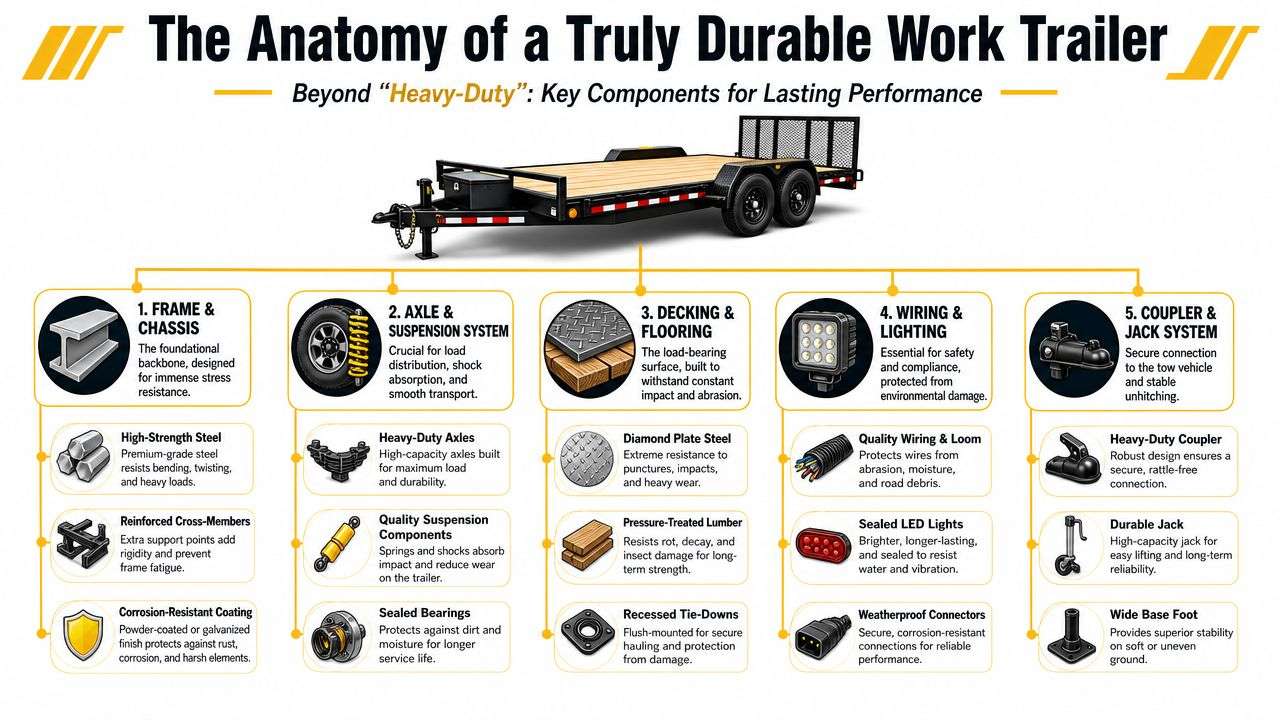
The main components that take that punishment are the frame and chassis, axle and suspension system, decking and flooring, wiring and lighting, and the coupler and jack system. They do not fail for the same reasons.
The frame carries the biggest long-term risk. Main rails, cross-members, the tongue, and weld transitions need to handle twist as well as weight. In field use, many trailer failures show up as fatigue first. Hairline cracking near the tongue, bed junctions, spring hangers, or cross-member connections often starts months before an operator notices a handling issue. By the time tire wear changes, deck alignment shifts, or the trailer starts pulling slightly off line, the repair is already bigger and more expensive.
Axles and suspension come next because they control how much impact gets passed into the structure. Poorly matched running gear does more than ride rough. It pounds the frame, loosens fasteners, and speeds up wear in hangers, equalizers, bushings, and weld zones. The coupler and jack also take repeated side load on uneven ground, especially on sites where hitching happens in a rush.
Fatigue damage is an operating-cost problem before it becomes a visible structural problem.
What to inspect beyond the brochure
A respectable weight rating does not guarantee long life. Buyers should look at how the trailer is built for repeated stress, what reserve capacity it carries in normal work, and where stress concentrates when the deck is loaded off center or one wheel drops into a rut.
For demanding commercial use, many buyers shop in the 10,000 to 16,000 pound GVWR range with deck lengths around 16 to 24 feet and payloads that vary with trailer configuration, axle package, and curb weight. Those are general market ranges, not proof of durability. The useful formula is still simple: GVWR minus trailer weight equals payload capacity.
The better question is how close the trailer will run to its limit every week. Keeping a 15 to 20 percent working margin above the heaviest routine load reduces stress cycling in the frame, suspension, deck attachments, and welds. That margin costs a little more up front. It usually saves money in tire wear, alignment corrections, welding repairs, and downtime.
Use this screening table during an inspection:
| Component | What holds up | What causes trouble |
|---|---|---|
| Frame and tongue | Reinforced structure, clean weld quality, strong cross-member layout | Flexing at the tongue, visible stress at bed joints |
| Suspension | Components matched to rough terrain and repeated hauling | Shock transferred into frame and deck |
| Deck and floor | Surface built for abrasion and point loads | Deformation from concentrated equipment impact |
| Wiring and seals | Protected routing and sealed entry points | Corrosion, shorts, moisture intrusion |
| Coupler and jack | Tight fit and stable operation | Slop, binding, side-load wear |
Corrosion protection needs the same practical review. Steel thickness helps, but water usually gets in through seams, fastener penetrations, damaged coatings, and debris traps. That is one reason why seal integrity is critical on equipment that lives outside, gets pressure washed, and works in mud or winter road spray. Buyers comparing long-term coating performance should also review hot-dip galvanizing cost considerations as part of total ownership cost, because corrosion around joints and hidden cavities often shortens trailer life before the deck or axles are fully spent.
Innovative Features That Extend Lifespan and Boost Safety
A trailer usually does not fail because it was overloaded one time. It wears out from thousands of smaller hits. Repeated loading, unloading, bouncing across uneven ground, and abrupt material shifts create cyclic stress that slowly opens up welds, loosens joints, and shortens the life of the deck, hinges, and hydraulics.
Low angles do more than ease loading
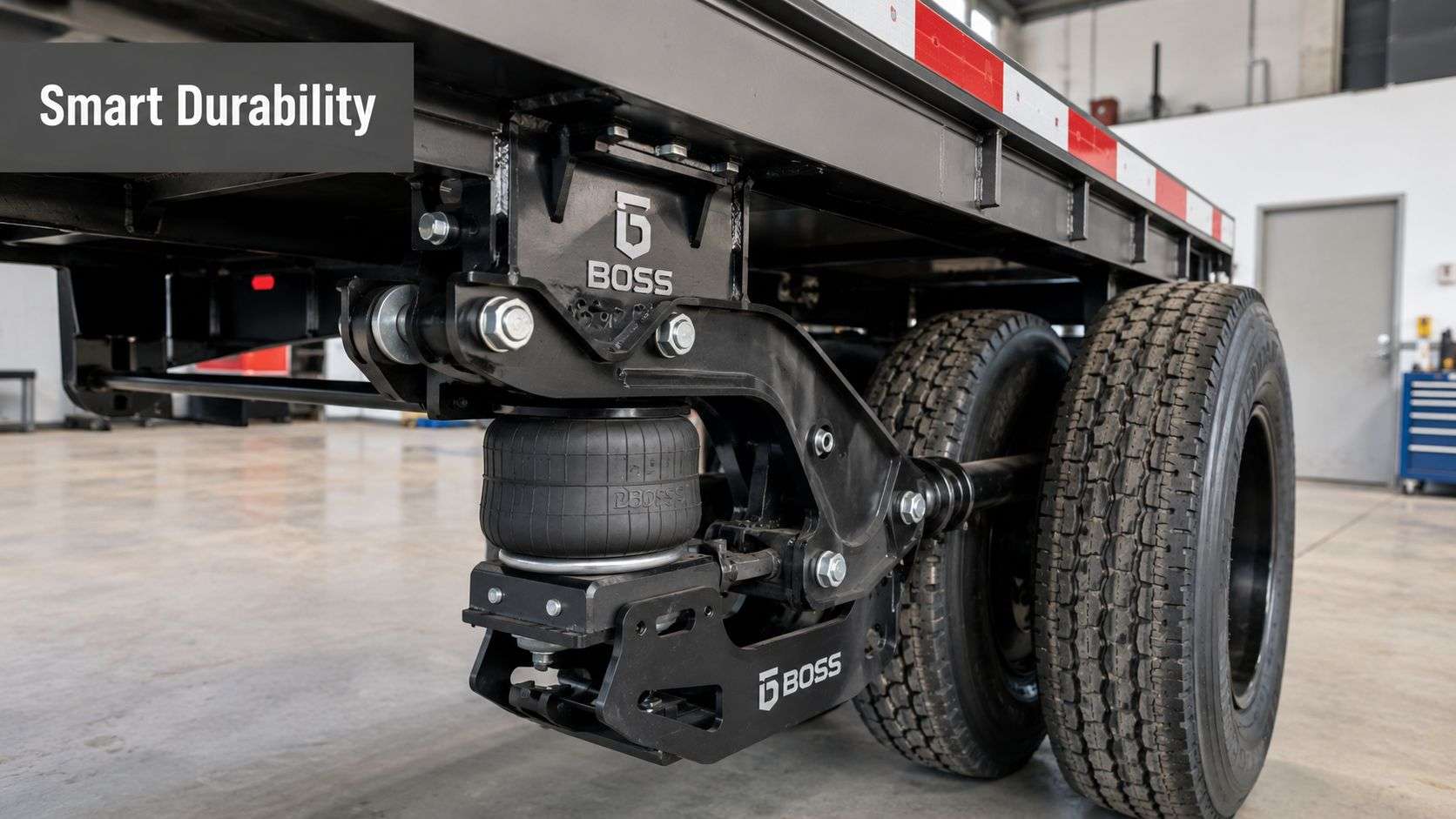
Low-load-angle geometry is one of the clearest examples of design that cuts fatigue instead of just improving convenience. As a best practice, a shallower bed and ramp angle reduces the jolt that hits the trailer when equipment climbs on, crosses the transition point, and settles onto the deck.
That matters on every cycle. A steep approach angle drives more force into ramp hinges, deck transitions, and the machine's first contact point. A lower angle smooths that movement out, which means less bounce, less frame twist, and less abuse transferred into the trailer structure.
On jobsites, the benefits show up in ways crews notice right away:
- Less impact at contact points, especially around hinge areas and deck breaks
- Better control during loading, with less wheel hop and fewer sudden throttle corrections
- Fewer field fixes such as loose boards, dirt build-ups, or makeshift ramp extensions
The floor matters too. Repeated traffic usually follows the same tracks, so deck wear is rarely uniform. Buyers comparing traction, abrasion resistance, and long-term maintenance should review diamond plate floor options for work trailers, because surface damage often starts where machines climb, pivot, and brake in the same spots day after day.
Controlled unloading cuts abuse
Unloading creates its own fatigue cycle. Traditional dump-style release can shock the structure when material hangs up, shifts to one side, or drops all at once. That kind of event may not leave obvious damage on day one, but it adds stress to the frame, hoist mounts, and body over time.
A live-bottom or conveyor-floor system reduces that spike load by moving material out in a controlled stream. The operator gets better placement, and the trailer avoids the hard slam that comes with sudden release. That is a real durability advantage on trailers that handle wet aggregate, demolition debris, mulch, or other loads that do not always break free evenly.
Kneeling and drop-deck layouts help for the same reason. They let the trailer match the ground instead of forcing the operator to fight bad approach geometry on rough surfaces. More stability during loading and unloading means fewer side-load events, fewer hard transitions, and fewer chances for the trailer to absorb the kind of twisting stress that shortens service life.
The safest trailer is usually the one that asks the operator for less improvisation.
How ANTS Trailers Delivers on Durability and Versatility
Where the design choices matter
ANTS Trailers is one example of a manufacturer building around the jobsite realities that shorten trailer life. The company manufactures its trailers in Baraga, Michigan, USA, which matters for buyers who want USA-made equipment built to American quality standards for demanding work.
The durability story is in the function, not the slogan. The 14/16 Live Bottom model uses a walking conveyor floor system for controlled unloading of bulk materials, and it also has a kneeling and tilting mechanism that lets the trailer lower or raise for precise ground-level adaptation. Those are functions not available on ordinary trailers, and they matter because they reduce the harsh loading and unloading events that wear out a trailer over time.
The 14/20X Drop Deck addresses a different problem. It's engineered with 3-degree bed and 9-degree ramp load angles for smoother equipment handling, which is exactly the kind of geometry that reduces stress during repeated loading cycles.
Why versatility affects lifespan
Versatility isn't just a convenience. It affects service life because the more accurately a trailer matches the work, the less abuse the operator has to build into the process. A trailer that handles bulk material one day and low-clearance equipment the next without makeshift ramps, awkward unloading, or overloading one area of the deck is going to stay in service longer.
The 7/12X Drop Deck is another practical example. It has an empty weight of 2,660 lb, a load capacity of 5,340 lb, and an enclosed bed measuring 70.5 inches wide by 13 ft 4 inches long, giving crews a secure space for valuable cargo in landscaping and material-handling applications.
For buyers who care about uptime after the sale, direct support and financing also matter. A trailer with responsive parts access and manufacturer support is easier to keep in service than one that turns a small repair into a long delay.
Matching the Trailer to the Job Application Specific Advice
The right trailer for one crew can be the wrong trailer for another. Long lasting work trailers stay productive when their design matches the work they do every week.
Construction and site development
Construction crews usually need to move compact equipment between uneven sites with limited loading room. In that environment, a drop-deck setup makes sense because it reduces approach problems for skid steers, compact loaders, and similar equipment.
What doesn't work is buying strictly by advertised capacity and ignoring how the machine gets on and off. A trailer can look sufficient on paper and still waste time every morning if the deck angle forces careful inching, repeated repositioning, or extra boards under the ramp.
Landscaping and material handling
Landscaping work is harder on trailers than many buyers expect. Crews haul equipment, but they also haul mulch, soil, hardscape material, plant stock, and odd-shaped cargo that doesn't always behave well during unloading.
A controlled-unloading trailer is valuable here because it can place bulk material without the sudden shift common in less controlled setups. That's easier on the trailer and usually cleaner on the jobsite.
If your trailer serves two or three roles in a week, buy for the hardest transition, not the easiest load.
Forestry and rough access work
Forestry and logging support work punish trailers with road conditions more than with simple payload. The rough access road, not the straight highway, is where weak structures start telling on themselves.
In this kind of use, frame integrity, suspension durability, and coupler stability matter more than convenience features. Buyers should look closely at how the trailer handles twist, vibration, and repeated uneven loading. A trailer that tracks well on rough approaches and doesn't transmit every hit into the frame will usually outlast a trailer that only feels fine on pavement.
Municipal and public works fleets
Municipal crews need flexibility because the equipment mix changes constantly. One day the trailer may move maintenance equipment. The next day it may carry tools, small machines, or material for repair work.
That means the best choice is usually a trailer that's easy for multiple operators to load safely and difficult to misuse. In public fleets, simplicity is durability. If a trailer requires a lot of judgment to use correctly, somebody will eventually use it incorrectly.
A good application match usually comes down to these questions:
- What are you loading most often. Equipment, bulk material, enclosed cargo, or a mix?
- What kind of terrain do you work on. Smooth pavement, rough access roads, uneven lots, or all three?
- Where does abuse happen in your day. Loading, unloading, transport, or storage?
- Who operates it. One experienced driver or a rotating crew with mixed experience?
The Operator's Checklist for Maximizing Trailer Lifespan
Buying well is only half the job. A high-quality enclosed work trailer can deliver a 10 to 15 year average lifespan, but that result depends heavily on maintenance consistency.
Daily checks that prevent expensive damage
Daily inspection should be fast, but it can't be lazy. The goal is to catch small problems before the road or the jobsite turns them into structural damage.
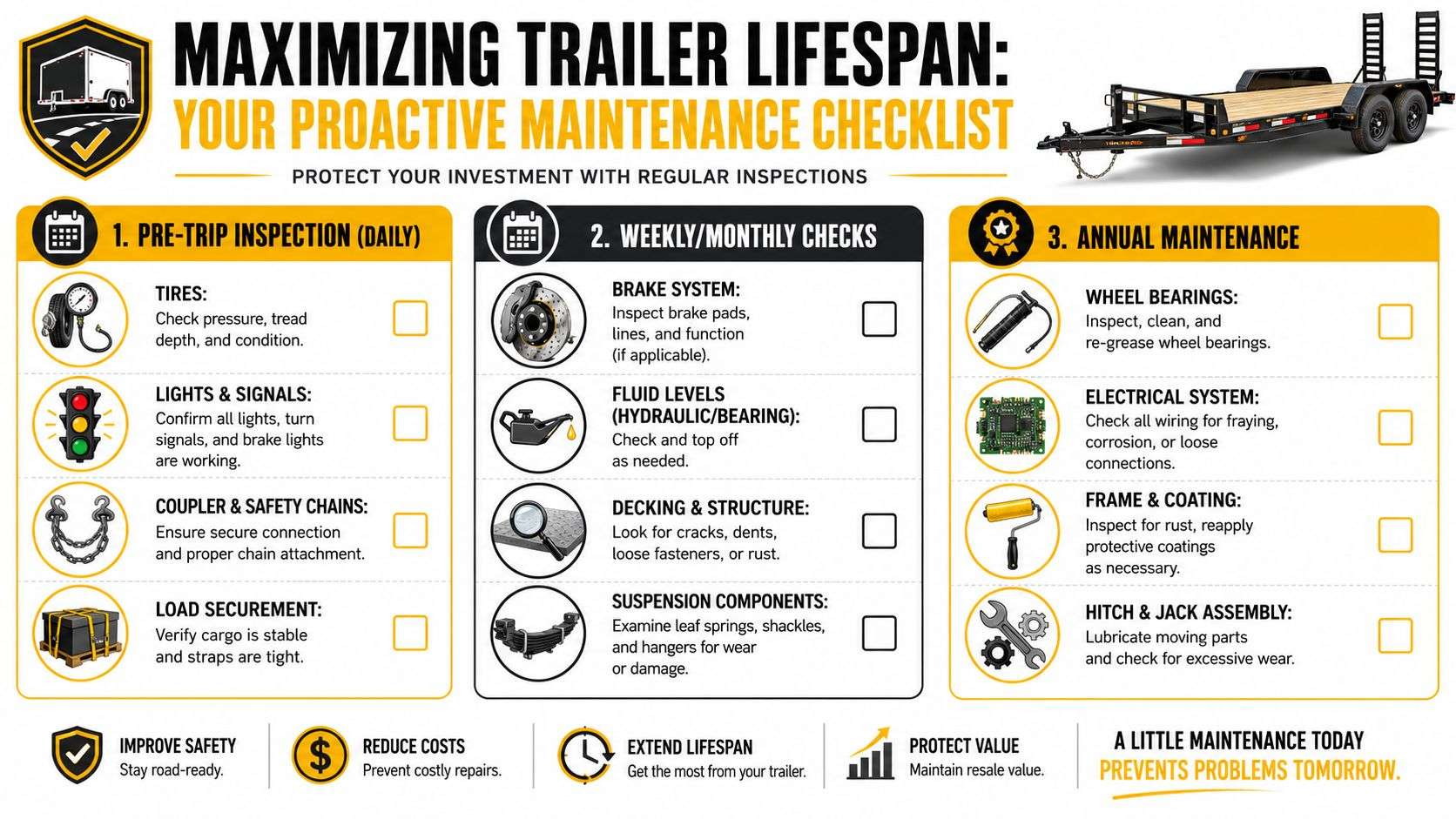
Use a pre-trip routine that covers:
- Tires and wheels. Check condition, visible damage, and inflation before every haul.
- Lights and signals. Verify all lighting works before the trailer leaves the yard.
- Coupler and safety chains. Confirm the hitch is fully engaged and chains are attached correctly.
- Load securement. Make sure equipment or cargo won't shift and create side-loading during transport.
One item many crews skip is a quick look underneath after loading. That's where you can spot a loose line, a fresh scrape, a hanging wire, or a component that just took contact.
Weekly and monthly checks that preserve service life
The weekly and monthly cycle is where service life is protected. This is the time to inspect the trailer, not just glance at it.
Focus on wear points that tell you how the structure is aging:
- Brake system. Look for loss of braking consistency, damaged lines, or uneven wear.
- Hydraulic components. Check fluid level, look for seepage, and inspect hoses and fittings for abrasion.
- Deck and structure. Inspect weld areas, bed joints, fasteners, hinge points, and any place where paint or coating has broken.
- Suspension hardware. Watch for loose components, wear, and signs that impact loads are moving through the system poorly.
A crack found in the shop is maintenance. The same crack found on the road is downtime.
For operators who want a practical spare strategy instead of reacting after a roadside issue, keeping a spare tire and wheel plan in place is one of the simplest ways to protect uptime.
Annual work that keeps a trailer in the fleet
Annual service is where you reset the trailer for another year of hard use. That means wheel bearings, electrical inspection, lubrication of moving parts, coating repair where corrosion has started, and a serious frame inspection.
This is also the time to review usage. If the trailer has spent the year carrying loads near its limit, working rough roads, or handling more loading cycles than expected, inspect it like a heavy-use asset, not like a general-purpose hauler.
A trailer lasts because the owner keeps small wear from becoming structural wear. That's the difference between a trailer that stays in the fleet and one that gets parked behind the shop while everyone says they'll “fix it when there's time.”
Your Next Trailer An Investment in Uptime and Profitability
The right trailer costs more upfront for a reason. It saves time in loading, avoids abuse during unloading, stays in service longer, and asks less of the crew in bad conditions.
That's why long lasting work trailers should be evaluated the same way you'd evaluate any productive asset. Look at fatigue resistance, load geometry, unloading method, maintenance access, parts support, and whether the design fits the actual work. If you only compare sticker price and advertised capacity, you'll miss the costs that show up later as downtime, repairs, and shortened service life.
The most disciplined fleets already think this way. In maintenance-heavy industries, the same logic shows up in broader conversations about optimizing manufacturing operations, where preventing failure is usually cheaper than reacting to it. Trailer ownership works the same way. You make money when the trailer is available, safe, and ready to move.
A premium trailer isn't just a purchase. It's a decision about whether your crew will spend the next several years hauling productively or managing avoidable problems.
If you're evaluating a trailer for construction, landscaping, forestry, material handling, or municipal work, take a close look at ANTS Trailers. Their USA-made trailers are built in Baraga, Michigan, and the lineup includes practical features that matter in the field, including a convey belt trailer bed on the live bottom trailer and the ability to lower or raise the trailer for better ground-level adaptation.