
Don't just skim the spec sheet on a drop-deck trailer—think of it as the playbook for your entire operation. Those numbers, from payload capacity to deck height, aren't just details. They're the difference between a smooth, profitable workday and one filled with headaches, downtime, and potential fines. For anyone in construction, landscaping, or equipment hauling, getting these specs right is everything.
Why a Spec Sheet Is Your Most Important Tool
Picking out a new drop-deck trailer is a serious investment, and a bad choice can have real consequences. Go too small, and you're facing equipment damage or costly overweight tickets. Go with the wrong features, and you're sacrificing efficiency on the job site every single day. A great trailer, on the other hand, just makes work easier and protects your bottom line. It’s all about matching the trailer’s capabilities directly to the work you do.
For instance, a low deck height isn't just a talking point. It's what gives you a gentle, safe loading angle for a scissor lift or a compact excavator, making the process faster and dramatically reducing risk. In the same way, a high payload capacity isn't about bragging rights; it’s the legal and structural green light to haul your heaviest gear without stressing the frame or breaking the law.
The American-Made Engineering Edge
This is where you really see the difference with premium, American-made manufacturers like ANTS Trailers. These aren't just assembled here; they're engineered from the ground up by people who understand the job site. The result is exceptional durability and smart, versatile features that solve real problems. ANTS Trailers are made in the USA, ensuring they are high-quality, durable, and versatile enough for any job.
A perfect example is the ground-level loading function you’ll find on some ANTS models. The ability to lower or raise the entire trailer deck flat to the ground creates a true zero-degree angle. For low-clearance equipment like pavers or floor grinders, this is an absolute game-changer for speed and safety.
They also push the envelope with clever designs, like the conveyor belt trailer bed system on their live bottom trailer. This lets you unload loose materials like gravel or asphalt with precision control, avoiding the instability that comes with a traditional dump trailer. It's this kind of practical, problem-solving engineering that sets them apart.
The demand for this kind of specialized equipment is booming. The flatbed trailer market, which includes these drop-deck models, was valued at $12.17 billion in 2025 and is on track to hit $23.36 billion by 2033, fueled by a surge in infrastructure work. Forward-thinking companies are stepping up to meet this need. ANTS Trailers in Michigan, for example, engineered their 14/20X Drop Deck model with an incredibly low 3-degree load angle—a feature proven to slash loading times. You can learn more about how these drop deck trailer trends and market shifts are impacting the industry to get the full picture.
To help you cut through the noise, we’ve put together a quick-reference table. It breaks down the most important specifications and explains what they actually mean for your day-to-day work.
Key Drop Deck Trailer Specifications at a Glance
This table summarizes the most critical specifications and their direct impact on trailer performance and job suitability.
| Specification | What It Measures | Why It Matters for Your Job |
|---|---|---|
| Payload Capacity | The maximum weight of cargo the trailer can legally carry. | Ensures you can transport your equipment without risking fines or structural failure. |
| Deck Height | The distance from the ground to the trailer's main deck surface. | A lower height creates a safer, gentler angle for loading and unloading equipment. |
| Load Angle | The steepness of the ramp or tilted deck during loading. | A lower angle is critical for low-clearance machines and prevents "bottoming out." |
| Tare Weight | The empty weight of the trailer itself. | A lighter trailer allows for a heavier payload while staying within legal weight limits. |
| GVWR | The total combined weight of the trailer and its maximum payload. | The absolute legal limit your trailer can weigh when fully loaded on the road. |
Think of these five specs as the foundation. Getting them right ensures the trailer you choose is not just an asset, but a true partner in getting the job done right.
The Four Foundational Trailer Specs
Staring at a trailer's data plate can feel like trying to decipher a secret code. But out of all those numbers, four of them are the absolute bedrock of your operation. Get these right, and you're set up for success. Get them wrong, and you're in for a world of headaches.
Let’s break down the big four: Gross Vehicle Weight Rating (GVWR), Payload Capacity, Tare Weight, and Dimensions. This isn't just about staying legal; it's about keeping your crew safe, your jobs efficient, and your business profitable.
First up is the Gross Vehicle Weight Rating (GVWR). Think of this as the trailer's absolute red line—the maximum legal weight, period. It’s the total weight of the trailer itself plus everything you put on it, from a mini-excavator right down to the chains and binders. Blowing past this number isn't just asking for a ticket; it's putting a dangerous amount of stress on the frame, axles, and brakes. That’s how catastrophic failures happen on the road.
Payload And Tare Weight: A Delicate Balance
The GVWR naturally leads us to Payload Capacity, which is the number most of us are really after. It’s the actual weight of the machine or materials you can legally haul. The math is simple: GVWR – Tare Weight = Payload Capacity.
Tare Weight, sometimes called curb weight, is just what the trailer weighs when it's completely empty. This is where smart engineering and quality materials really show their value. Top-tier, American-made trailers from manufacturers like ANTS Trailers are built with an eye toward reducing tare weight without ever compromising on strength.
The payoff here is huge. A lighter trailer means you can haul a heavier payload. That simple fact can be the difference between making one trip or two, which directly hits your fuel budget, labor costs, and the overall profitability of a job.
This hierarchy shows how these core numbers are the foundation for everything else. Get them right, and you're building on a solid base of capability, safety, and compliance.
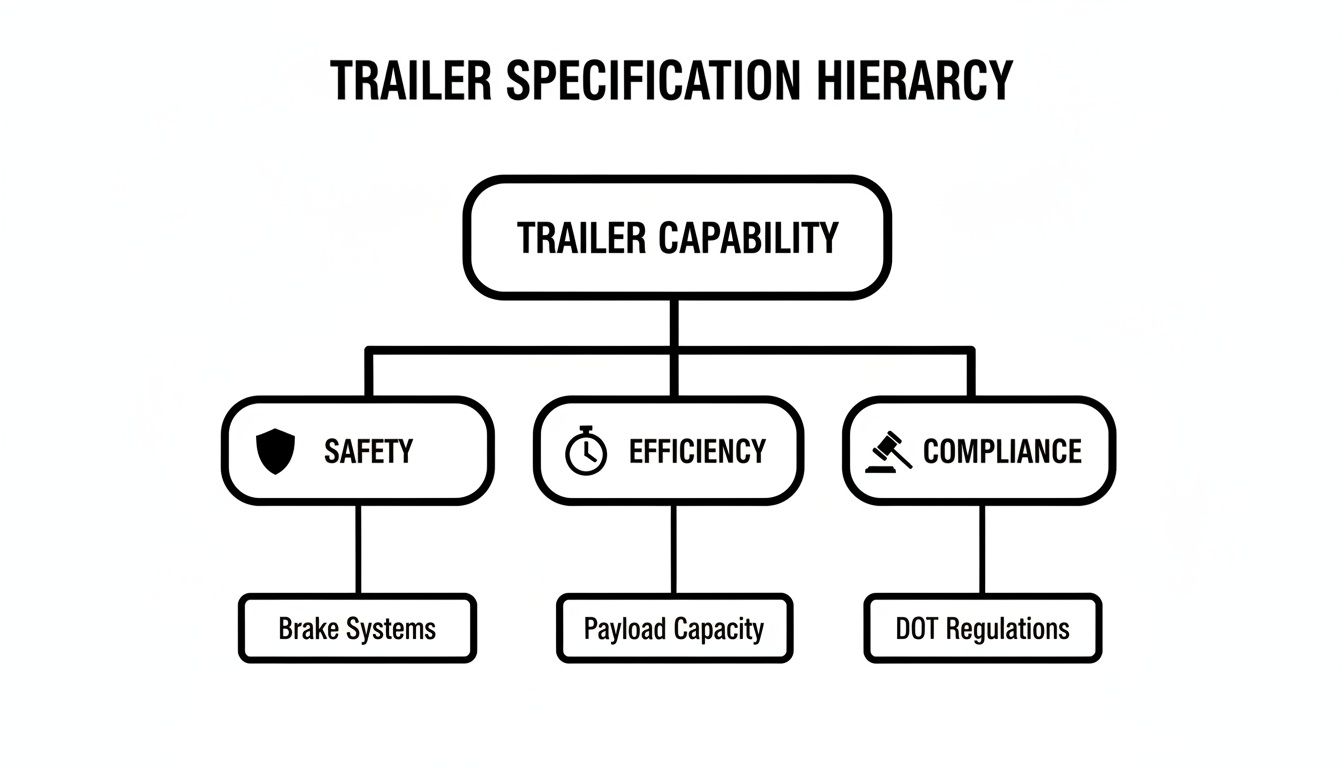
As you can see, everything good that happens on the job site starts with getting the numbers right from the very beginning.
Dimensions: Defining Your Cargo Space
Finally, we have the trailer's Dimensions—its length, width, and deck height. These specs define the physical space you have to work with and what kind of equipment will actually fit. The "drop" in a drop-deck trailer is its secret weapon here, giving you a lower main deck for unmatched stability and hauling versatility.
That lower deck creates a lower center of gravity, which is a massive advantage when hauling tall or top-heavy equipment. The engineering proves it out: a dropped deck can improve the balance of your load by 25-40% by keeping the weight closer to the axles.
Take the ANTS Trailers' 7/12X Drop Deck. It has an incredibly light empty weight of just 2,660 lbs, which gives it a powerful 5,340 lb payload. It packs all that capability into an enclosed 70.5-inch by 13-foot-4-inch bed, perfect for securing tools and smaller equipment while staying nimble on crowded job sites.
Getting any of these four foundational specs wrong can be a costly mistake. I've seen guys show up to a site only to realize their excavator won't fit on the trailer they brought. Worse yet is getting pulled over and slapped with thousands in fines and hours of downtime for being overloaded. Understanding these numbers is the first step toward making a smart investment. They aren't just figures on a chart; they're the heart of what makes a trailer a valuable tool instead of a liability.
How a Trailer Performs Under Load
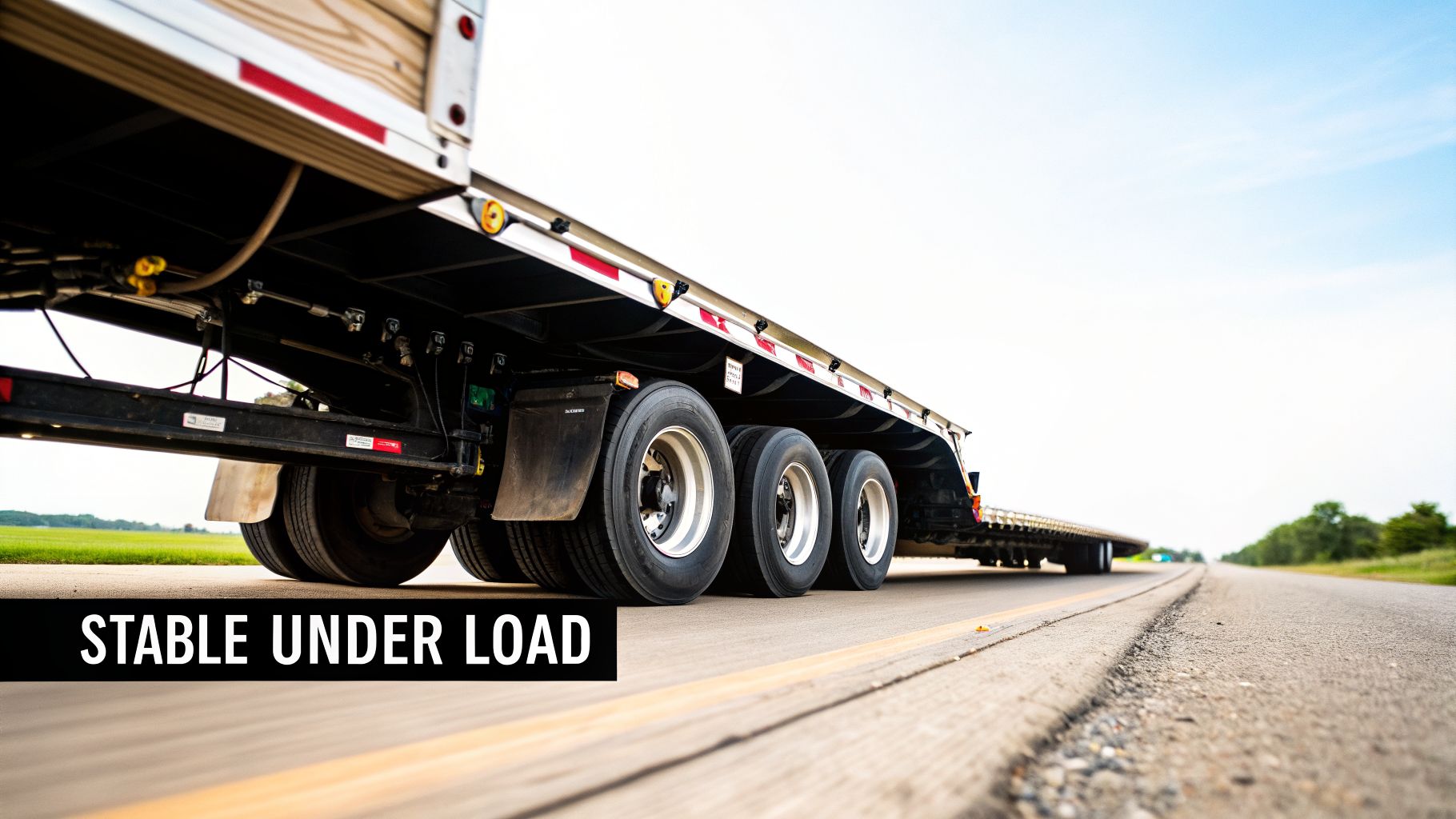
The spec sheet tells you what a trailer can carry, but how it handles that weight on the road is a completely different story. This is where the real character of a drop deck comes out. The dynamic parts—the axles, brakes, and suspension—are what determine if you have a stable, confident tow or a white-knuckle ride.
This is also where you can feel the difference that premium, American-made quality makes. It’s not just a sticker. When companies like ANTS Trailers build their equipment in the USA, it’s about having direct control over the engineering, using higher-grade steel, and obsessing over durability and versatility. Their trailers are built from the ground up to handle the abuse of a real job site, day in and day out.
Axles and Weight Distribution
Think of a trailer’s axles as its foundation in motion. They shoulder the entire load of your cargo, and how they’re configured directly impacts everything from highway stability to maneuverability in tight spots.
- Tandem Axles: You'll see this two-axle setup on most trailers, and for good reason. It provides a great balance of stability and weight distribution for the kinds of loads most contractors and landscapers haul. It’s the versatile workhorse of the industry.
- Tridem Axles: When you’re moving into truly heavy-duty territory, a three-axle tridem configuration is a must. By spreading the load across a wider footprint, it allows you to carry more weight legally and puts less strain on the trailer frame and tires.
Getting the weight distributed correctly across these axles isn’t just about performance; it’s about staying legal. An overloaded axle is a magnet for hefty fines and creates seriously dangerous driving conditions. That's why knowing your axle ratings is just as crucial as knowing your total GVWR.
Braking Systems: The Unseen Safety Net
When you're hauling tons of equipment, your brakes are your most important safety feature. As any professional driver knows from studying air braking systems, there's a lot to understand to operate them safely. For the drop deck trailers we're talking about, you’ll typically run into two main types.
Electric brakes are the standard on most modern gooseneck and bumper-pull trailers. An in-cab controller sends a signal to the brakes, giving you proportional stopping power that mirrors what you’re doing in the truck. They’re reliable, easy to service, and sync up with nearly any tow vehicle.
Hydraulic surge brakes are a bit different. They work mechanically—as your truck slows down, the trailer's forward momentum pushes a hydraulic cylinder to apply the brakes. They're simpler and don't rely on the truck's wiring, but you don't get the same fine-tuned control you have with a good electric brake system.
The true test of a trailer isn't one part, but how they all work together. A company like ANTS Trailers gets this. They engineer their systems so the brakes engage smoothly, the frame takes a full payload without a hint of flex, and every component provides dependable, drama-free performance.
Suspension and Advanced Functions
The suspension is what soaks up the bumps, protecting your cargo, the trailer, and your own sanity on a rough road. Leaf spring suspensions are the old-school standard—they're tough, proven, and cost-effective. But for hauling sensitive equipment or for a significantly better ride, an air ride suspension uses adjustable air bags to provide unmatched dampening.
This is where you see some manufacturers really push the envelope. ANTS Trailers, for example, offers functions that you just won't find on other trailers. Imagine being able to lower or raise the entire trailer deck with a remote control. It completely changes how you load equipment and lets you adapt to uneven job sites instantly.
Then there’s their live bottom trailer design, which swaps the traditional deck for a conveyor belt bed. Instead of the inherent risks of a tip-and-dump trailer, you can unload asphalt, gravel, or soil with complete control and precision. These aren't just specs on a page; they're genuine solutions to real-world problems.
Making Loading and Unloading Safer and Faster
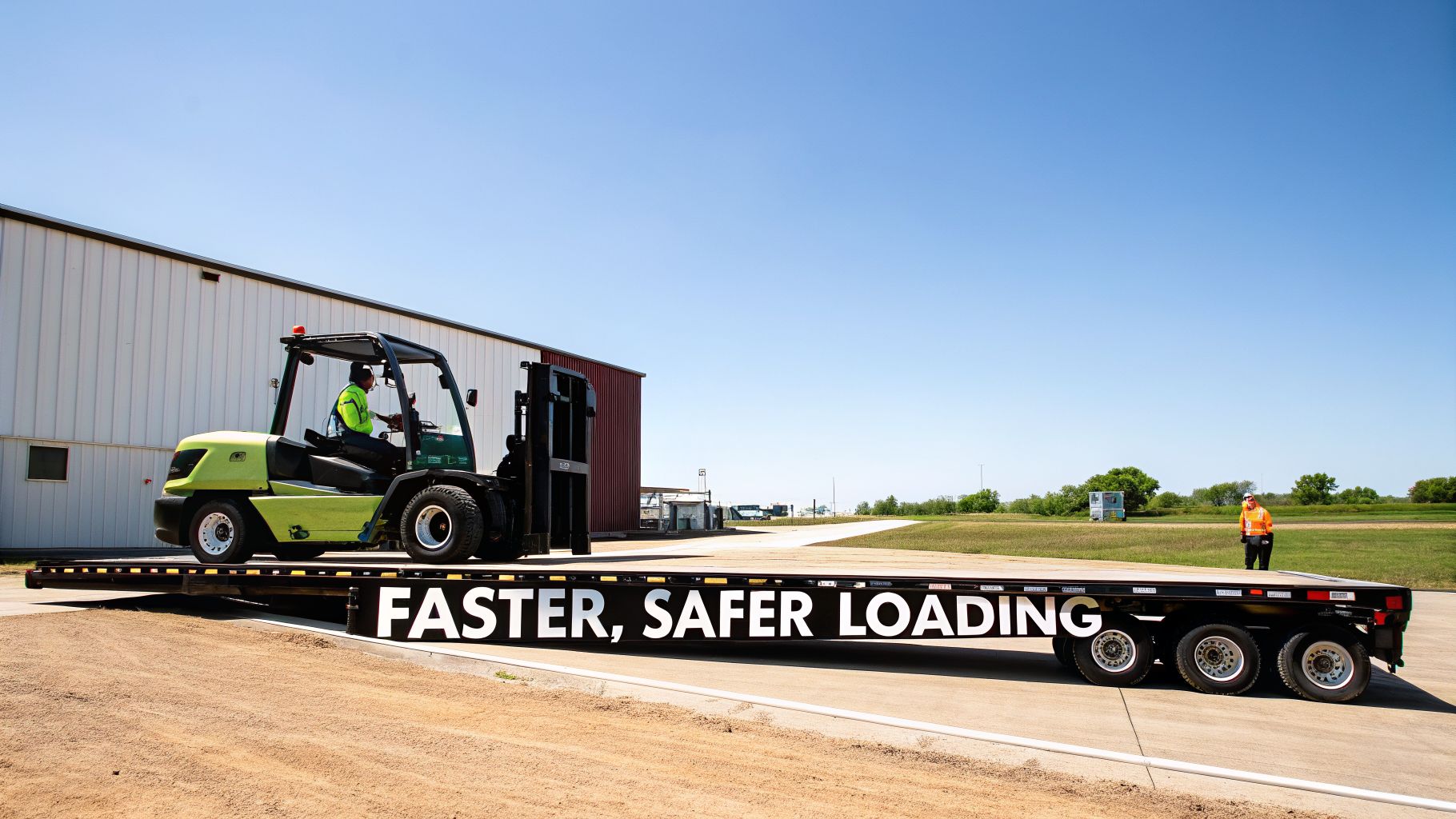
On any busy jobsite, time is money. Every minute you spend wrestling with steep ramps or awkward tie-downs is a minute you're not earning. This is where certain drop deck trailer specifications stop being numbers on a page and start directly impacting your efficiency and, more importantly, your team's safety. The right features aren't just a luxury; they're essential for a profitable day's work.
When it comes to loading, the one spec that trumps all others is the load angle. Think of it as the hill your machine has to climb to get on the trailer. A steep angle is a major headache. It dramatically increases the risk of "bottoming out"—that gut-wrenching scrape when your machine’s undercarriage hits the top of the ramp. It also makes equipment far more likely to slip or lose balance, which is the last thing you want.
The Problem with Steep Ramps
For anyone moving low-clearance gear like scissor lifts, asphalt pavers, or concrete grinders, a steep ramp can shut down the whole operation. It forces crews into clumsy and dangerous workarounds, like hunting for a ditch to back into or piling up dirt to create a makeshift ramp. These "tricks" waste precious time and introduce a ton of risk for both the operator and the expensive equipment.
This is one of the biggest differences between a basic trailer and a true, professional-grade piece of equipment. The best manufacturers have obsessed over this problem, engineering their trailers to create the lowest possible loading angle. The goal is simple: make loading as flat and effortless as possible.
Innovations in Ground-Level Loading
The real solution here is a feature called a kneeling function. This is an advanced hydraulic system on premium trailers that lets the entire deck lower right down to ground level. Instead of forcing a machine up a ramp, you simply drive it straight on.
This technology creates a true zero-degree loading angle—the absolute gold standard for speed and safety. It completely eliminates the risks that come with an incline, turning the loading of even the most difficult low-clearance gear into a quick, one-person job.
This is the kind of smart engineering you’ll find in top-tier, American-made trailers from companies like ANTS Trailers. Their focus on building durable and versatile solutions is clear in features that solve the biggest real-world headaches. The ability to lower or raise the trailer on demand shows a deep understanding of what crews actually face on the job.
The impact on your workday is huge. A well-designed drop deck can slash unloading times from 45 minutes on a standard flatbed to less than 15. Specs like ultra-low approach angles, some as gentle as 9 degrees, make a massive difference in labor and time saved on-site.
Beyond Equipment Hauling with Live Bottoms
This focus on efficiency doesn't stop with wheeled equipment. For contractors who also move bulk materials like gravel, sand, or asphalt, unloading comes with its own set of dangers. A traditional dump trailer has to lift its bed high into the air, creating a high center of gravity. That can be incredibly unstable on uneven ground and flat-out dangerous near overhead obstacles like power lines or tree branches.
To solve this, some manufacturers have developed a brilliant alternative: the live bottom trailer. This design swaps the standard deck for a heavy-duty conveyor belt bed. Instead of dumping, the material is carried out the back of the trailer in a controlled, steady flow. This allows you to place material exactly where you need it without ever raising the bed.
ANTS Trailers offers one of these unique live bottom models, which opens up possibilities other trailers can't match. It’s perfect for paving jobs where asphalt can be fed directly into a hopper, or for landscapers who need to spread mulch with precision. You can see exactly how it works by exploring their conveyor trailer designs. This feature provides an incredible level of safety and control, proving once again how the right specs can make your whole operation faster and safer.
Matching the Right Trailer to Your Trade
A spec sheet tells you what a trailer can do, but the real question is what it can do for your business. The best drop deck for a heavy construction outfit isn't the same one a landscaping crew needs to thrive. Getting this choice right means matching the drop deck trailer specifications to your day-in, day-out work, turning your purchase into a genuine asset instead of a daily frustration.
Think of it this way: you wouldn't send a skid steer to do a mini-excavator's job. In the same way, the features that make a trailer perfect for hauling heavy machinery might be expensive overkill for a crew just moving mowers and materials.
Construction and Heavy Equipment Hauling
If you’re moving iron—mini-excavators, compact track loaders, or scissor lifts—the conversation begins and ends with two things: payload capacity and deck height. Your trailer absolutely must be rated to handle your heaviest piece of equipment safely and legally. Skimping here isn't just a bad idea; it's a direct risk to your equipment, your crew, and your compliance, potentially leading to frame damage or worse.
This is precisely where a heavy-duty model like the ANTS 14/20X Drop Deck proves its worth. These are tough, durable trailers made in the USA, engineered for the chaos of a real job site. Their beefy construction handles a massive payload, and the ability to lower or raise the trailer hydraulically is a game-changer when you're loading on the uneven, unpredictable ground that contractors know all too well.
Landscaping and Grounds Maintenance
For a landscaping business, the name of the game is versatility. One day it's zero-turn mowers and aerators, and the next it's pallets of sod, a load of mulch, or debris from a cleanup. A gentle ramp angle is a must-have for loading expensive, low-clearance mowers without damaging the cutting deck.
An agile, secure trailer like the ANTS 7/12X Drop Deck is often the ideal solution. It’s nimble enough to get into tight residential properties but still offers the enclosed security and robust build ANTS Trailers are known for. It keeps thousands of dollars in mowers and tools protected, all while being easy to tow. For crews who move a lot of bulk material, a specialized trailer can dramatically boost efficiency. You can see how a live bottom trailer with a conveyor bed makes placing mulch or soil faster and much safer.
Forestry and Demanding Off-Road Work
There’s no tougher test for a trailer than forestry and land-clearing work. You're dealing with punishing terrain, rough access roads, and heavy, unbalanced loads. Here, the focus shifts squarely to axle ratings, suspension quality, and overall frame strength. Your trailer has to be built to take a beating on unpaved ground without flexing or failing.
ANTS Trailers are engineered with this kind of abuse in mind. Their American-made quality is evident in the superior welds, high-grade steel, and designs that account for real-world stress. The unique ability to lower the deck completely to the ground offers a huge advantage for recovering equipment or loading in tough, off-road situations.
It's also important to remember that it's not just about the hardware. Legal frameworks like the transport chain of responsibility place liability on everyone involved, making a properly specced and maintained trailer a critical part of your risk management.
Ultimately, choosing the right trailer comes down to an honest look at your daily operations. When you prioritize the specs that directly impact your workflow, you’ll find a trailer that feels less like a tool and more like a trusted partner.
The table below offers a side-by-side look at two popular ANTS models to help you visualize how their different specifications serve different trades.
ANTS Trailer Model Specification Comparison
A direct comparison of key specifications for the ANTS 7/12X and 14/20X models to help buyers choose.
| Specification | ANTS 7/12X Drop Deck | ANTS 14/20X Drop Deck |
|---|---|---|
| Primary Use | Landscaping, Small Equipment, Secure Tool Transport | Construction, Heavy Equipment, Low-Clearance Machinery |
| Payload Capacity | 5,340 lbs | 14,000 lbs |
| Tare Weight | 2,660 lbs | 6,000 lbs |
| Bed Dimensions | 70.5" W x 13' 4" L | 82" W x 20' L |
| Key Feature | Enclosed Bed for Security and Versatility | Ground-Level Loading (Kneeling Function) |
As you can see, the 14/20X is built for pure hauling power, while the 7/12X focuses on combining moderate capacity with security and agility—two very different tools for two very different jobs.
Common Questions About Drop Deck Trailers
When you start digging into drop deck trailer specifications, questions always come up. That’s a good thing. This isn’t just another purchase—it's a serious investment in your business, and getting it right affects your safety and efficiency for years to come.
Let's walk through some of the most common questions I hear from professionals looking for a new trailer. Getting clear on these points will help you narrow down your choices and pick the right rig with confidence.
What Is the Difference Between GVWR and Payload Capacity?
This is easily the most critical distinction to understand, and it’s where people get into trouble. It's easy to confuse the two, but mixing them up can lead to a dangerously overloaded trailer and hefty fines.
Think of it this way: the GVWR (Gross Vehicle Weight Rating) is the absolute, final, all-in weight your trailer can be. That includes the trailer itself, the machine you’re hauling, and every chain, binder, and tool you've thrown on the deck. It's the maximum legal and structural limit, period.
The Payload Capacity is what’s left over for your actual cargo. To figure it out, you simply subtract the trailer’s own weight (its tare or curb weight) from the GVWR.
- If a trailer has a GVWR of 10,000 lbs and weighs 3,000 lbs empty, its true payload capacity is 7,000 lbs. Push past that, and you're putting incredible strain on the frame, axles, and tires.
When Do I Need a Trailer with a Kneeling Function?
If you’ve ever had to hunt for a ditch or build makeshift ramps just to load a machine with low ground clearance, a kneeling function will feel like a miracle. This feature uses hydraulics to lower or raise the trailer deck, and it’s a total game-changer for certain types of equipment.
You should be looking for a kneeling trailer if you regularly haul:
- Scissor lifts and aerial work platforms
- Asphalt pavers and compact rollers
- Floor grinders and concrete polishers
- Specialty turf mowers or other low-profile vehicles
This is a standout feature on premium trailers from builders like ANTS Trailers. It lets you drop the deck completely to the ground, creating a zero-degree loading angle. It not only makes loading faster and easier for a single operator but also eliminates the risk of a machine bottoming out or tipping on steep ramps.
Are American-Made Trailers Like ANTS Really a Better Investment?
Absolutely. It’s a classic "you get what you pay for" scenario. While a premium trailer made in the USA might have a higher upfront cost, it pays you back over and over in reliability and longevity. A company like ANTS Trailers isn’t just assembling parts; they’re engineering equipment specifically for the tough conditions of an American jobsite.
That commitment shows in the final product. You're getting higher-grade steel, better welds, and smarter engineering that adds up to a high-quality, durable, and versatile trailer. This is a rig built to handle rough terrain, harsh weather, and heavy use day after day, year after year.
Don’t forget about support, either. When you need a part or have a question, you’re talking directly to the people who built it, not trying to navigate a complex international supply chain. That peace of mind is worth a lot.
What Is a Live Bottom Trailer and Who Should Use One?
A live bottom trailer is a specialized machine designed for one thing: unloading bulk material safely and precisely. Instead of a standard deck, it has a rugged conveyor belt bed that moves materials like asphalt, gravel, or mulch out the back in a smooth, controlled flow.
The biggest advantage here is safety. A traditional dump trailer has to lift its bed high in the air, which makes it top-heavy and dangerously unstable, especially on uneven ground. It's also useless if there are overhead power lines, tree branches, or bridges.
A live bottom trailer, like the ones ANTS has perfected, keeps the trailer bed flat on the frame at all times. This completely eliminates the risk of tipping, making it the go-to choice for:
- Paving Contractors who need to feed asphalt directly into a paver.
- Landscapers placing mulch or soil in tight spots without making a mess.
- Agricultural Operations moving grain or feed with minimal spillage.
This is a perfect example of how the right drop deck trailer specifications aren't just about numbers—they're about solving real-world problems and making your entire operation safer and more efficient.
Ready to invest in a trailer that's built to perform? ANTS Trailers offers a lineup of high-quality, durable, and versatile trailers made in the USA. From ground-level loading drop decks to precision-unloading live bottom models, our equipment is engineered to make your work safer and more efficient. Discover the difference American-made quality makes by visiting us at https://antstrailer.com.