
At 6 a.m., a crew is standing beside a muddy access road with wet tools, loose materials, and a compact machine that still needs to reach the first jobsite. An open trailer may carry everything, but it won't protect valuable equipment, keep the load organized, or make overnight storage comfortable. The right enclosed work trailer turns that daily scramble into a repeatable loading, securing, and deployment process.
The buying decision starts with the work, not the brochure. Identify what you'll haul, how you load it, what terrain you'll cross, and whether the trailer must move loose material, compact equipment, tools, or all three. Then match the body style, payload, loading geometry, and security system to those conditions.
Table of Contents
- What Enclosed Work Trailers Are and Why Operators Choose Them
- Core Components and Engineering of a Quality Enclosed Trailer
- Live Bottom vs Drop Deck Configurations Explained
- How to Match Payload, GVWR, Floor, and Ramp Angles to Your Work
- Industry Use Cases from Construction Sites to Forestry Roads
- Maintenance and Safety Practices for Daily Jobsite Use
- Financing and Manufacturer-Direct Support Considerations
- Matching ANTS Trailers Models to the Right Jobsite
What Enclosed Work Trailers Are and Why Operators Choose Them
An enclosed work trailer is a fully walled cargo body mounted on a trailer chassis. The body protects tools, materials, and small equipment from weather while giving crews a controlled place to store, organize, and transport working gear. For contractors, groundskeepers, municipalities, forestry operators, and rental fleets, it functions as mobile storage and equipment infrastructure, not merely as a box with wheels.
The move from an open utility trailer usually happens when exposure starts costing time or money. Rain damages supplies, loose tools disappear from the bed, and crews waste part of every morning rebuilding the load. Enclosed bodies also let operators leave equipment at a remote location without shuttling everything back to the yard every evening.
A useful way to understand the broader role of mobile jobsite space is the Pacific Mobile Structures trailer guide, which places trailer-based facilities in the context of field operations. An enclosed work trailer is smaller and more mobile, but the operating principle is similar: put the resources where the work happens and make them usable when the crew arrives.
What the enclosure adds
The walls and roof provide weather protection, but that's only the starting point. A professional build can support:
- Organized storage: Shelving, cabinets, rails, and dedicated tie-down points keep tools from becoming a shifting pile.
- Jobsite security: Lockable doors and internal restraints make unauthorized access more difficult.
- Brand visibility: The exterior can serve as a mobile identification surface for a contractor or public works department.
- Faster deployment: A crew can arrive with tools and consumables already staged instead of loading a pickup from scratch.
- Remote readiness: Equipment can remain protected near a project, provided the operator uses a layered security plan.
The trade-off is weight and access. An enclosed body weighs more than an open deck, can limit side access, and may require more attention to ventilation and interior layout. Buyers who only compare floor dimensions often miss the operational question: how many times will the crew open, load, secure, and unload this trailer during a normal shift?
Core Components and Engineering of a Quality Enclosed Trailer
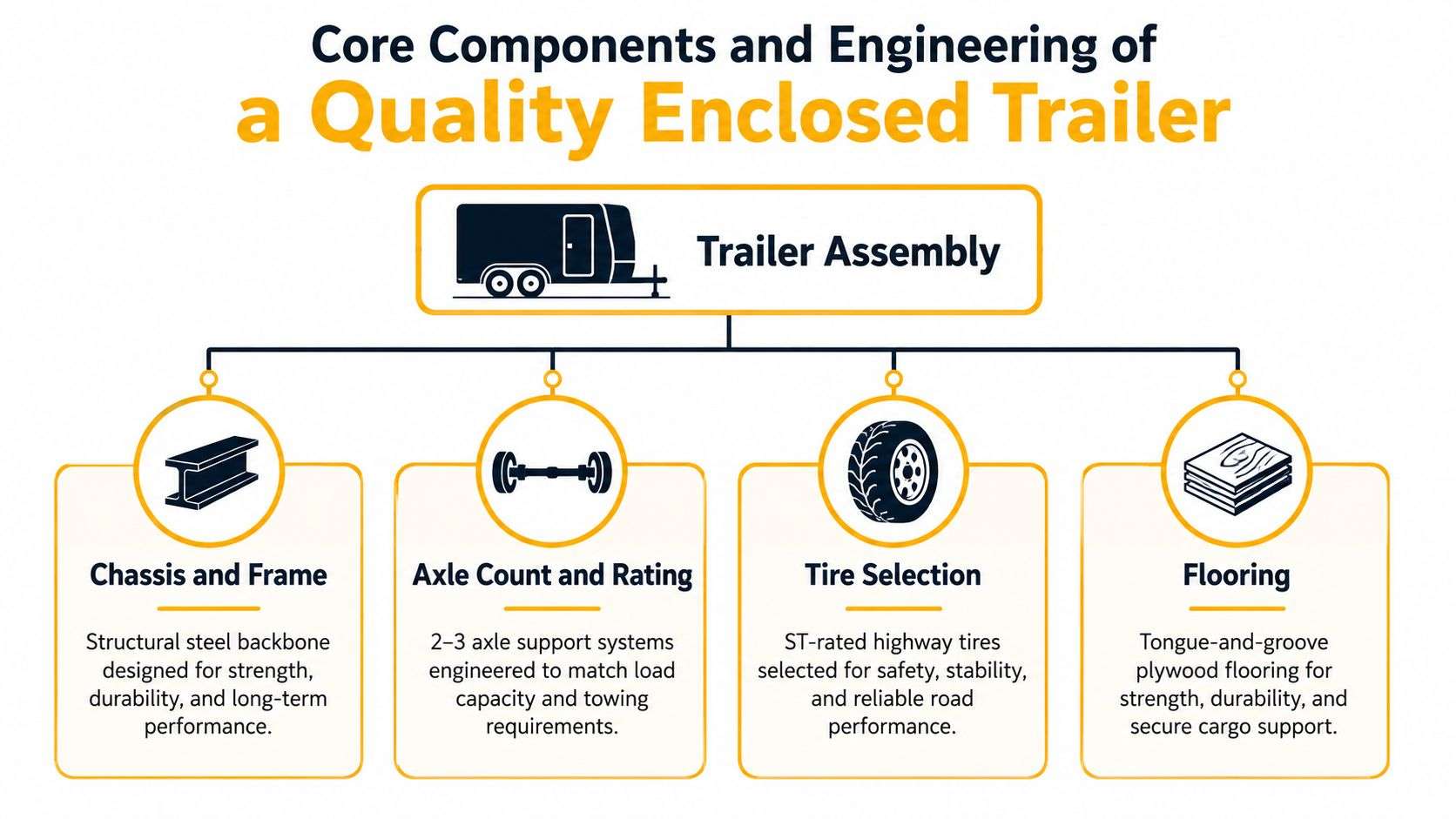
A quality enclosed trailer starts with the chassis, not the wall skin. The frame carries the body, axles, cargo, and dynamic loads created by braking, turning, rough roads, and repeated loading. Ask for the frame material, crossmember spacing, axle ratings, suspension design, and the relationship between the trailer's gross vehicle weight rating and its actual empty weight.
Axles and tires deserve the same scrutiny. A tandem setup may improve stability and distribute weight, but it doesn't make an overloaded trailer safe. Confirm the tire load rating, wheel rating, inflation requirement, brake equipment, and replacement availability before accepting a dealer's summary that the trailer is just “heavy duty.”
Read the body construction critically
Wall construction typically combines a metal exterior skin with wood or composite framing and an interior lining. The important questions are how the framing is supported, how fasteners are spaced, how seams are sealed, and whether the wall can accept shelving or interior equipment without pulling loose.
The roof needs similar attention. Roof material, bow spacing, edge treatment, and ventilation affect resistance to sag, water intrusion, and interior heat buildup. A trailer that looks sound on a dealer lot can still become troublesome if the roof structure isn't suited to the climate and loading cycle.
The floor carries the equipment that earns revenue. Check the floor material, thickness, support spacing, surface treatment, and point-load rating. Parking a compact machine concentrates force through tires or tracks, while palletized materials distribute weight differently. A floor suitable for hand tools may not be suitable for repeated equipment loading.
Hardware controls daily usability
Couplers, safety chains, breakaway equipment, doors, ramps, hinges, latches, wiring, and lighting all deserve a functional inspection. The coupler must match the tow vehicle and the trailer's rated load. Ramp hardware must support the equipment being loaded, not just the empty operator walking across it.
Practical rule: Never approve a trailer from the body shell alone. Inspect the parts that carry, stop, connect, illuminate, and secure it.
Live Bottom vs Drop Deck Configurations Explained
The most important configuration decision for many professional buyers is whether the trailer should move material through a conveyor floor or provide a low approach for wheeled equipment.
A live-bottom trailer uses a walking conveyor-belt floor. The conveyor moves loose material such as soil, gravel, mulch, or aggregate toward the rear without raising the entire bed. The ANTS 14/16 Live Bottom uses this mechanism, allowing material to be loaded or unloaded in locations where a conventional dump bed would not fit, because overhead clearance isn't required for a raised box. The manufacturer describes the live-bottom system here.
A drop deck solves a different problem. Its lower bed and ramp reduce the approach angle for compact equipment, mowers, machines, and palletized cargo. It doesn't replace a material conveyor, but it can make repeated equipment loading more manageable, especially where ground clearance and machine stability matter.
Live Bottom vs Drop Deck at a Glance
| Feature | Live Bottom, for example 14/16 | Drop Deck, for example 7/12X and 14/20X |
|---|---|---|
| Primary task | Controlled movement of loose material | Loading and transporting equipment or secured cargo |
| Operating mechanism | Walking conveyor-belt floor | Low deck with ramp access |
| Best-fit material | Soil, gravel, mulch, and aggregate | Compact equipment, tools, pallets, and machines |
| Overhead requirement | Material exits without raising the bed | No dump cycle, but ramp clearance is required |
| Main advantage | Controlled discharge in restricted spaces | Low loading geometry and direct equipment access |
| Main trade-off | More specialized mechanism and maintenance | Less suited to continuous loose-material discharge |
A conventional dump bed still has a place when the operator needs a simple raised discharge cycle and has sufficient overhead clearance. The live bottom earns its place when controlled discharge, restricted clearance, and repeated material handling matter more than mechanical simplicity.
For buyers focused on low equipment access, the enclosed drop deck trailer format provides a useful reference point. Choose the mechanism based on throughput and cargo behavior. Loose material wants controlled movement. Wheeled equipment wants a stable ramp and a predictable transition.
How to Match Payload, GVWR, Floor, and Ramp Angles to Your Work
Start with the number that limits every other decision: available payload. Calculate the trailer's GVWR, subtract the empty trailer weight, and then verify the axle, tire, hitch, and tow-vehicle limits separately. The lowest applicable rating controls the working load, even if another component appears to offer more capacity.
The ANTS 7/12X Drop Deck provides a concrete example. Its listed empty weight is 2,660 pounds, its listed load capacity is 5,340 pounds, and its enclosed bed measures 70.5 inches wide by 13 feet 4 inches long, according to the manufacturer's published specifications. The model lists a 3-degree bed angle and 9-degree ramp angle, details that matter when loading compact equipment instead of just storing boxes. See the published 7/12X specifications.
Those figures still don't answer whether it fits your operation. Measure the machine's actual width, attachment overhang, operating weight, and turning path at the ramp. Then account for fuel, buckets, tools, chains, spare equipment, and any shelving or cabinets that become permanent trailer weight.
Treat the trailer as a system
A floor rating isn't separate from the ramp. A ramp that handles a machine's weight may still create a poor transition if the approach angle, surface traction, or ground condition is wrong. Likewise, a long bed may offer useful space but encourage operators to place dense cargo too far rearward.
Customization should follow the workflow:
- Tie-down locations: Place anchors where restraints can hold cargo longitudinally and laterally.
- Interior height: Confirm the tallest stored item and the usable door opening, not just the advertised box height.
- Shelving and cabinets: Keep heavy storage low and forward of the trailer's designed balance region.
- Electrical equipment: Specify lighting and power around actual service tasks, with protection from impact and moisture.
- Exterior finish: Choose a practical color and surface treatment that supports visibility and maintenance.
A larger trailer isn't automatically better. Extra empty weight reduces available payload, increases towing demands, and can make maneuvering difficult on tight sites. The best specification leaves enough capacity for the heaviest normal load without forcing the crew to operate at the edge of every rating.
Industry Use Cases from Construction Sites to Forestry Roads
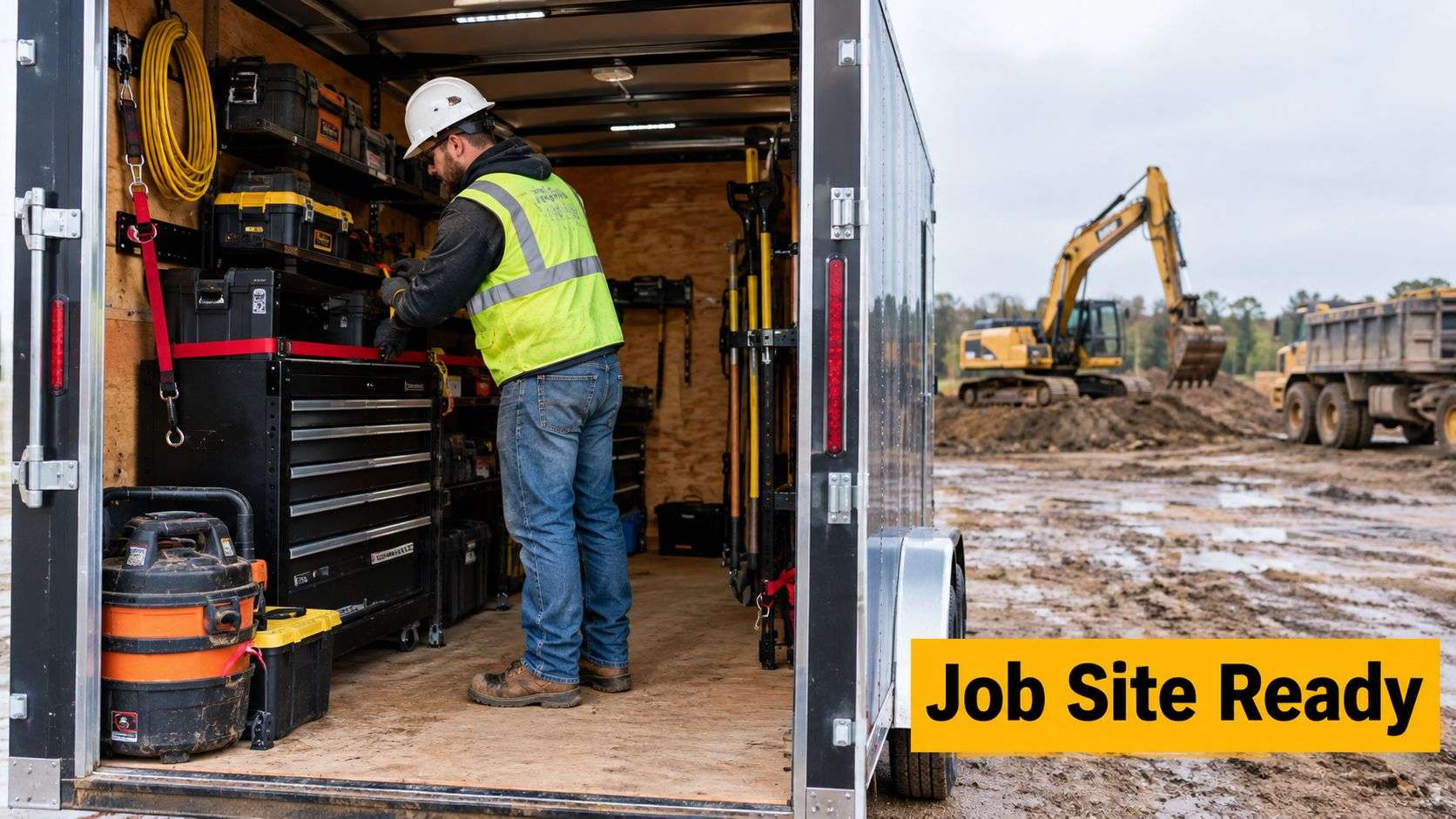
A construction contractor usually needs an enclosed trailer to behave like a rolling tool room. Power tools, fasteners, measuring equipment, small generators, and protective gear stay organized and protected, while a compact machine may need a low, direct loading path. That buyer generally benefits from a drop-deck arrangement with deliberate anchor placement, interior storage, and a ramp suited to the heaviest machine.
A landscaping crew makes a different choice when its day involves repeated mulch, soil, gravel, or aggregate movement. The question isn't only how much material fits. It's how quickly the operator can discharge it, whether the site has overhead restrictions, and whether the crew can place material accurately without a full dump cycle. A live-bottom configuration fits that workflow more naturally than a tool-storage trailer built around hand loading.
Terrain changes the specification
Forestry operators often work from rough roads, uneven staging areas, and remote locations. Their enclosed trailer may carry chainsaw equipment, fuel containers, personal protective equipment, recovery gear, and maintenance supplies. A drop deck can help with compact equipment and organized access, but the operator must pay close attention to ground conditions, trailer stability, lighting, and the location of dense cargo.
Municipal public works departments tend to value readiness and repeatability. An enclosed trailer can keep signage, generators, barriers, emergency supplies, and seasonal equipment staged for rapid deployment. The fleet manager may favor durable access hardware and clear inventory control over maximum interior volume, because missing one critical item can delay a response.
Match the configuration to the work rhythm
- Construction: Prioritize secure tool storage, ramp access, and flexible tie-down placement.
- Landscaping and earthworks: Prioritize controlled discharge and efficient material handling.
- Forestry: Prioritize ground clearance decisions, stable loading, and organized remote-service gear.
- Municipal operations: Prioritize readiness, inventory visibility, lighting, and straightforward maintenance.
- Rental fleets: Prioritize intuitive loading, durable hardware, and configurations that different operators can use safely.
The same enclosed body can't optimize every workflow. A trailer that excels at material throughput may be unnecessarily complex for a contractor hauling hand tools, while a beautifully organized cargo body may be inefficient for a landscaping crew moving loose material all day.
Maintenance and Safety Practices for Daily Jobsite Use
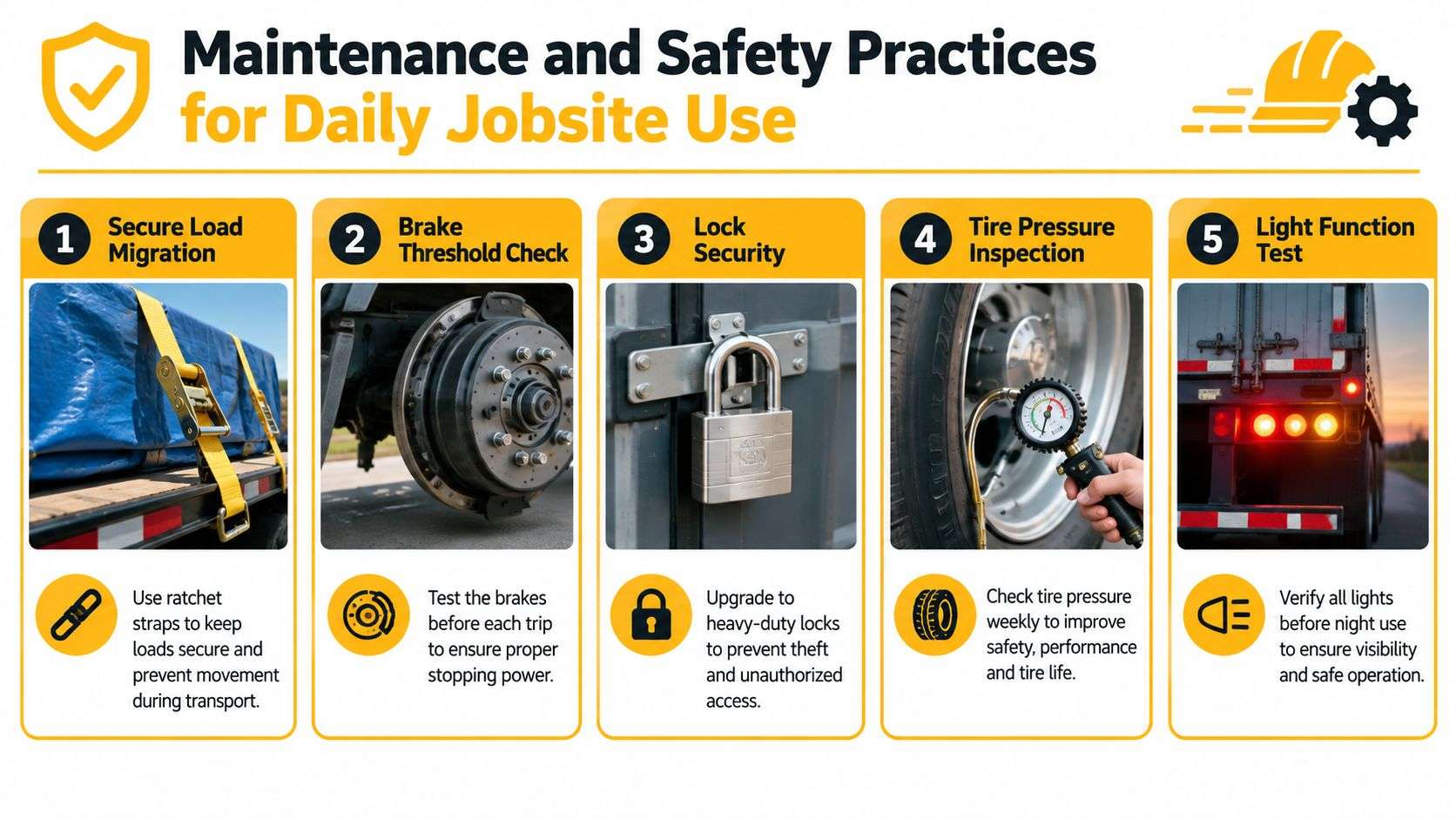
Most trailer problems begin with routine tasks that nobody owns. Assign a pre-trip inspection and make it short enough that crews will perform it. Check tire condition and inflation, lights, coupler engagement, safety chains, brake function, breakaway equipment, door latches, ramp hardware, and visible damage before the trailer leaves the yard.
Cargo securement must account for movement, not just static weight. Federal commercial-vehicle criteria require securement systems to resist 0.8 g of forward deceleration and 0.5 g of rearward acceleration. For a 2,000-pound load, that represents approximately 1,600 lbf forward and 1,000 lbf rearward inertial demand, while the aggregate working load limit must be at least 1,000 pounds. FMCSA explains the cargo-securement requirements.
The weakest component controls the system. A high-rated strap attached to a low-rated anchor doesn't create a high-rated tie-down. Marked working load limits must be checked for anchors, connectors, straps, chains, and tensioners, while blocking and bracing should be considered separately from tiedown capacity.
Control stability and theft together
NHTSA towing guidance emphasizes balanced side-to-side loading, sensible distribution along the trailer length, and prevention of cargo movement. Dense equipment should sit low and near the trailer's designed center-of-gravity region, not concentrated at the rear where it can reduce hitch load and increase sway risk. The guidance also notes that brake selection depends on the tow vehicle and the trailer's fully loaded weight, and that many jurisdictions require independent brakes and a breakaway switch above 1,500 pounds of loaded trailer weight, although local thresholds differ. Review the NHTSA towing safety material.
Security also needs layers. Annual U.S. construction-equipment theft losses are estimated between $300 million and $1 billion, with an average loss of about $30,000 per incident. Towables including generators, light towers, chippers, and trailers are repeatedly identified among common targets. The construction-equipment theft summary provides this context.
Use identity markings, coupler and wheel immobilization, concealed tracking, inventory records, suitable overnight parking, and a documented recovery process. For daily loading on uneven ground, verify combined ratings, measure machine width and overhang, chock or secure the trailer, inspect ramp traction, align the load with the centerline, and reassess after rain or freeze-thaw. A low ramp angle helps, but it doesn't remove rollover, runaway-equipment, or slip hazards.
For routine roadside readiness, keep the correct spare assembly available and verify that it matches the trailer's requirements. A dedicated spare tire and wheel can prevent a minor tire failure from becoming a lost workday.
Financing and Manufacturer-Direct Support Considerations
The purchase price is only one part of trailer cost. A work trailer earns its keep when it stays available, carries the intended load, and can be repaired without a long search for compatible parts or technical answers. Manufacturer-direct support matters because the person answering a parts or troubleshooting question has a closer connection to the design and build than a distant reseller may have.
That relationship becomes more valuable as the trailer becomes specialized. Conveyor floors, low-loading mechanisms, electrical packages, ramps, and interior storage all create parts and service questions that generic trailer knowledge may not resolve quickly. Ask who supplies replacement components, who handles warranty decisions, how technical support works, and whether the manufacturer can document the original configuration.
ANTS Trailers states that its work trailers are made in the USA and manufactured in Baraga, Michigan. The company positions the line as high-quality, durable, and versatile for demanding professional applications, with manufacturer-direct parts and troubleshooting support and financing available through partners such as Ascentium Capital. Review the company's manufacturing and support information.
Evaluate cash flow without losing operating capacity
A contractor or rental fleet may prefer to preserve cash for payroll, fuel, materials, and repairs rather than pay the full trailer cost immediately. A practical overview of working capital for construction equipment can help frame the decision around operating liquidity instead of sticker price alone.
Financing doesn't make an unsuitable trailer suitable. First confirm the payload, loading geometry, tow vehicle, and service plan. Then compare terms with the trailer's expected working life and the downtime cost of a delayed repair.
Use the trailer financing options available through the manufacturer's process to understand what payment structures may fit the fleet. The right question isn't just whether a monthly payment is affordable. It's whether the trailer will produce enough reliable working capacity to justify the commitment.
Matching ANTS Trailers Models to the Right Jobsite
A trailer earns its place by solving the actual jobsite problem: what the crew carries, where it loads, and how often it must unload. Start with cargo, terrain, and daily throughput. Then choose among ANTS Trailers' three configurations.
The 14/16 Live Bottom fits material handlers, ground care professionals, and aggregate operators moving loose material repeatedly. Its walking conveyor floor discharges soil, gravel, or aggregate without raising the bed. Kneeling and tilting functions help crews adjust to changing loading and unloading conditions. Choose it when controlled, repeatable discharge matters more than using the trailer as a general equipment box.
The 7/12X Drop Deck, profiled in the payload discussion above, suits smaller contractors and rental fleets carrying compact equipment, tools, and valuable cargo. Check the widest machine, attachment, and tie-down position against the 70.5-inch bed width before requesting a quote. This model makes sense when enclosed security and low-access equipment loading must fit a smaller operating footprint.
Choose the heavier drop-deck workflow
The 14/20X Drop Deck suits crews hauling skid steers or compact loaders when a longer deck provides room to position and secure the load without stacking attachments forward of the balance point. It serves heavier equipment work while retaining lowboy-style loading behavior. Confirm the machine's actual weight, axle limits, tow-vehicle capacity, floor rating, and tie-down arrangement before purchase.
A useful specification review begins with three jobsite facts:
- The three heaviest items: Count attachments, fuel, tools, and equipment that normally remains inside.
- The worst loading surface: Identify mud, gravel, slopes, snow, tight urban space, or limited overhead clearance.
- The security requirement: Decide whether the crew needs locked storage, internal restraints, trailer immobilization, tracking, inventory control, or a combination.
Throughput can change the answer. A crew loading one compact machine each morning may value the drop deck's enclosed storage and straightforward access. A material operator making repeated discharge cycles may lose time with the wrong configuration, even if its rated capacity appears adequate.
Match the operating problem to the configuration. Start with the load and site, verify every rating, and select the trailer that lets the crew work safely and consistently.
ANTS Trailers offers made-in-the-USA work trailers manufactured in Baraga, Michigan, including the 14/16 Live Bottom, 7/12X Drop Deck, and 14/20X Drop Deck configurations. Visit ANTS Trailers to compare loading geometry, material-handling functions, enclosed security, and manufacturer-direct support for your jobsites.