
A three-person concrete crew has two jobs booked with a regional builder, deposits arrive consistently, and the next contract requires a gooseneck trailer to move equipment. The owner's 580 FICO score is the problem. A retail lender may treat that number as a stop sign, but commercial equipment underwriters look at a broader repayment picture.
That distinction matters in trailer financing for bad credit. The trailer secures the loan, while business deposits, contract visibility, time in operation, existing debt, and the trailer's purpose help determine whether the payment makes sense. This guide focuses on the approval paths that work in practice, not generic advice that treats a credit score as the entire application.
Table of Contents
- When Your Credit Is Weak but Your Business Is Solid
- Financing Paths That Actually Approve Bad Credit Buyers
- Documentation Lenders Want From Contractors and Fleets
- Why Strong Income Can Outweigh a Low Credit Score
- How to Stack the Odds Before You Apply
- What Lenders Actually Price Beyond the Credit Number
- Negotiating the Deal and Closing With Confidence
When Your Credit Is Weak but Your Business Is Solid
The concrete owner in this example isn't applying for a personal purchase. The gooseneck will support revenue-producing work, and the lender wants to know whether that work can generate enough cash to service the obligation. Commercial underwriting changes the conversation as soon as the application is tied to a business, equipment use, and collateral.
A score below 620 is commonly treated as subprime equipment-financing territory. Some specialized programs may still consider borrowers around 500 to 550, but those approvals generally come with stronger collateral requirements, larger down payments, or a cosigner. The score affects the risk category, but it doesn't tell the lender whether the contractor has recurring deposits, signed work, or a manageable debt load. Independent equipment-financing guidance explains how lenders treat scores below 620 and the added requirements for weaker profiles.
What the underwriter reads first
A commercial lender typically wants to establish four things:
- Cash flow: Are customer deposits recurring, identifiable, and sufficient to support the proposed payment?
- Business history: Has the company operated long enough to show a pattern rather than one favorable month?
- Contract visibility: Does the contractor have scheduled work, signed agreements, or a credible backlog?
- Equipment purpose: Will the trailer directly support hauling, loading, or jobsite operations?
A bureau file still matters. Recent defaults, unpaid obligations, or excessive debt can weaken an application even when deposits look healthy. But a contractor with project-based revenue can present a stronger repayment case by showing how invoices become deposits and how the trailer will be used on specific work.
Practical rule: A low score creates friction. It doesn't automatically end a commercial trailer application.
Why one rejection isn't the final answer
Lenders use different score thresholds, collateral policies, and documentation standards. A bank may decline the 580 FICO profile, while a specialty equipment lender may approve it after reviewing deposits, the trailer's value, and the down payment. Credit unions may also take a more relationship-based view, while dealer-arranged programs can route an application to financing sources with a different risk appetite.
The right mindset is to treat credit as one input among several. Prepare the business evidence first, then match the application to a lender that understands equipment risk. That approach gives a healthy contractor a real path forward without pretending weak credit is irrelevant.
Financing Paths That Actually Approve Bad Credit Buyers
Bad-credit buyers shouldn't submit applications randomly. Each financing route makes a different trade between speed, documentation, ownership, and cost.
| Lender Type | Typical Min Score | Down Payment | Term Range | Best Fit |
|---|---|---|---|---|
| Dealer or manufacturer finance program | Varies by program | Varies by risk tier | Varies by lender | Buyers purchasing eligible inventory through a participating dealer |
| Specialty equipment lender | Often considers below 620 | Commonly 10 to 25% | Varies by collateral and cash flow | Contractors with usable collateral and documented revenue |
| Credit union | Varies by institution | Varies by profile | Varies by institution | Existing members with explainable credit issues |
| Secured trailer loan | Depends on underwriting | Higher down payment may be required | Varies by lender | Buyers willing to pledge the trailer as collateral |
| In-house lease-to-own | May use alternative underwriting | Varies by provider | Contract-specific | Buyers who need ownership access despite a bureau decline |
| Rent-to-own structure | May avoid a traditional bureau pull | Contract-specific | Contract-specific | Applicants prioritizing access over conventional loan pricing |
The secured trailer loan is the core reason financing remains possible. Because the trailer serves as collateral, the lender has an asset to evaluate instead of relying only on an unsecured promise to repay. Specialized programs may improve approval odds when the borrower offers more cash down, demonstrates revenue, or adds collateral. This overview of cargo-trailer financing explains why asset-backed structures remain available to borrowers with imperfect credit.
Match the channel to the file
A dealer-arranged program can be efficient when the trailer qualifies and the dealer works with multiple finance sources. A specialty equipment lender is usually a better fit when the business has uneven deposits, project-based work, or a recent credit event that needs explanation. Credit unions may suit applicants with an established relationship, but they shouldn't be assumed to approve a score that falls outside their policy.
Lease-to-own and rent-to-own structures can help when traditional approval fails, but read the total contract cost, purchase option, maintenance obligations, payment frequency, and default terms carefully. A structure that gets a trailer working can be useful, yet it may cost more than conventional financing.
Before hauling equipment across state lines, make sure the business also understands its operating obligations. Guidance on DOT compliance for hotshot drivers can help contractors identify requirements that sit alongside the financing decision.
Start by reviewing the available trailer financing options and identifying which route matches your documentation, collateral, and cash position. Don't lead with the lender offering the lowest advertised payment. Lead with the lender most likely to understand the file.
Documentation Lenders Want From Contractors and Fleets
A weak credit profile gives the lender less room for missing paperwork. A complete file won't erase risk, but it can prevent an avoidable decline and help the underwriter distinguish unstable income from normal contractor seasonality.
Build the core file
Prepare these documents before submitting an application:
- Business bank statements: Provide the recent operating history the lender needs to verify deposits and cash movement. Many commercial applications request three to six months.
- Profit and loss statements: Show whether revenue converts into operating profit after payroll, materials, fuel, and other costs.
- Tax returns or IRS transcripts: Be ready with two years when the lender requires historical income verification.
- Job schedule and contracts: List current work, expected billing dates, customer names, and the role the trailer will perform.
- Business identity documents: Gather EIN verification, articles of incorporation, or DBA paperwork.
- Personal guarantee documents: Owners with weaker business credit may need to guarantee repayment personally.
Don't send a bank statement with unexplained transfers and expect the lender to reconstruct the story. Mark large deposits, separate transfers from customer payments, and explain seasonal swings in a short cover note.
Make project revenue count
Contractor income becomes more persuasive when documents show how and when payment arrives. Signed contracts establish the obligation to perform and pay. Progress billing history demonstrates that the customer has paid through earlier project stages. Retainage letters explain why earned revenue may not appear immediately in the operating account. Letters of intent from general contractors can support future work, although they carry less weight than executed contracts.
Recurring commercial deposits also differ from a personal paycheck. A payroll deposit usually follows a predictable schedule and amount. Business deposits may arrive in uneven batches, so the underwriter must connect them to invoices, progress payments, and completed work.
A lender doesn't need every month to look identical. The lender needs a credible explanation for the pattern.
Organize the file in the order an underwriter will read it. Start with the business summary, then bank statements, income reports, tax records, contract evidence, debt obligations, and the trailer purchase details. That structure reduces questions and gives the lender a clear repayment thesis.
Why Strong Income Can Outweigh a Low Credit Score
Income quality can outweigh a weak score when the lender can verify repayment capacity. That doesn't mean revenue automatically wins approval. It means a contractor with reliable cash conversion and limited debt may present less payment risk than a higher-scoring applicant with thin reserves and no demonstrated ability to support another obligation.
A commercial underwriter studies deposits, customer concentration, contract continuity, and equipment utilization. The file should answer a simple question: will this trailer help produce enough gross activity, and does the business retain enough cash after existing obligations to make the payment?
The income-first reading
For a project-based contractor, the useful evidence includes:
- Historical deposits: Business bank activity shows whether revenue is recurring or isolated.
- Contract pipeline: Signed jobs and scheduled billing support future repayment capacity.
- Debt service: Existing loan, lease, and credit obligations reveal how much cash is already committed.
- Utilization: A trailer assigned to regular hauling or equipment movement has a clearer business purpose than an asset with no defined workload.
A contractor with a 580 score, stable six-figure revenue, documented open jobs, and manageable obligations may receive an approval from a specialty lender. A salaried buyer with a 680 score, little cash reserve, and a heavy existing debt burden may still be declined. The point isn't that the higher score is unimportant. The point is that credit history and current repayment capacity measure different risks.
An independent lender-facing guide specifically notes that strong income or a low debt-to-income ratio can offset a weak score, which is particularly relevant to contractors whose personal credit doesn't fully reflect business cash flow. The trailer-loan guidance discusses income strength and debt-to-income ratio as counterweights to poor credit.
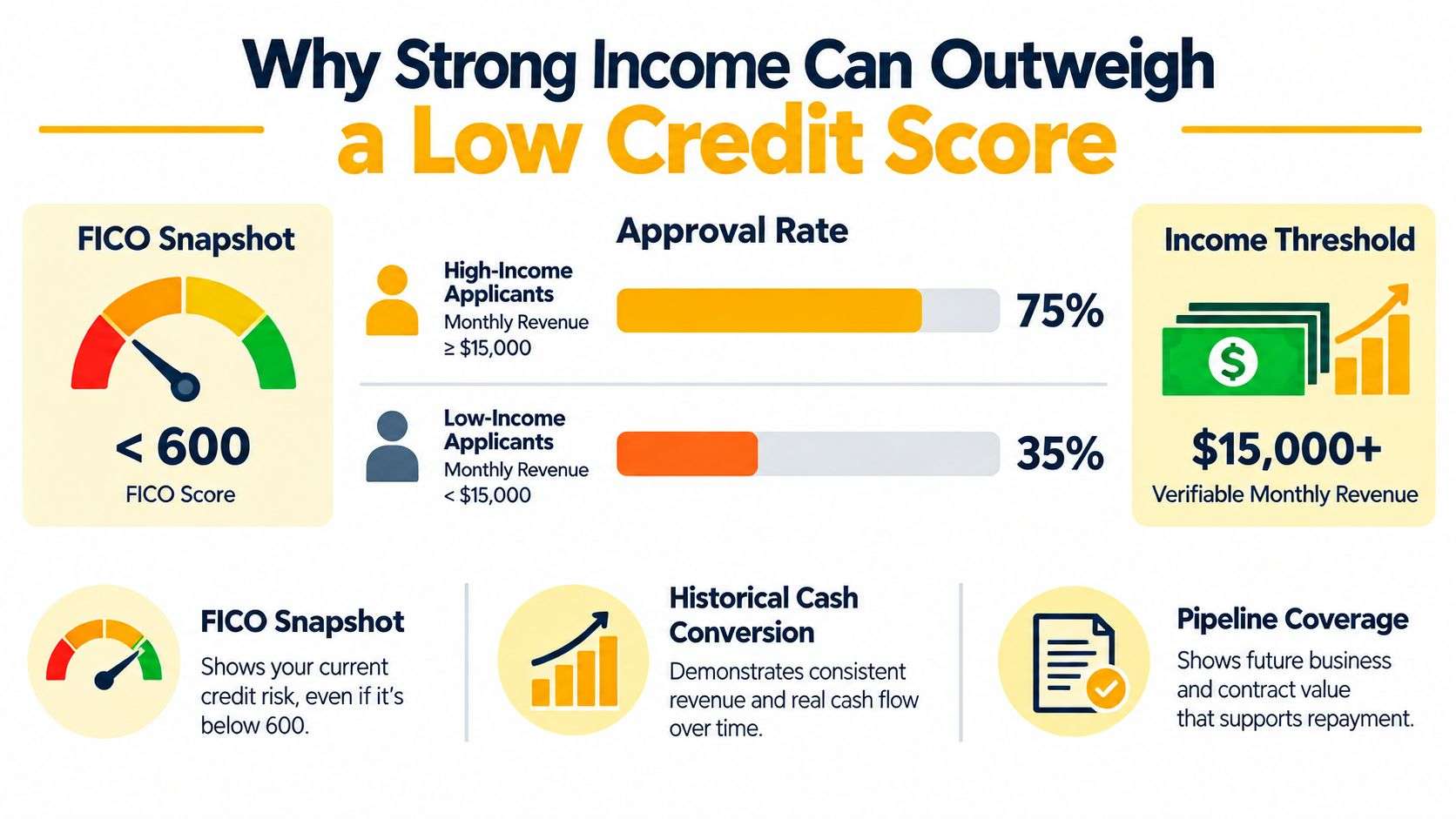
The strongest applications connect revenue to obligations instead of merely displaying a large top-line number. A business can invoice heavily and still lack cash after payroll, materials, taxes, and existing debt. Show the lender the full conversion from contract to deposit to available cash, then use the down payment and collateral to reduce the remaining exposure.
How to Stack the Odds Before You Apply
Apply in the right order. The most effective preparation reduces the lender's exposure, strengthens repayment evidence, and avoids unnecessary credit activity.
Start with cash, not applications
A 10 to 20% down payment is a practical starting target for a damaged-credit application. Some applicants may need 20 to 30% or more, while well-qualified borrowers may still find programs requiring no down payment. Larger cash contributions lower the loan-to-value ratio, reduce the financed balance, and signal that the owner has capital committed to the purchase. This equipment-trailer financing guide outlines the recommended sequence of correcting report errors, preparing 10 to 20% down, and then approaching specialty lenders.
Don't drain the operating account to produce a larger down payment. A lender may prefer a slightly smaller contribution with healthy working capital over a large payment that leaves payroll and fuel money exposed.
Add a cosigner only when the relationship is strong
A spouse, business partner, or family member with stronger credit can change the application math, but that person accepts real repayment responsibility. The lender will evaluate the cosigner's income, obligations, and willingness to guarantee the debt. A cosigner isn't a signature used to disguise weak finances. It's a second repayment source.
If you can choose between a cosigner and additional cash, compare the long-term cost and the relationship risk. More cash reduces the balance directly. A qualified cosigner may improve access or pricing, but missed payments can damage both parties.
Repair the file before the pull
Correct errors first. Dispute accounts that don't belong to you, inaccurate balances, and incorrect payment histories. Then pay down revolving balances, resolve collections where possible, and wait for the updated information to reach the bureaus before submitting multiple applications.
Use prequalification when available, especially if it uses a soft inquiry. Decide whether the application should rely on the business EIN, a personal guarantee, or both. Ask the lender how it handles inquiries, then group legitimate applications within a focused shopping period rather than sending separate applications to every source.
Before choosing a unit, review the manufacturer and dealer environment, including trailer manufacturers in Idaho, if that market is relevant to your sourcing plan. Inventory, specifications, and fair collateral value affect the financing conversation.
What Lenders Actually Price Beyond the Credit Number
The trailer type doesn't rescue a weak application, and the brand doesn't guarantee approval. Underwriters price the relationship between the asset, the borrower, and the repayment obligation.
A steel dump trailer from a regional builder can receive similar treatment to a nationally distributed brand when the collateral value, loan amount, cash flow, and guarantor profile align. Conversely, an expensive trailer with little money down can create a difficult approval even when the equipment is commercially useful.
Four inputs move the offer
| Pricing Lever | What Lender Measures | Effect on Rate |
|---|---|---|
| Loan-to-value | Loan balance compared with verified trailer value | Higher exposure generally produces less favorable pricing |
| Debt-to-income | Existing monthly obligations against verified income | Greater payment burden can tighten approval and raise pricing |
| Time in business | Operating history and evidence of continuity | Shorter history often requires stronger compensating factors |
| Revenue after obligations | Cash remaining after current commitments | More available cash supports repayment confidence |
Loan-to-value is often the controllable lever. A larger down payment creates more equity in the trailer and lowers the lender's potential loss if the borrower defaults. It can also reduce the monthly payment enough to fit the lender's debt-service calculation.
Term selection creates a separate tradeoff. A longer term can reduce the monthly payment, but it may increase total interest and keep the lien attached longer. A shorter amortization may cost more each month while reducing total financing expense and signaling a faster repayment plan.
Read lease structures carefully
A lease with a $1 buyout is designed to transfer ownership for a nominal amount at the end, while a lease with a 10% residual assumes a larger end-of-term value. Those structures can produce different payments, ownership outcomes, and tax treatment. Ask an accountant to review the tax consequences, and ask the finance provider to state the purchase option, residual, maintenance responsibility, and default provisions in writing.
Lenders also consider collateral liquidity, condition, title status, and resale demand. The trailer's usefulness matters, but the lender still needs confidence that the asset can support recovery if repayment fails. Treat every pricing term as negotiable only after you understand which risk factor caused it.
Negotiating the Deal and Closing With Confidence
Negotiate the trailer purchase before you let the conversation collapse into a monthly payment. Payment-first discussions make it easy to hide a higher price, longer term, add-on products, or fees inside an apparently manageable figure.
Use a price-first sequence
Start with the trailer's base price and specifications. Confirm what equipment, warranty coverage, delivery charges, and required accessories are included. Then compare financing offers using the financed balance, interest rate, term, total repayment, and fees.
A larger down payment may support a rate reduction, but ask the lender or dealer to show the change in writing. Don't assume a lower rate offsets every added fee. Request competing offers and give each finance source the same trailer price, down payment, and term so the comparisons remain meaningful.
Choose the term based on cash flow, not optimism. A shorter term can reduce total interest and pay the balance sooner. A longer term may protect working capital during seasonal periods, but it can increase the total cost and leave the business committed after the trailer's most productive period.
Before signing, review the final package line by line:
- Confirm the lender: Verify the lien holder's legal name and contact information.
- Match the asset: Check that the VIN, model, equipment description, and condition match the agreement.
- Audit add-ons: Review GAP coverage, service contracts, documentation fees, delivery charges, and any other amount added to the balance.
- Check payoff rules: Ask whether early payoff penalties, minimum interest provisions, or administrative charges apply.
- Verify insurance: Confirm binding requirements, coverage limits, loss-payee wording, and the date coverage must begin.
- Read default terms: Understand late fees, cure periods, repossession rights, and the effect of missed payments before leaving the lot.
For a practical example of how equipment dealers and buyers may coordinate around a purchase, review Tracey Road Equipment in East Syracuse, New York. The important point is process, not location. Get every negotiated term into the contract before funding.
ANTS Trailers are made in the USA and manufactured in Baraga, Michigan, with a focus on high-quality, durable, and versatile work equipment. Its 14/16 Live Bottom uses a walking conveyor belt floor to simplify loading and unloading, and the trailer can kneel and tilt for different working situations and terrain conditions. That conveyor-bed system and the ability to lower or raise the trailer provide functions that aren't available on other trailers, so verify the specifications and collateral value before including a unit in a financing package. ANTS describes its USA-made manufacturing and product positioning here, while its Live Bottom specifications explain the walking conveyor floor and kneeling and tilting functions.
If your credit is weak but your contracts, deposits, and equipment plan are solid, start by assembling the file instead of submitting blind applications. Review the financing paths and work-ready trailer options from ANTS Trailers, then contact the team with your business profile, target trailer, down payment, and documentation ready for a more productive financing conversation.