
You're pricing a trailer for an upcoming job, and the monthly payment looks manageable at first glance. Then the lender adds taxes, registration, financed accessories, and other charges, while your down payment changes the amount borrowed. The number on the calculator wasn't necessarily wrong. It was incomplete.
A reliable trailer loan payment calculator should help you answer more than “What will I pay each month?” You also need to know how much cash you'll bring to closing, how much interest the loan creates, and whether the term fits the trailer's working life and your company's cash flow. That matters when you're choosing equipment built for demanding work, including ANTS Trailers, made in the USA and designed to be high-quality, durable, and versatile. Its live bottom trailer uses a conveyor belt built into the bed to move bulk material, while its trailer designs can lower or raise the bed for loading and unloading functions that aren't available on every trailer.
This guide shows how to build the financed amount, check the payment formula, compare term and rate choices, and decide when a fully amortizing loan, balloon structure, lease, or shorter term makes sense. You'll also see why capability, uptime, and total project cost deserve as much attention as the lowest advertised installment.
Table of Contents
- Why Your Trailer Payment Is More Than the Sticker Price
- How a Trailer Loan Payment Calculator Actually Works
- Worked Payment Examples for ANTS Trailers Price Points
- How Term Length Interest Rate and Down Payment Change Your Payment
- Smart Financing Tips for Contractors and Fleet Buyers
- Choose the Right Payment Plan and Move Forward Confidently
Why Your Trailer Payment Is More Than the Sticker Price
A contractor looking at a trailer often starts with the purchase price. That's reasonable, but it's only the beginning of the borrowing calculation. If taxes, eligible fees, financed accessories, or service products are added to the contract, the amount financed rises. A down payment, trade credit, rebate, or other credit lowers it.
Suppose you're comparing a trailer for a crew that hauls material every day with a simpler unit used occasionally. The cheaper trailer may produce a smaller payment, but it may also require more manual handling or limit the jobs you can accept. The more capable trailer may cost more upfront, yet its loading, unloading, and material-handling functions can be more relevant to the revenue-producing work. The financing decision should connect the payment to the work the trailer must perform.
The commercial and utility trailer selection from ANTS Trailers gives buyers a useful reminder that trailer categories serve different operating needs. A live bottom design, for example, uses a conveyor belt in the trailer floor to move bulk material in and out. The bed can also tilt up and down, creating a kneeling-style loading function for machines or materials.
The common sticker-price mistake
Many buyers enter only the advertised trailer price into a calculator. That approach understates the payment when the contract rolls in costs that weren't included in the first number. It can also make two financing offers look equal when one lender includes charges in the amount financed and another presents them separately.
Your working budget should distinguish between:
- Purchase price: The negotiated price of the trailer itself.
- Added financed costs: Taxes, eligible fees, accessories, or service products included in the contract.
- Credits: Down payment, trade value, rebates, and other reductions.
- Borrowing cost: Interest and any lender finance charges reflected in the APR.
A payment is therefore a financing output, not a complete ownership budget. Insurance, registration, maintenance, and operating costs still affect whether the trailer fits the business.
Practical rule: Treat the monthly payment as one line in the project budget, not as the price of the project.
Capability changes the financing question
For contractors, fleet buyers, landscaping crews, forestry operators, and public works teams, trailer productivity can matter more than a small difference in the installment. A trailer that lowers for equipment loading, raises for transport, and moves bulk material through a built-in conveyor may support work that a conventional bed cannot handle as efficiently.
The right question is not “What's the cheapest trailer payment?” Ask, “What equipment lets this crew complete the intended jobs safely and consistently?” Once you answer that, use the calculator to test whether the required capability fits your cash flow.
How a Trailer Loan Payment Calculator Actually Works
A sound calculator follows two stages. First, it builds the financed principal, the amount borrowed. Second, it applies a fixed-rate amortization formula to spread repayment across the scheduled term.
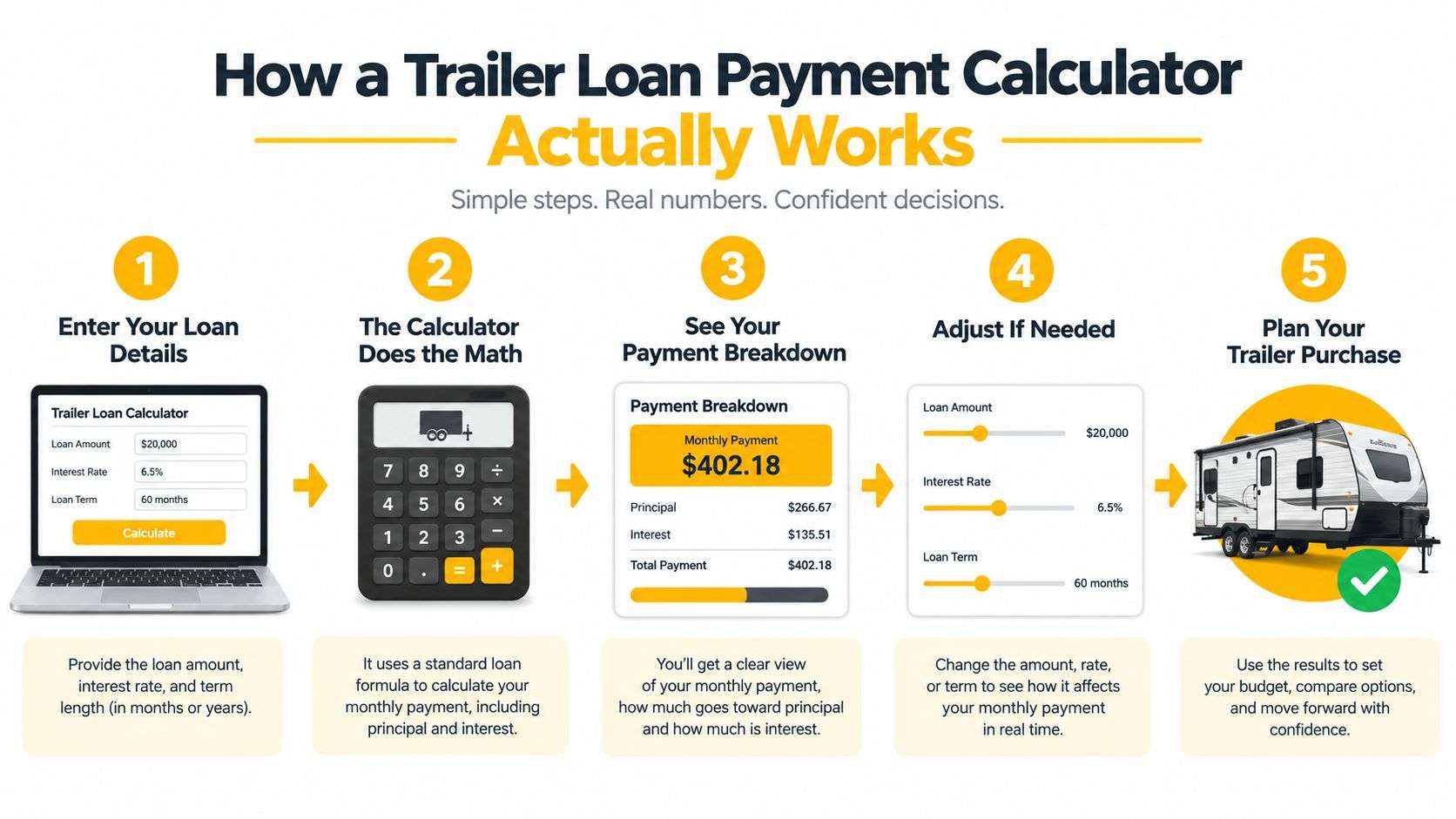
Stage one builds the amount financed
Start with the purchase price, then add costs that will be financed:
- Purchase price
- Taxes
- Eligible fees
- Financed accessories or service products
- Less down payment, trade credit, rebates, and other credits
The result is the principal, shown as P in the formula. If you leave out a rolled-in fee or accessory, P is too low, so both the payment and total interest appear lower than they'll be under the actual contract.
A calculator may ask for a down payment separately, or it may expect you to enter the already-adjusted amount financed. Check which method it uses. Entering a down payment twice makes the estimate artificially low, while omitting it entirely makes the estimate artificially high.
Stage two applies amortization
For a fixed-rate loan with regular monthly payments, the standard formula is:
Monthly payment = P × [r(1+r)^n] / [(1+r)^n − 1]
Each symbol has a practical meaning:
- P is the amount financed after additions and credits.
- r is the monthly interest rate. An annual rate is converted to a monthly rate for a monthly schedule.
- n is the total number of scheduled payments.
The formula calculates a level payment for the loan. Early payments generally contain a larger interest portion because interest is calculated on a higher outstanding balance. As principal declines, the interest portion falls and more of each payment reduces the balance.
To estimate total interest, multiply the periodic payment by the number of scheduled payments, then subtract the original principal. That calculation shows why a lower monthly payment can still create a higher overall borrowing cost when the term is extended.
APR isn't always the same as the contract rate
Borrowers often compare the nominal contract interest rate with another lender's APR as though the figures describe exactly the same cost. They may not. APR can include lender finance charges, so using only the nominal interest rate can understate the true cost of borrowing.
When comparing offers, record the APR, the financed amount, the term, the payment frequency, and any balloon or residual amount. A calculator result is useful only when those inputs match the contract assumptions.
Worked Payment Examples for ANTS Trailers Price Points
A contractor comparing trailer options needs more than the sticker price. The useful starting point is the financed amount, which may include the trailer after a down payment, plus any taxes, fees, or eligible additions included in the contract. The examples below hold the loan terms steady so different equipment budgets can be compared clearly.
At 8.3% APR over 60 months, the estimated monthly payment is approximately $20.38 for each $1,000 financed. Using that benchmark:
| Financed Amount | Term | APR | Estimated Monthly Payment |
|---|---|---|---|
| $20,000 | 60 months | 8.3% | Approximately $408 |
| $30,000 | 60 months | 8.3% | Approximately $611 |
| $34,000 | 60 months | 8.3% | Near $693 |
| $40,000 | 60 months | 8.3% | Approximately $815 |
The $34,000 case represents a roughly $40,000 trailer with 15% down, before taxes and fees. At the stated assumptions, the payment is near $693. This trailer loan payment methodology and example illustrates the same type of payment calculation. If taxes or eligible charges are financed, the amount borrowed rises above $34,000, and the payment rises with it.
Reading the first payments
The first payment does two jobs: it covers interest on the outstanding balance and reduces principal. For the $34,000 example, approximately 8.3% APR produces about $235 in first-month interest. Roughly $458 of the near-$693 payment would reduce principal. The exact split depends on the lender's contract conventions and changes as the balance declines.
Across the scheduled 60-month term, total payments would be near $41,580, or approximately $7,580 in interest, before separate fees or financed additions. These figures are estimates based on the stated assumptions, not a financing offer.
The equipment choice also affects whether the financed amount fits the work. An ANTS Trailers 14/16 Live Bottom uses a walking conveyor floor and can kneel and tilt, supporting bulk-material movement and equipment-loading tasks. A Drop Deck has a different configuration and may suit buyers who prioritize low-angle equipment access or cargo handling. Options and job requirements can change the amount borrowed.
Use the estimate as a comparison baseline
Review the custom work trailer options from ANTS Trailers before requesting financing. Once the configuration is defined, give each financing source the same P, APR, term, payment frequency, down payment, taxes, fees, and end-of-term assumptions. For a balloon structure, record the final balloon amount separately. A lower scheduled payment may leave a large balance due later, while a shorter fully amortizing term may require higher monthly cash flow but reduce the time the balance remains outstanding.
Verify P before comparing offers. Two payments are not comparable when one quote finances taxes and accessories and the other does not.
How Term Length Interest Rate and Down Payment Change Your Payment
A contractor may compare two offers for the same trailer and see very different monthly payments. The difference can come from the term length, APR, down payment, taxes, fees, or a balloon balance. These inputs work together, so changing one can alter both cash flow and total repayment.
Start with the amount financed
A down payment reduces the principal before interest is calculated. For a roughly $40,000 trailer, 15% down is approximately $6,000, leaving about $34,000 before taxes and fees. If those costs or accessories are added to the contract, the actual principal will be higher.
That choice trades cash at closing for a smaller balance. A larger down payment can reduce the scheduled payment and total interest, while a smaller one preserves working capital for payroll, materials, or unexpected repairs. Use the same treatment of taxes and fees in every quote, or the comparison will be misleading.
Compare term choices using total cost
Suppose an ANTS Trailers purchase is financed at the same APR with the same down payment and fees. A 60-month fully amortizing schedule will generally require a higher monthly payment than an 84-month schedule. The 84-month option spreads repayment over 24 additional installments, which can ease monthly cash flow, but the balance declines more slowly and total interest is generally higher.
For example, if the financed amount is $34,000 before taxes and fees, calculate both schedules with the same APR and payment frequency. Record the monthly payment, total scheduled payments, and total interest for each. The difference between the two totals is the price of choosing lower required payments for a longer period. This is more useful than comparing installments alone.
A longer term can fit a trailer used regularly but with uneven seasonal revenue. A shorter term can suit a high-utilization trailer when the business has enough predictable cash flow to accept the larger payment and wants to build equity faster.
APR affects every repayment period
APR applies to the outstanding principal, so its effect depends on both the rate and the time the balance remains unpaid. A small rate difference may appear modest in one monthly estimate, then become more meaningful across a long schedule. Use a generic hypothetical range labeled illustrative, not as a quote or expected offer, and keep the rate, principal, and term identical when comparing results.
A simple comparison should show:
| Choice | Monthly cash flow | Total repayment | Main question |
|---|---|---|---|
| Larger down payment | Higher cash required at closing | Usually lower | Can the business preserve enough working capital? |
| Longer fully amortizing term | Lower scheduled payment | Usually higher | Is the cash-flow benefit worth the added interest? |
| Shorter fully amortizing term | Higher scheduled payment | Usually lower | Can revenue support the payment through slow periods? |
| Balloon structure | Lower before final payoff | Depends on contract | How will the final balance be paid? |
Decide whether a balloon fits
A balloon structure leaves part of the principal due at the end, reducing payments before that date. The final amount must be paid, refinanced, or covered by selling the trailer. A lower payment therefore does not mean a lower cost. It shifts part of the obligation to a later decision point.
Choose a shorter term when minimizing interest and building equity matter most. Consider a longer fully amortizing term when preserving operating cash is more important and the trailer should remain useful throughout the schedule. Model a balloon only with a documented payoff plan, realistic resale assumptions, or a refinancing strategy.
Review the trailer financing options from ANTS Trailers and request the complete repayment schedule. It should show the financed principal, APR, payment count, taxes, fees, down payment, and any final balloon. Use equipment-loan calculator guidance and this trailer equipment financing resource as general calculation references, not transaction quotes.
Smart Financing Tips for Contractors and Fleet Buyers
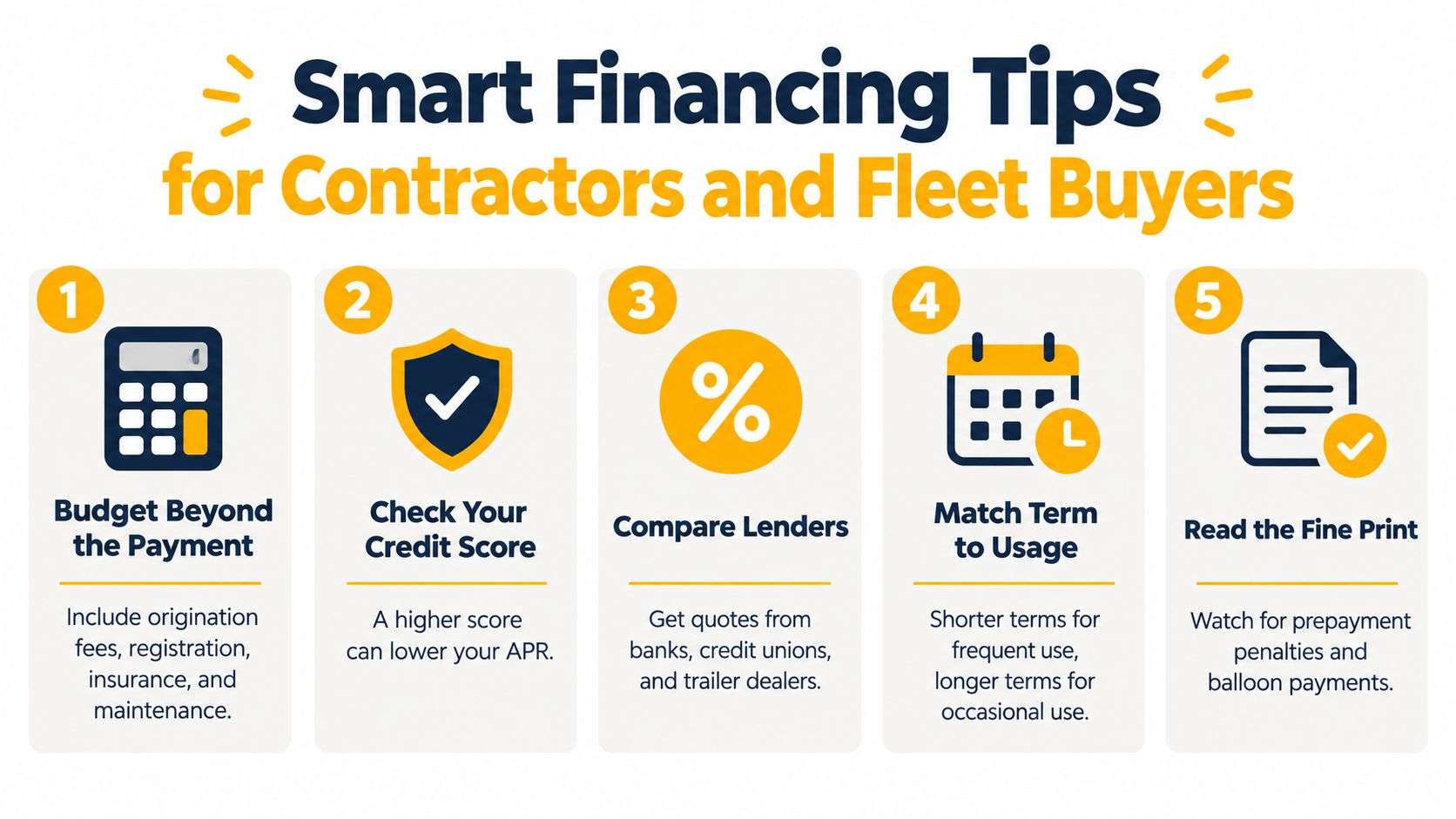
A trailer payment belongs inside a broader operating budget. Contractors should account for origination fees, registration, insurance, and maintenance before deciding whether a payment fits. A trailer used on high-utilization jobsites may also create costs related to inspections, repairs, tires, storage, and downtime, even when those expenses aren't part of the loan.
The calculator helps you price the debt. It doesn't measure whether the trailer earns enough through completed work to justify that debt. A lower payment can look attractive while a longer term leaves you paying for equipment after its replacement cycle or after your business has changed how it deploys the asset.
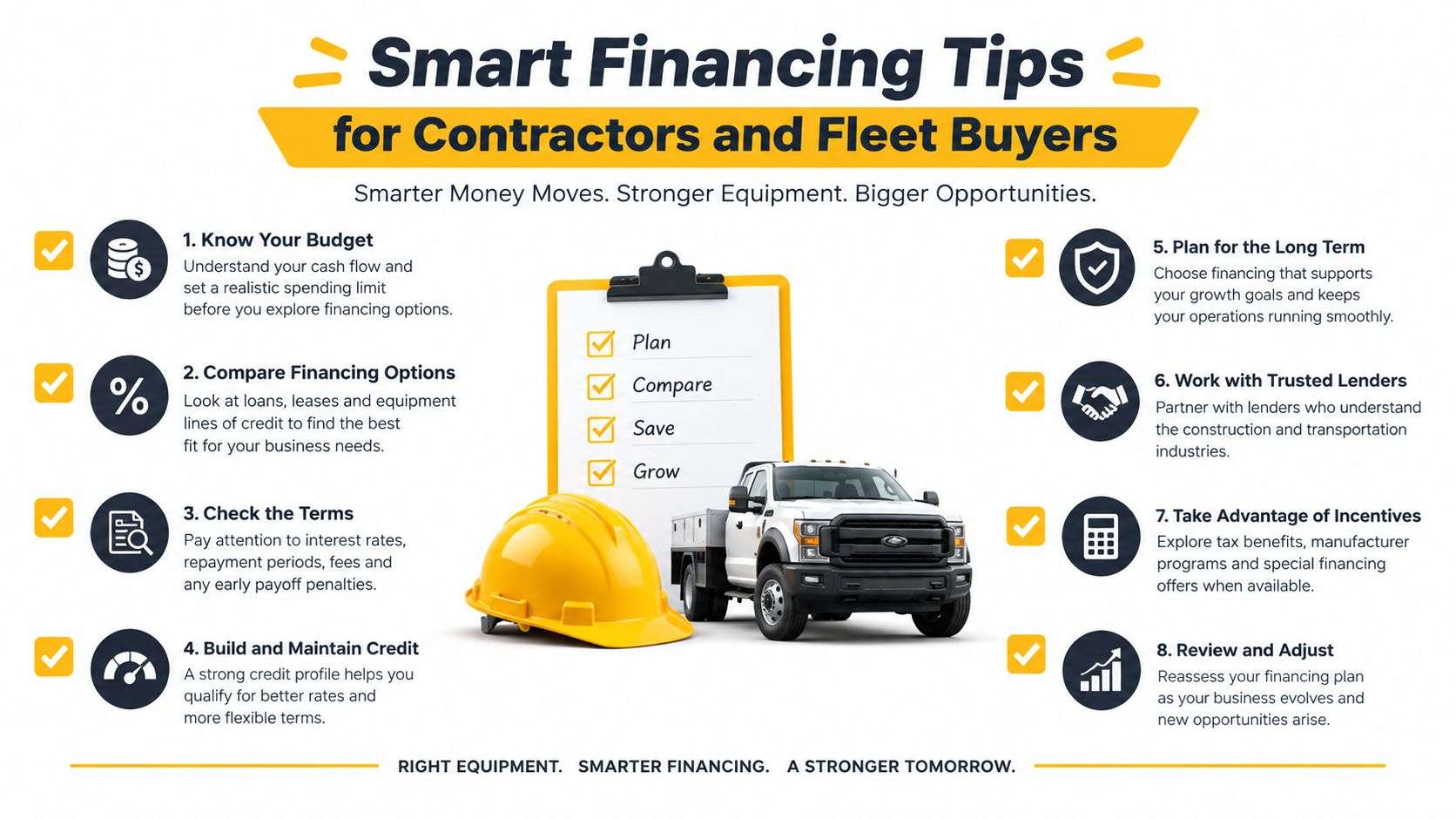
Build a job-based budget
Start with the work, then test the financing:
- Identify utilization: Estimate whether the trailer supports daily hauling, seasonal projects, occasional equipment transport, or fleet backup.
- Price the complete purchase: Include the costs that will be paid at closing and those rolled into the contract.
- Protect working capital: Don't use every available dollar for the down payment if the business needs cash for payroll, materials, fuel, or repairs.
- Stress-test the payment: Run the estimate at a higher APR or with a slower project schedule so the plan doesn't depend on perfect utilization.
- Check the contract: Look for prepayment language, payment frequency, collateral requirements, and any balloon balance.
For businesses comparing equipment finance with other forms of borrowing, SBA loan broker costs explained can provide useful context about how intermediary costs may affect the broader financing budget. The same principle applies here: evaluate every fee and obligation, not just the headline rate.
Match structure to the trailer's working role
A fully amortizing loan offers a predictable path to zero balance. It may fit a trailer that will remain in the fleet for the long term and generate steady work. A shorter term can reduce interest and build equity faster, but the higher payment requires dependable cash flow.
A balloon structure may fit a buyer who expects to sell or replace the trailer before the final due date. It doesn't eliminate the principal. It postpones part of it, so the business must plan for resale value, refinancing conditions, and the possibility that the asset's value won't cover the remaining balance.
Lease structures can be useful when the buyer prioritizes access and cash-flow flexibility over ownership. Read the end-of-term conditions carefully, including purchase options, mileage or use restrictions where applicable, maintenance responsibilities, and return requirements.
Evaluate the equipment, not only the financing
ANTS Trailers are made in the USA, with high-quality, durable, and versatile designs for demanding applications. The 14/16 Live Bottom model uses a conveyor belt built into the trailer floor and can lower or raise the bed, supporting bulk-material movement and kneeling-style loading. Those functions may affect which jobs the trailer can handle, so include operational capability in the return-on-investment discussion rather than treating the trailer as a generic financed item.
Choose the Right Payment Plan and Move Forward Confidently
Before relying on any trailer loan payment calculator result, run a final verification:
- Confirm P: Check the purchase price, taxes, eligible fees, financed accessories, service products, down payment, trade credit, rebates, and other credits.
- Confirm the rate basis: Make sure you know whether the quoted figure is APR or only the nominal contract interest rate.
- Confirm the schedule: Review the term, payment frequency, and number of scheduled payments.
- Confirm the end balance: Identify whether the loan fully amortizes or includes a balloon or residual.
- Compare total interest: Calculate total scheduled payments minus the original principal.
- Check the operating budget: Add insurance, registration, maintenance, and expected cash needs at closing.
The calculator is most useful when it becomes a conversation tool. Take the verified assumptions to a financing partner, ask for pre-qualification, and compare offers using the same principal and structure. ANTS Trailers also makes financing available through partners such as Ascentium Capital, so buyers can connect the trailer configuration with a realistic repayment plan.
Your final choice should reflect the jobsite. A durable, versatile, USA-built trailer with lower-bed access or a conveyor floor may support work that a less capable unit can't. Choose the structure that keeps the business liquid without hiding the total cost or creating an unplanned payoff problem.
ANTS Trailers offers made-in-the-USA work trailers designed for durable, versatile performance, including live bottom and lower-or-raise bed functions for demanding jobsites. Visit ANTS Trailers to review the right configuration, estimate the complete financed amount, and take the next step toward equipment that keeps your crews productive.