
A lot of trailer purchases start the same way. A crew is growing, jobs are getting heavier, and the old trailer that seemed “good enough” is now slowing down every morning. Loading takes too long. Tie-down points are in the wrong places. The deck height fights you on every machine with low clearance. On wet ground, the whole process gets more awkward and more dangerous.
That's the point where a trailer stops being a commodity and starts being a piece of production equipment.
The trailer market keeps moving in that direction. The global utility trailers market was valued at about USD 1.54 billion in 2026 and is projected to reach roughly USD 2.0 billion by 2035, with North America holding up to 45% of the market, reflecting demand from construction and transport sectors for dependable equipment, according to utility trailer market projections. Buyers aren't just looking for something that rolls. They're looking for something that helps crews work faster, load safer, and stay in service.
Why Your Standard Trailer Is Costing You Money
A standard trailer usually doesn't fail all at once. It bleeds money a little at a time.
One crew loses time shimming ramps on uneven ground. Another beats up a mower, skid steer, or compact excavator because the load angle is too steep. A third keeps welding, patching boards, replacing lights, and fighting bent components after hauling equipment the trailer was never built to handle day after day. None of that looks dramatic on a quote sheet. It shows up in payroll, delays, and callbacks.
Where the hidden cost shows up
The cheapest trailer often creates expense in places owners don't track carefully enough:
- Labor drag: Two workers spend extra time guiding, adjusting, and reloading because the trailer doesn't match the task.
- Downtime: Small failures stack up. Wiring issues, worn ramps, damaged decking, and bent hardware take equipment out of rotation.
- Safety exposure: A loading mistake on soft ground or a bad approach angle can turn routine work into an incident.
- Asset damage: Machines, attachments, and materials take unnecessary hits when the trailer platform isn't stable or properly supported.
Practical rule: If your trailer adds friction to loading, unloading, or securing, it's not saving money. It's moving cost from the purchase order to the field.
That's why experienced fleet buyers look past sticker price. They ask a maintenance question first. What will this unit cost to keep in service, and what does failure look like during a busy week? If you already use structured maintenance thinking on trucks, loaders, or shop equipment, the same logic applies here. A solid framework like RCM and FMEA optimization helps teams think through failure modes before those failures start burning labor hours.
Rugged is about uptime, not appearance
A rugged work trailer isn't just one with thicker steel and an aggressive spec sheet. It's one that keeps doing its job on rough access roads, muddy laydown yards, salt-exposed routes, and repetitive loading cycles without turning every job into a workaround.
That matters more now because buyers have options across a broad equipment category. The wider multipurpose trailer market was estimated at USD 4.24 billion in 2024 and is forecast to rise to USD 6.5 billion by 2035 at a 3.9% CAGR. In the same report, North America alone is projected to grow from USD 1.6 billion in 2024 to USD 2.4 billion by 2035, showing how large and active this segment is in the U.S. and Canada, based on multipurpose trailer market data.
A better trailer doesn't just haul. It removes wasted motion from the workday.
The Anatomy of a Truly Rugged Work Trailer
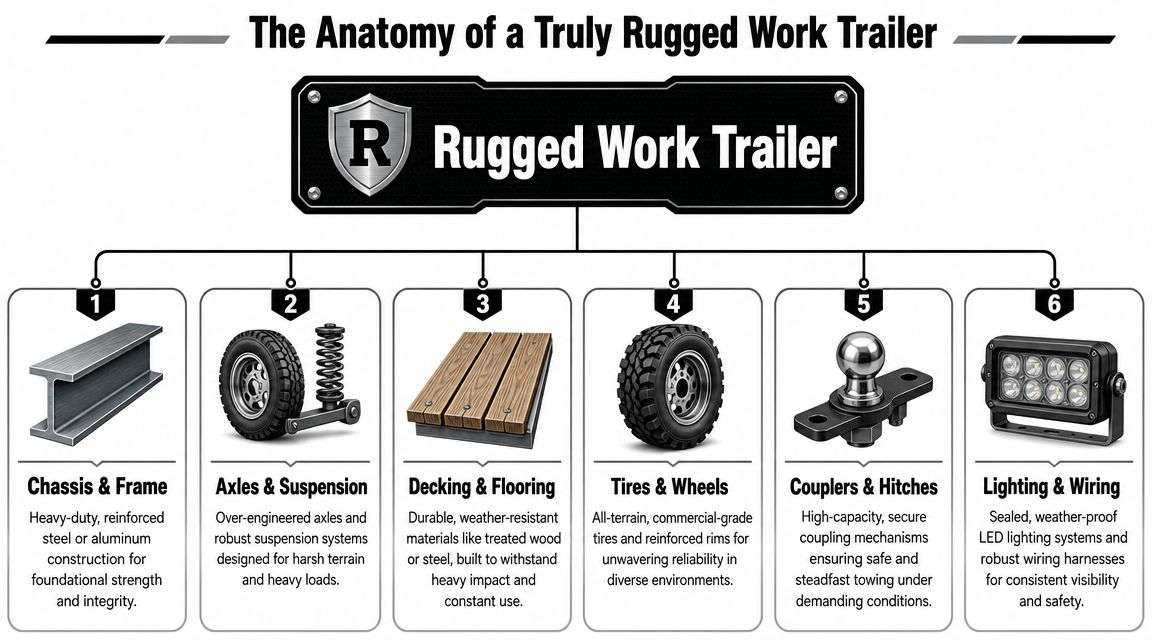
The difference between a consumer-grade trailer and a serious work trailer is mostly hidden underneath. Paint can make weak equipment look respectable. The frame, cross-members, deck support, axle setup, coupler, and wiring tell the story.
Start with the frame
Think of the frame as the skeleton. If it flexes too much, everything above it suffers. Decking loosens, welds take abuse, alignment goes off, and loading heavy point loads becomes harder on the whole chassis.
A practical benchmark for rugged work trailers is GVWR in the 10K to 16K class, with a 7-foot bed and 16 to 24-foot deck length, because that range typically supports 6,950 to 12,660 lb of load capacity while still giving enough usable footprint for compact equipment and materials, as shown in equipment trailer specifications from Sure-Trac. Manufacturers commonly use a C-channel frame with cross-members because it improves bending stiffness and spreads point loads from tracked or wheeled machines more evenly.
What to inspect before you buy
Don't stop at the brochure. Get under the trailer and inspect it like a mechanic would.
- Frame design: Look for a real structural chassis, not just a deck sitting on light members.
- Cross-member spacing: Closer support matters when you're loading machines with concentrated wheel or track loads.
- Deck support at stress points: The rear load area and ramp transition zone usually show you how serious the build is.
- Coupler and jack setup: These parts take daily abuse. Sloppy fit and light-duty hardware become field problems fast.
- Lighting and wiring protection: Sealed systems and protected routing hold up better in mud, vibration, and weather.
Buy the trailer that looks overbuilt in the places your crew won't notice until something breaks.
Deck, load angle, and usable geometry
A trailer can have good paper capacity and still be frustrating to use. Geometry matters. Bed height, ramp angle, rear transition, and tie-down placement all affect whether a crew can load quickly without scraping, spinning, or re-positioning.
That's why low-angle drop-deck designs have become such a practical solution for contractors moving compact equipment and valuable cargo. If that's your use case, an enclosed drop deck trailer configuration is worth studying because the layout solves problems that a flat, higher-deck trailer often creates.
Here's the key distinction:
| Component | What works | What doesn't |
|---|---|---|
| Frame | C-channel and strong cross-member structure | Light frame that relies on the deck to make up stiffness |
| Load support | Even distribution under tracks or wheels | Concentrated stress in a few unsupported spots |
| Deck geometry | Low, controlled loading angle | Steep approach that slows loading and increases strike risk |
| Electrical | Sealed, protected routing | Exposed wiring that gets torn up in brush or mud |
A rugged trailer earns its keep under the deck, not in the sales copy.
Innovations That Boost Jobsite Efficiency and Safety
The old idea of a heavy-duty trailer was simple. Make it stout, add ramps, and let the crew figure out the rest. That still works for some jobs, but it doesn't solve the problems that eat time on site.
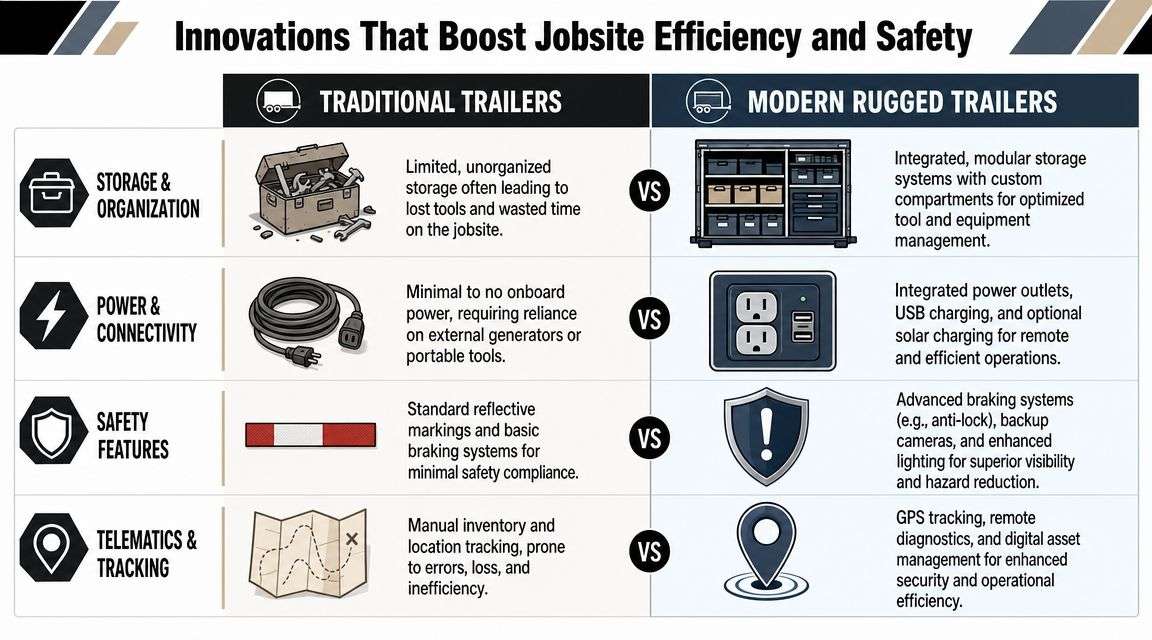
Loading incidents remain a major source of risk, and newer features such as low-load-angle ramps and adjustable chassis systems directly address that by reducing manual handling and improving stability on uneven terrain, according to jobsite loading and trailer safety guidance. That's a practical shift, not a cosmetic one.
Traditional trailers versus problem-solving trailers
A traditional trailer asks the operator to adapt to the equipment. A modern rugged work trailer should do more of the adapting itself.
Consider the difference:
- Fixed-height loading: Works fine on level pavement. Gets frustrating on rutted approaches, frozen ground, or soft shoulders.
- Basic ramp systems: Simple and familiar, but they can create a steeper breakover point for low-clearance equipment.
- Tip-or-dump thinking: Effective in some material applications, but not always precise or safe where overhead clearance, slope, or controlled placement matters.
Now compare that to designs built around workflow:
- Lowering or raising chassis systems: These let the trailer meet the terrain instead of forcing the machine to climb a poor angle.
- Tilting or kneeling functions: These reduce setup hassle and can make repetitive loading more controlled.
- Conveyor-based beds: These move material out in a managed way rather than relying on gravity and a full dump cycle.
Where the gains are real
Specialized designs distinguish themselves from generic work trailers. Ants Trailers, made in the USA, offers models built around that practical logic, including a conveyor trailer with a live bottom trailer bed and the ability to lower or raise the trailer. That combination gives crews options a standard trailer doesn't provide, especially when they need controlled unloading and better adaptability on uneven sites.
A live bottom setup makes sense when you need placement, not just discharge. A crew handling aggregate, mulch, asphalt-related material flow, or other loose product can benefit from moving material out progressively instead of lifting the body and committing to one dump motion.
Safety is tied to efficiency
Fast and safe usually go together when the trailer is designed well.
If a trailer lowers the load angle, operators spend less time jockeying for alignment. If the chassis can adapt to the site, workers do less improvising with blocking and repositioning. If unloading is controlled, the crew spends less time standing near unstable movement.
The safest loading routine is usually the one that asks the crew to do the fewest extra steps.
That's the standard I'd use when comparing features. Don't ask whether a feature sounds advanced. Ask whether it removes a common failure point in the field. If it saves setup time, reduces awkward handling, and gives the operator more control, it's doing real work.
Matching the Trailer to the Trade Selection Checklist
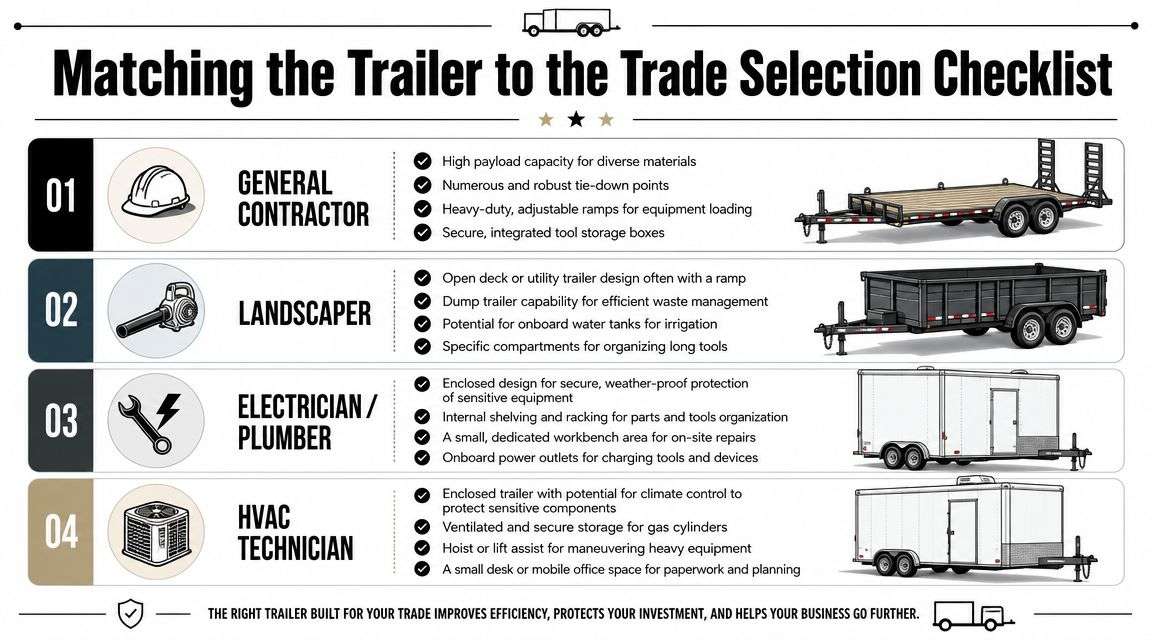
The right trailer for a general contractor isn't automatically right for an outdoor grounds crew, municipal crew, or forestry operator. Problems start when buyers choose a trailer by category name instead of by daily task.
General contractor needs
If you haul compact excavators, skid steers, attachments, palletized material, and job boxes in the same month, you need flexibility first.
Check for:
- Payload confidence: The trailer should comfortably handle your usual equipment, not barely qualify on paper.
- Tie-down access: You want securement points where machines naturally sit, not where the factory happened to place them.
- Ramp or deck geometry: Compact equipment with attachments loads faster on a low-angle setup.
- Tool protection: Locked storage matters if the trailer doubles as mobile support equipment.
If your crew regularly loads low-clearance machines, a 14/20X drop deck layout fits that kind of work because low loading geometry usually matters more than raw deck simplicity.
Landscapers and earthworks crews
Outdoor service providers often need one trailer to do several jobs badly, unless they buy on purpose. The right question isn't “Can it haul?” It's “Can it switch between machines, pallets, and loose material without slowing down the crew?”
A practical fit often looks like this:
| Trade | Better match | Why it fits |
|---|---|---|
| Landscaping | Open deck, drop deck, or material-handling trailer | Easier equipment loading and more flexibility with bulk material |
| Earthworks | Heavier-duty equipment trailer or conveyor-based trailer | Better support for compact equipment and controlled unload needs |
| Municipal work | Versatile trailer with safe loading features | Mixed duties and varied site conditions reward adaptability |
For crews moving sod, compact loaders, trenchers, or small rollers, loading convenience matters every day. For crews also handling loose product, a controlled-unload design can remove a second machine from part of the workflow.
Electricians, plumbers, and HVAC teams
These trades usually need enclosed security more than raw open-deck capacity. Their trailer is part warehouse, part mobile work area.
Priorities change:
- Weather protection: Sensitive tools, fittings, and stocked parts need a sealed environment.
- Organization: Shelving, bins, and interior access reduce wasted time.
- Stable entry and loading: Repetitive loading of carts, cylinders, and boxed components should be easy, not awkward.
- Power support: If the trailer acts as a field base, onboard utility matters.
Forestry and high-abuse operations
Forestry, land clearing, and rough rural work punish trailers differently. Brush catches wiring. Mud packs into moving parts. Uneven approaches challenge ramps and rear structure.
If the trailer will live off pavement, buy for impact, contamination, and awkward loading. Not showroom appearance.
For that environment, I'd put rear structure, wiring protection, frame stiffness, and serviceability ahead of cosmetic finish every time. The trailer has to work dirty, not just look good on delivery day.
Essential Maintenance and Safety Protocols
A rugged work trailer still needs discipline. Good equipment lasts because somebody inspects it before it turns into a repair order.
The easiest mistake is treating the trailer as passive gear. It isn't. It's a working asset with tires, brakes, wiring, deck surfaces, hinges, hydraulics, couplers, and securement hardware that all affect safety and uptime.
A practical inspection rhythm
Keep it simple enough that the crew will do it.
Before every use
- Walk the perimeter: Check tires, lights, coupler engagement, safety chains, ramp condition, and visible damage.
- Look at the deck: Watch for loose boards, bent edges, oil contamination, and anything that could affect traction.
- Confirm securement gear: Straps, chains, binders, and anchor points should match the load and be in usable condition.
Weekly or at regular service intervals
- Inspect wiring and connectors: Mud, abrasion, and vibration are hard on electrical systems.
- Check moving features: If the trailer has hydraulic, kneeling, tilt, or conveyor functions, verify smooth operation and look for leaks or damaged hoses.
- Review wear points: Hinges, ramp pivots, latches, jacks, and suspension hardware usually tell you where future downtime is coming from.
Safety habits that should be non-negotiable
Advanced features help, but they don't replace procedure.
- Load on stable ground when possible. If the site is uneven, stop and assess before deploying ramps, tilt, or kneeling functions.
- Clear the operating zone. Nobody should stand where they can get pinned by moving decks, ramps, or shifting material.
- Use a spotter when visibility is compromised. That's especially important on soft shoulders, crowded jobsites, or when loading low-clearance equipment.
- Don't improvise around a bad setup. If the angle is wrong or the ground won't support the operation, reposition.
For crews that need a formal checklist, DOT trailer inspection requirements offer a useful baseline for building a repeatable process into daily operations.
Protecting the long-term value
Corrosion, neglected hydraulics, and ignored wiring problems are the big trailer killers. Keep the unit clean, address damage early, and repair small issues before they become structural ones.
The operators who get the longest service life aren't necessarily the gentlest. They're the most consistent. They inspect, grease, clean, tighten, and fix things while the problem is still cheap.
Calculating the Real ROI of a Premium Work Trailer
Most buyers get stuck on the wrong number. They compare purchase prices and stop there.
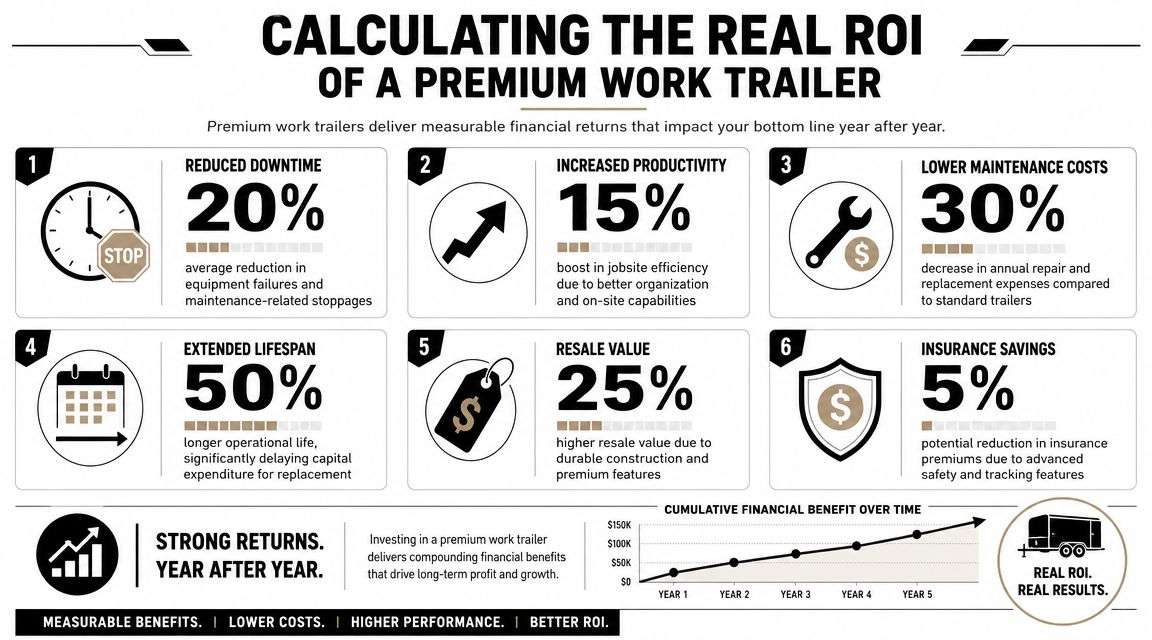
That approach misses the real decision. The hard question is whether the trailer lowers total operating cost and helps the crew produce more work with fewer interruptions. One underserved issue in trailer buying is total cost of ownership versus upfront price. Buyer content often compares visible features, but it rarely addresses maintenance, downtime, corrosion resistance, or repairability over a long service life. That gap matters because buyers are putting more emphasis on lifecycle value and asset utilization, as discussed in this analysis of trailer ownership cost and lifecycle value.
The right way to think about payback
You don't need a complicated finance model. You need to compare two categories of cost.
Upfront cost
- Purchase price
- Financing terms
- Initial setup or accessories
Operating cost
- Repairs and maintenance
- Downtime when the trailer is out of service
- Extra labor during loading and unloading
- Damage risk to hauled equipment or materials
- Lost scheduling flexibility when the trailer can't adapt to the job
A premium trailer often costs more on day one. That part is obvious. What buyers miss is that better corrosion resistance, stronger structure, and smarter loading design can lower the day-to-day penalties that cheap equipment creates.
A field test for profitability
Ask these questions about your current trailer:
- Does loading take longer than it should? If yes, your labor cost is higher than it looks.
- Do operators need workarounds on rough ground? That's a productivity problem and a safety problem.
- Do repairs keep coming in waves? Repetitive failures are ownership cost, not bad luck.
- Are you turning down certain tasks because the trailer isn't suited to them? Then the trailer is limiting revenue options.
A profitable trailer saves time on ordinary days and prevents expensive problems on bad days.
That's why premium builds can make financial sense even before resale enters the conversation. If a trailer lets the same crew load faster, unload with more control, and stay in service with fewer interruptions, the return shows up in throughput and reliability.
Premium value is broader than toughness
The strongest trailer isn't automatically the smartest buy. Profitability often comes from fit.
A contractor hauling compact equipment may gain more from low load angles than from chasing maximum rated capacity. A material-handling crew may gain more from controlled unloading than from a conventional dump-style approach. A municipal fleet may care most about service access, parts support, and lower downtime.
Financing can also change the equation. When a manufacturer offers workable payment options, the business can align trailer cost with the cash flow produced by the jobs the trailer supports. That makes the decision less about absorbing a large one-time hit and more about matching equipment cost to operating benefit.
If the trailer improves labor efficiency, lowers service hassle, and expands what your crew can handle, it's not just an expense. It's part of your production system.
Your Next Move Toward a Smarter Jobsite
A rugged work trailer should earn its place the same way a good skid steer, mini excavator, or service truck does. It should save time, reduce hassle, and keep the crew moving without constant improvisation.
That means looking past the easy sales points. Capacity matters, but so do frame design, deck geometry, loading angle, corrosion resistance, repair access, and how the trailer behaves on bad ground. Those details decide whether the trailer becomes a productive asset or a recurring field complaint.
The smartest buyers also think beyond the first year. They ask how the trailer will hold up under real loading cycles, what it takes to maintain it, how safely it operates on uneven sites, and whether it supports the kind of work the company wants to do next. That's the difference between buying transport and buying capability.
If you're replacing a unit that has already started costing you time, the move is simple. Write down your actual use cases. List the equipment, materials, terrain, and loading problems your crew deals with every week. Then match the trailer to those realities, not to the lowest quote.
A growing contractor doesn't need a flashy trailer. They need one that helps the crew finish the day with less wasted motion, fewer delays, and more confidence in the field.
If you want to explore purpose-built options, ANTS Trailers is worth a look. The company builds its trailers in the USA and focuses on durable, versatile work platforms for demanding jobsites, including drop deck and live bottom designs with functions such as a conveyor belt trailer bed and the ability to lower or raise the trailer. For contractors who care about jobsite efficiency, controlled unloading, and long-term ownership value, that kind of design is the right place to start.