
The first sign you've got the wrong trailer is usually on the ground, not in the brochure. A crew shows up to a soft or uneven site, the load is sticky, the lane is tight, and the dump body wants room that the job doesn't have. That's where a material conveyor trailer starts making sense, because it moves bulk material out while staying level, instead of turning the whole trailer into a raised lever arm.
Table of Contents
- What a Material Conveyor Trailer Does on a Real Jobsite
- Core Concepts and Key Types of Conveyor-Based Trailers
- Specifications and Performance Numbers Buyers Should Evaluate
- Matching ANTS Models to the Haul You Actually Run
- Applications Across Construction, Landscaping, Forestry, and Public Works
- Safety and Maintenance Questions Most Buyers Forget to Ask
- Cost, ROI, and Financing for a Conveyor Trailer Purchase
- Choosing the Right Material Conveyor Trailer for Your Jobsite
What a Material Conveyor Trailer Does on a Real Jobsite
The crew is waiting on a wet morning, the delivery truck has to stay off the soft shoulder, and the foreman does not want a tipped body blocking the lane. That is the job a material conveyor trailer is built to handle. Instead of raising the bed, the trailer unloads while remaining horizontal, which lowers rollover exposure compared with a tip-style discharge system and gives the crew a steadier stream of material that is easier to place where it needs to go live-bottom engineering explanation.
Why level unloading changes the job
On an uneven yard, a raised dump body creates problems before the material even starts moving. The operator has to find space for the lift, the bed changes the center of gravity, and the truck or trailer needs a cleaner setup than the site often gives. A live-bottom design uses a moving floor to carry bulk material out at a controlled rate, which keeps the unit more stable on rough ground and lets the crew meter discharge instead of releasing the whole load at once.
That controlled discharge is what crews notice first. The load does not drop in one abrupt surge, so there is less scrambling with shovels, less cleanup at the tailgate, and fewer moments where one mistake turns into a spill across a driveway or travel lane. For municipal work, landscaping, and aggregate delivery, that consistency often matters more than raw capacity.
Practical rule: if the site cannot comfortably handle a raised dump body, the trailer choice should start with discharge control, not with payload bragging.
ANTS Trailers fits that mindset because the company builds in Baraga, Michigan, and positions its trailers around durability, versatility, and practical engineering for demanding jobsites. The lineup includes features such as a convey belt trailer bed on the live bottom model and the ability to lower or raise the trailer for terrain changes, which is the kind of flexibility a mixed-material crew can use on a real shift. For crews comparing discharge behavior across trailer styles, the company's conveyor belt trailers give a clearer picture of how controlled unloading changes day-to-day work.
Core Concepts and Key Types of Conveyor-Based Trailers
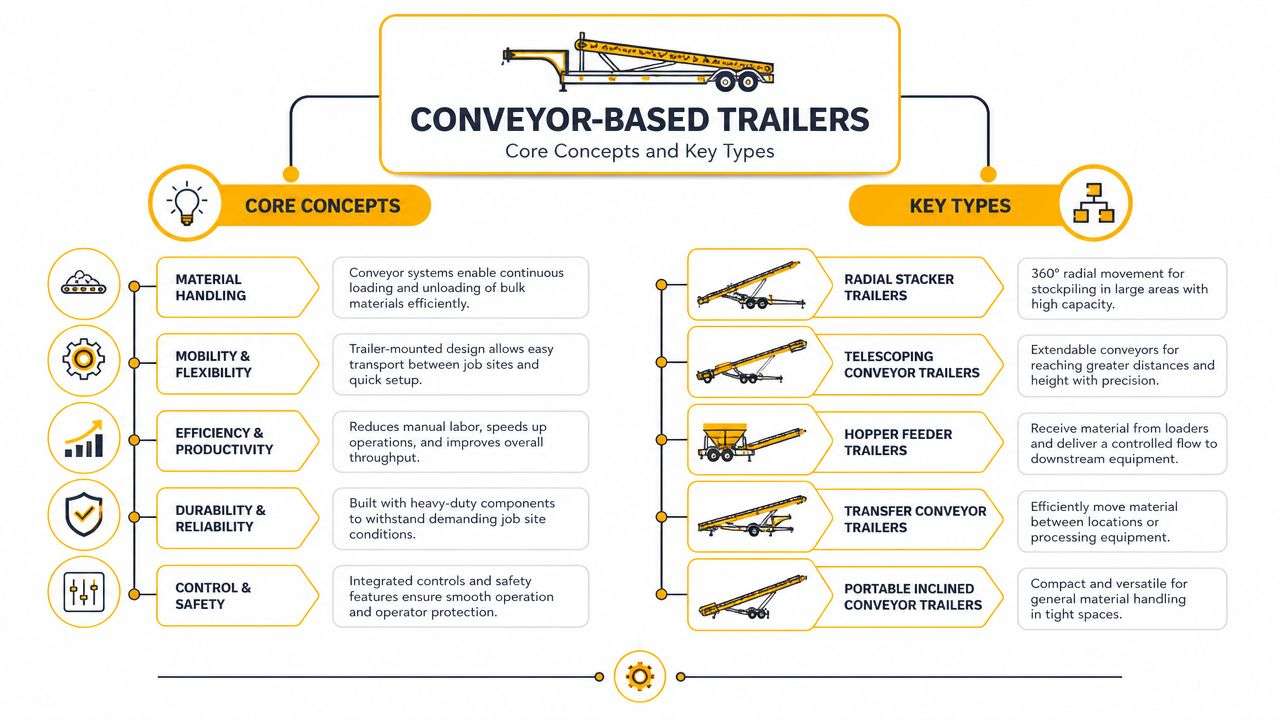
A conveyor-based trailer looks straightforward until a crew has to load, move, and place mixed material without making a mess. It shifts bulk material with a powered conveying surface instead of relying on a full-body tip. That difference changes how the trailer behaves on the ground, how much cleanup follows the unload, and how much time gets burned fixing spills that never should have happened.
The main trailer families
Walking-conveyor or live-bottom trailers use slats or a moving floor to feed material rearward in a steady stream. They fit dense, sticky, or uneven loads that do not release cleanly from a raised body, such as aggregate, asphalt-related material, or wet organics. The value is controlled discharge, not a dramatic dump angle, and that matters when the crew needs the load to come out in a predictable line.
Belt conveyor trailers use a continuous belt driven by motors. A belt conveyor is a common bulk-material-handling setup that moves material continuously across a fixed path, as outlined in an industry belt-conveyor technical sheet. That arrangement suits crews that want a smooth, metered transfer instead of a single release event at the tail end.
Some units also use a hopper with a powered conveyor. That setup works when the load needs to be captured, fed, and discharged in a controlled way, especially where loose material can bridge, spill, or surge if it is dumped all at once. On the jobsite, the value is not the label on the trailer. It is whether the material keeps moving at the pace your crew can place.
Drop-deck integrations combine a lower deck height with conveyor-based unloading or equipment-handling geometry. They matter when loading height, clearance, or machine access affects the work as much as the discharge pattern does. A lower deck can also make positioning easier in tight areas where a taller setup creates more problems than it solves.
How to match the type to the haul
Match the trailer to the way the material behaves. Use live-bottom units for loads that need steady discharge. Use hopper conveyor setups for loose material that benefits from being metered out of a hopper. Use drop-deck configurations when access and load height are part of the job. That keeps the choice tied to actual site conditions instead of buying a feature that sounds useful but sits idle.
ANTS Trailers frames its conveyor belt trailers from ANTS Trailers around that same practical decision, since the key question is how well the trailer controls discharge, handles carryback, and limits maintenance time after dirty loads. For a fleet supervisor, those thresholds matter as much as capacity. A trailer that leaves material hanging in the system, or needs constant cleanup around the moving parts, costs time every day it runs.
Specifications and Performance Numbers Buyers Should Evaluate
Specs are where trailer buying gets honest. A brochure can promise smooth unloading all day, but a real jobsite cares about line speed, drive power, angle limits, and whether the load stays contained when the crew is moving fast. I look at conveyor-based equipment as a controlled transfer system, not just a trailer with a moving floor.
The numbers that govern discharge
Published conveyor specifications show common belt speeds of 10–30 m/min, power options from 1.1 kW to 3.7 kW, and loading-app targets around 1,800 pieces/hour truck loading conveyor specification sheet. At the industrial end, conveyor systems can be engineered up to 850 tons per hour, with belt widths up to 48 inches and incline angles of 18 degrees and 19 degrees in specific configurations Genemco conveyor specification sheet. Those figures matter because they show how line speed, power, and belt width shape throughput.
For trailer buyers, the practical takeaway is simple. Faster line speed is not always better if the material is wet or irregular, because the flow still has to stay stable. More power helps, but only if the rest of the discharge system keeps up.
A trailer that moves material too fast for the load type does not look efficient for long, it looks messy.
The angle and loading limits most buyers skip
The most under-discussed design variable is operating angle. Conveyor-engineering guidance says capacity depends on material density, trough angle, belt speed, surcharge angle, and load cross-section, and it notes that conveyor loading should generally not exceed 75% to reduce spillage PPI conveyor-engineering guide. The same guidance says belt sag should stay within 3% under normal load and 4.5% when standing still PPI conveyor-engineering guide.
| Trailer Conveyor Specs Buyers Should Compare | Typical Range | Why It Matters |
|---|---|---|
| Belt speed | 10–30 m/min | Governs how quickly material leaves the trailer truck loading conveyor specification sheet |
| Drive power | 1.1 kW to 3.7 kW | Shapes how well the system handles dense or sticky loads truck loading conveyor specification sheet |
| Throughput target | Around 1,800 pieces/hour | Helps compare cycle time in loading applications truck loading conveyor specification sheet |
| Belt width | Up to 48 inches | Wider belts support higher-volume transfer Genemco conveyor specification sheet |
| Incline angle | 18 degrees and 19 degrees in specific configs | Shows the practical slope limits of conveyor equipment Genemco conveyor specification sheet |
| Load fill | No more than 75% | Reduces spillage and unstable carry conditions PPI conveyor-engineering guide |
| Belt sag | 3% normal, 4.5% standing still | Indicates whether the system is being held within normal engineering limits PPI conveyor-engineering guide |
Those numbers only help if the trailer keeps discharge controlled in the field. For buyers comparing published trailer specs, the conveyor belt dump truck overview keeps the focus on controlled discharge instead of generic dump-trailer language. On mixed-material jobs, that difference shows up in carryback, cleanup time, and how often the crew has to stop and clear buildup before the next load.
Matching ANTS Models to the Haul You Actually Run
A trailer only earns its place on a site if it matches the material that moves day after day. A crew hauling mixed aggregate, wet spoil, or finished material has different needs than a crew moving enclosed cargo or equipment. ANTS Trailers' lineup makes that distinction clear, because each configuration solves a different jobsite problem instead of forcing one bed style to do everything.
Live bottom for controlled material transfer
The 14/16 Live Bottom model uses a walking conveyor floor and can kneel and tilt to adapt to terrain and simplify loading and unloading, as shown in the ANTS gravel-trailer brochure. That setup fits jobs where the trailer needs to stay level while material comes out, especially on uneven ground or in places where tipping would be awkward or risky.
For mixed-material work, that matters more than raw capacity. If the load has to come out cleanly into a spreader, a pile, or a narrow work zone, a live-bottom system gives the operator more control than a conventional raise-and-dump sequence. It also cuts out the extra maneuvering that can waste time when the site is cramped.
For buyers who want to compare that discharge style with other trailer layouts, the live bottom trailers for sale page is the simplest place to look at how the configuration is presented in ANTS' own lineup.
Drop decks for cargo and equipment
The 7/12X Drop Deck solves a different problem. It has a 2,660 lb empty weight, a 5,340 lb load capacity, and an enclosed bed measuring 70.5 inches wide by 13 ft 4 in long. Those numbers matter when you are matching a trailer to a truck and deciding whether the bed protects cargo the way you need it to.
The 14/20X Drop Deck is the heavier equipment option, with 3 degrees on the bed and 9 degrees on the ramp. That low-angle geometry matters in tight yards because it makes loading feel more controlled and less like a compromise.
The ANTS live bottom model also uses a convey belt trailer bed function that ordinary flat-deck trailers do not have, and that is the separation point. One trailer is built to move bulk material with a conveyor-style floor, another is built to contain cargo, and another is built to handle equipment with a lower approach angle.
Applications Across Construction, Landscaping, Forestry, and Public Works
A trailer only earns its keep when it matches the way crews move material. Different jobs put different stress on the equipment, and the wrong unloading method turns into cleanup, delays, or both. Conveyor-based trailers do not solve every hauling problem, but they do handle a lot of the ones that show up in the four sectors ANTS Trailers serves.
Where the trailer type changes the outcome
Construction crews use conveyor-bed trailers for aggregate, base material, and asphalt-related work when a tipped body would block traffic or force awkward positioning. Controlled discharge keeps material where the crew wants it, especially in tight urban lanes and staged work zones.
Landscaping and earthworks teams move mulch, topsoil, and stone with live-bottom beds because the trailer can meter discharge into spreaders, small equipment, or hand-worked piles. Wet material is where this pays off most, since a sudden dump often creates more grading work than it saves time.
Forestry and logging operations need a different setup again. Hopper-conveyor trailers make sense for chips, biomass, and similar loose material because the load can be captured and fed without depending on a high lift angle. That matters when the site is uneven or the turnaround space is limited.
Public works and municipal crews often need controlled discharge for salt, sand, or patch material. Low deck height and measured flow help keep road crews safer during winter work, especially on narrow routes where a tip-up trailer would be awkward to position.
The point is not that one trailer covers all four sectors. Each sector has a different tolerance for spillage, clearance, and load stability, and those trade-offs shape the ownership cost just as much as the price tag.
Field rule: if the site changes by the hour, the discharge method has to be forgiving enough to keep up.
ANTS Trailers also shows how this category extends beyond one job type. A brochure for an aluminum hopper conveyor ag trailer points to the same basic operating logic in an agricultural setup, which makes the category easier to recognize as a real working tool rather than a narrow specialty Trail King aluminum hopper conveyor ag trailer brochure.
Safety and Maintenance Questions Most Buyers Forget to Ask
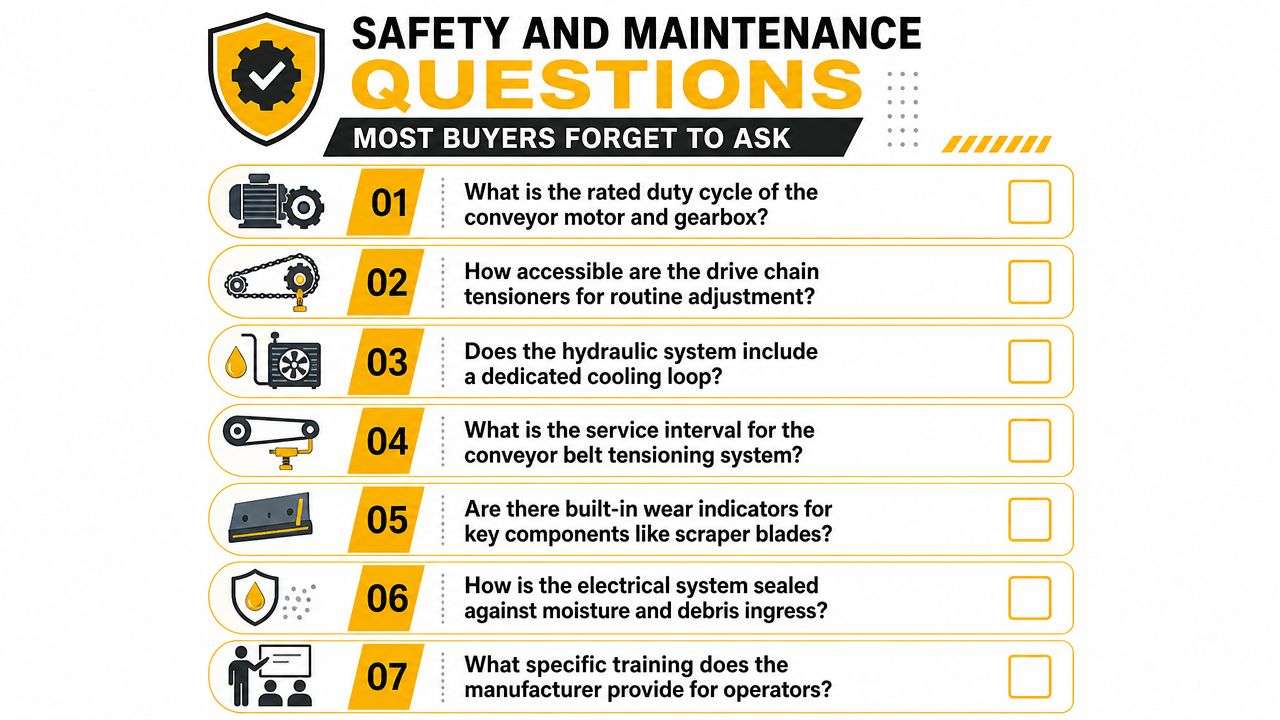
A trailer can look safe on the lot and still cost the most to own if it leaves residue everywhere, needs constant cleanup, or takes too long to inspect. A conveyor trailer lowers that risk because it unloads while staying horizontal, which reduces rollover exposure compared with tip-style discharge since the bed never has to be raised. In live-bottom designs, the moving floor also gives the operator controlled discharge without the instability that comes with a raised dump.
The questions that predict downtime
Once the safety question is settled, maintenance becomes the next filter. Conveyor troubleshooting guidance puts a lot of weight on belt cleaners, skirt boards, apron seals, tighter idler spacing, and slider beds because those parts help reduce carryback and spillage. It also points out that overloaded belts are a common source of material loss conveyor troubleshooting guidance.
That matters more than many buyers expect. If you are hauling abrasive aggregate, sticky clay, wet compost, or salted road material, carryback turns into road debris, cleanup time, and extra wear. The buying question is not whether the trailer can unload on day one, it is what the belt, seals, and cleanup points look like after a full season.
Ask what happens after the first winter, not just what happens on the demo day.
A good buyer should press for answers on a few practical points:
- Belt cleaning access: Can the crew reach the cleaners and scrape points without taking half the trailer apart?
- Carryback control: Which parts handle wet or abrasive residue before it ends up on the road?
- Inspection rhythm: What gets checked daily, and what gets checked after mixed-material use?
- Spillage management: How does the design keep the load under control when the material changes from dry stone to wet organics?
- Wear-path visibility: Can the operator see the parts that usually fail first?
Those questions do not sound flashy, but they tell you whether the trailer will stay useful or turn into a maintenance project. A buyer who also wants to browse depreciation calculation methods should still judge the trailer on downtime, cleanup, and wear, because those costs show up long before the accounting schedule does.
ANTS Trailers also fits into that same maintenance conversation. The live-bottom engineering explanation shows why horizontal discharge matters when the site is tight, the load is variable, and the crew cannot afford a messy unload.
Cost, ROI, and Financing for a Conveyor Trailer Purchase
A conveyor trailer should be judged on how many headaches it removes, not just on sticker price. Controlled discharge keeps paid material on the job where it belongs, and that alone changes the cost picture when crews are moving aggregate, mulch, salt, or patch material every week. Horizontal unloading also cuts the delay that comes with maneuvering a raised dump body into a tight site.
Where the return shows up first
The first savings usually show up in labor and cleanup. If the discharge stays controlled, the crew spends less time rehandling piles, sweeping roads, or correcting spills around curbs and drives. If the trailer can kneel and tilt for loading or terrain changes, the operator spends less time fighting the site and more time moving material.
There's also the avoided cost side. A better unloading geometry lowers the chance of tip-over incidents, overhead interference, and the mess that follows unstable dumping. That's not an abstract benefit, it's a direct operating risk that fleets try to eliminate long before it turns into a claim.
If you're comparing ownership methods, it's smart to think through depreciation alongside cash flow planning. A practical place to start is to browse depreciation calculation methods so the purchase gets framed in accounting terms, not just in shop-floor opinion.
ANTS Trailers also works with manufacturer-direct support for parts and troubleshooting, and financing through partners like Ascentium Capital is part of the buying structure for working contractors. That matters because a trailer that fits the route but strains the cash cycle can still be the wrong buy.
Choosing the Right Material Conveyor Trailer for Your Jobsite
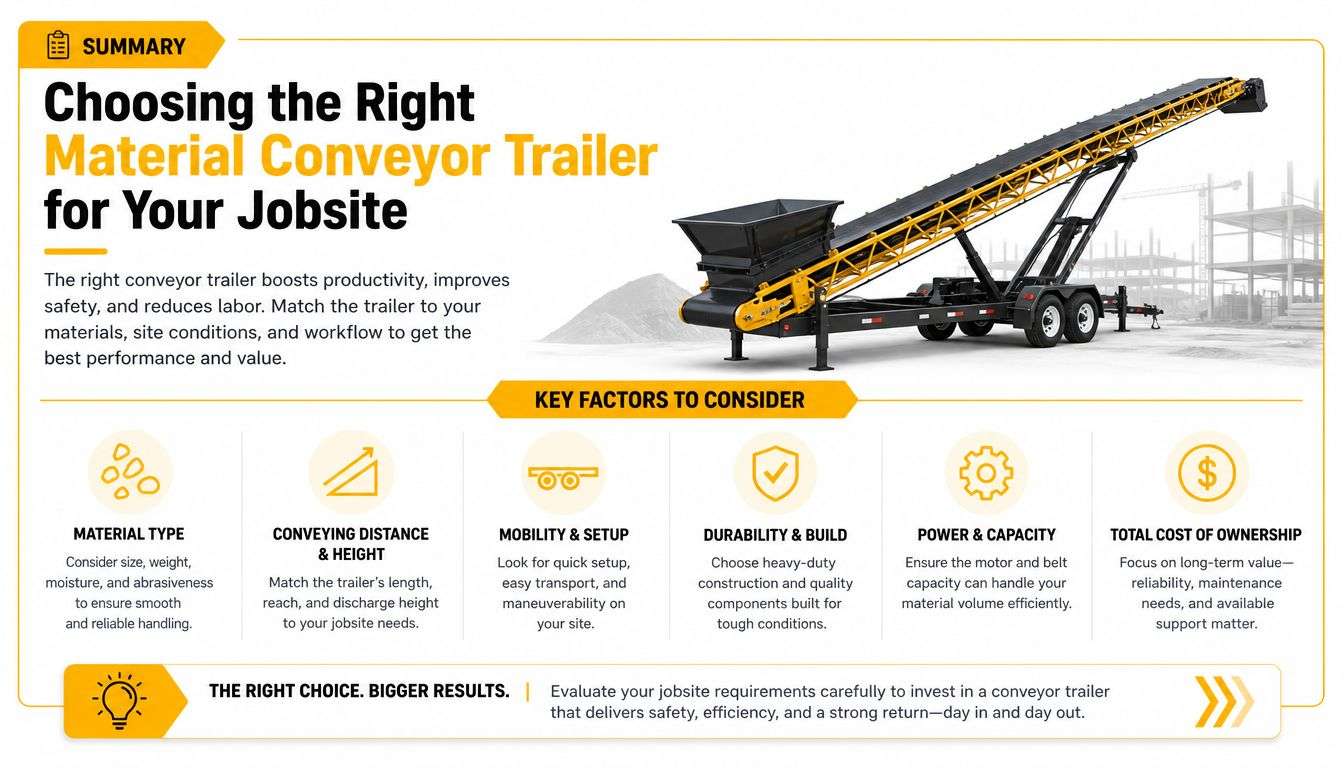
Start with the material, not the paint color or the headline capacity. If the dominant haul is bulk material that needs controlled discharge, a live-bottom or hopper-based setup makes more sense. If your main job is equipment or enclosed cargo, a drop-deck format is the better fit. If the site is tight, the operating angle and unloading method matter as much as payload.
A short buying checklist that keeps you honest
- Match bed type to material. Dense, sticky, or spill-prone loads usually need controlled transfer, not a raised dump.
- Check the tightest site first. If the worst jobsite can't handle the unloading method, the trailer isn't right.
- Verify weight and capacity against the truck. The trailer has to make sense with the tow vehicle, not just on paper.
- Look at loading ergonomics. Kneeling, tilting, and low deck height can save time and reduce strain.
- Ask about maintenance access. A trailer with easy service points usually stays in rotation longer.
- Confirm support and parts flow. A U.S.-built trailer with direct support is easier to keep working.
- Check the cash plan. If financing is part of the purchase, make sure it fits the season and the project cycle.
ANTS Trailers is one option that fits that checklist because the trailers are made in Baraga, Michigan, built for durability and versatility, and include features like the convey belt trailer bed on the live bottom model plus the ability to lower or raise the trailer for varied terrain. If your project timing is tight, it also helps to understand how equipment payments affect working capital, so it's worth reviewing a resource on how to speed up project cash flow before you lock in the purchase structure.
For a real-world decision, shortlist two or three configurations, ask for spec sheets from a manufacturer-direct rep, and put the trailer on a live shift before you sign. That's the fastest way to see whether the discharge stays clean, the loading stays calm, and the trailer fits the way your crew works.
A CTA for ANTS Trailers.