
82% of small businesses use some form of financing to acquire equipment, making equipment financing for small business a mainstream strategy rather than a niche option. The right structure can preserve working capital while putting revenue-producing trailers, machinery, and vehicles to work before the business has paid for them in full.
That distinction matters on a real jobsite. A contractor may need a trailer today, but still has payroll, fuel, insurance, repairs, materials, and slow customer payments to manage. Paying cash can leave the company asset-rich and operationally tight. Financing can solve that problem, but only if the payment schedule, total acquisition cost, tax position, and equipment uptime all fit the way the business earns money.
Table of Contents
- The Mainstream Reality of Equipment Finance
- Comparing Loan Lease and Line Options
- Understanding Eligibility and Underwriting
- Navigating the Application Process
- Real World ROI and Cost Comparisons
- Strategies for Negotiation and Terms
- Leveraging Tax Benefits and Deductions
- Conclusion and Next Steps
The Mainstream Reality of Equipment Finance
A small landscaping company that buys a productive trailer isn't making an unusual financing decision. It's using the same basic playbook as thousands of other operators, keep cash available for operations while acquiring an asset that can support billable work.
The ELFA small business equipment finance fact sheet reports that 82% of small businesses used at least one form of financing to acquire equipment. Leasing was the most common method at 26%, followed by secured loans at 16% and lines of credit at 14%. Trucks and trailers also rank among the top 10 small-ticket equipment categories financed, which directly connects this market to contractors, and other mobile-work businesses.
The practical lesson is simple. Equipment finance isn't a last resort for a struggling startup. It's a way to avoid tying up operating cash in an asset that may take time to generate its return. The same ELFA source reports that small business commercial and industrial lending fell 9% year over year in Q2 2024, while outstanding loan balances still rose 4.3% year over year. Demand can remain meaningful even as lenders become more selective.
Why working capital comes first
Cash pays for more than equipment. It covers the gap between completing a project and collecting the invoice, keeps crews moving during weather delays, and absorbs unexpected repairs. A financed asset should therefore produce enough operational value to justify its recurring payment without leaving the company unable to handle normal volatility.
For trailer buyers, start with the work the asset will perform, not the monthly payment advertised on a quote. Review equipment hauling trailers alongside your expected loads, towing setup, storage needs, and service requirements. A lower purchase price can be a poor bargain if loading takes longer, the trailer sits idle, or downtime forces you to rent replacement capacity.
Comparing Loan Lease and Line Options
The three common structures solve different problems. An equipment loan is designed for ownership, a lease prioritizes use and payment flexibility, and a line of credit provides reusable access to capital. The correct choice depends on how long you'll use the asset, how predictable revenue is, and whether the business needs the equipment itself or broader liquidity.
| Feature | Equipment Loan | Equipment Lease | Line of Credit |
|---|---|---|---|
| Ownership | The business generally owns the equipment after repayment | The business uses the equipment and may return, renew, or purchase it depending on the contract | Ownership depends on what the draw purchases |
| Collateral | The equipment commonly secures the financing | The leased asset supports the lessor's position | May require business assets, a guarantee, or other support |
| Cash flow impact | Predictable scheduled payments, often matched to useful life | May reduce upfront cash needs and can offer lower scheduled payments | Interest applies to the amount drawn, giving flexibility |
| Tax treatment | Purchased assets may qualify for depreciation deductions, subject to tax rules | Lease payments may be deductible depending on the contract structure | Treatment depends on the use of borrowed funds |
| End of term | Ownership remains with the business | Return, renewal, or buyout terms control the outcome | The facility may remain available after repayment, subject to lender terms |
| Best fit | Durable equipment used for many years | Assets that may become outdated or may not be needed permanently | Uneven needs, multiple purchases, or mixed working-capital demands |
An equipment loan usually makes sense when the trailer or machine has a long useful life and ownership matters. A lease can protect liquidity when preserving cash is more important than building equity, but read the end-of-term and early-termination language carefully. A line of credit can be useful when needs arrive in stages, although using a flexible facility for a long-lived asset can make repayment discipline harder.
Rates deserve context. U.S. Bank's equipment financing guidance places benchmark APRs at roughly 4% to 15% for well-qualified borrowers using banks or SBA lenders, and about 6% to 45% for online or specialized lenders. Terms commonly run 2 to 7 years, while some structures offer zero-down financing over 24 to 60 months with origination fees.
Practical rule: Compare APR, fees, payment timing, ownership, and total repayment. A low headline rate doesn't compensate for a payment schedule that clashes with your slow season.
Before choosing, model the asset's useful life against the finance term. You don't want the debt to outlast the period in which the equipment reliably earns revenue. Review trailer financing options with that full-cost question in mind, rather than treating the monthly figure as the decision.
Understanding Eligibility and Underwriting
Lenders assess repayment risk, not just the owner's credit score. The equipment may serve as collateral, but the lender still needs confidence that the business can make payments through ordinary slowdowns, maintenance events, and seasonal revenue gaps.
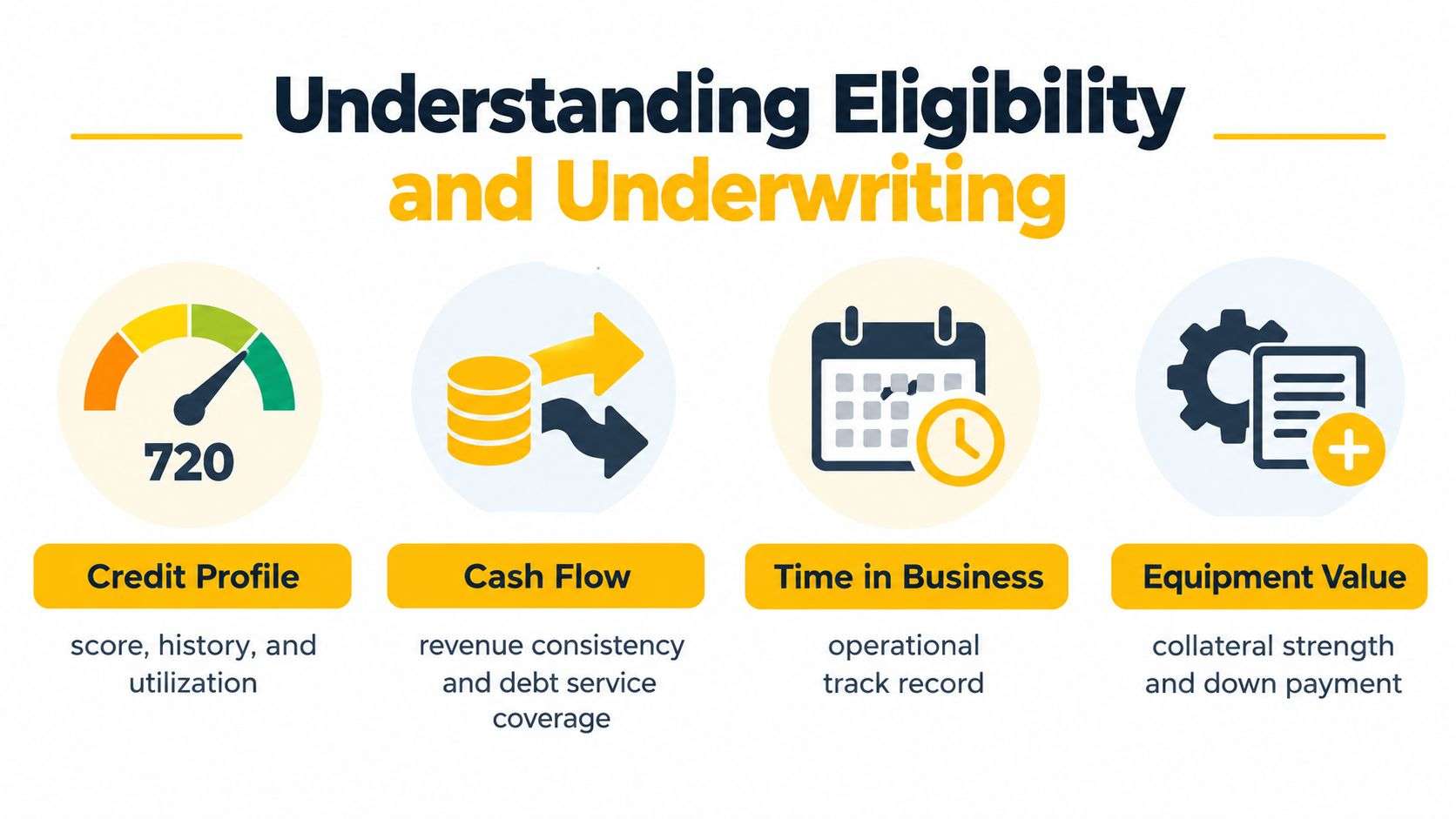
Four areas lenders examine
- Credit profile: Review personal and business credit history, existing utilization, payment records, and any unresolved issues before applying. Credit quality affects approval confidence and pricing.
- Cash flow: Show how revenue arrives across the year, not just the strongest months. Bank statements, income statements, debt obligations, and accounts receivable help the lender judge debt-service capacity.
- Time in business: A longer operating history gives the lender more evidence to evaluate. Newer businesses may need stronger guarantees, more documentation, or a larger equity contribution.
- Equipment value: The asset's condition, resale market, useful life, and purchase documentation affect collateral strength. A lender may also consider whether the requested term matches the equipment's expected service period.
Seasonality shouldn't be hidden. If winter reduces landscaping revenue or project billing fluctuates, annotate the financial statements and explain the pattern. Pair the explanation with signed contracts, recurring customers, backlog information, or a cash reserve plan where available.
The request should also account for existing debt. A business may be profitable on paper and still struggle if several payments fall due during the same low-revenue period. Underwriting works better when the owner presents a complete obligation schedule and a realistic payment calendar instead of submitting only the most favorable month.
Navigating the Application Process
Preparation removes much of the friction from equipment financing. Lenders need to verify the borrower, understand the business, and confirm exactly what the financing will purchase. Missing documents create delays and can make a straightforward request look disorganized.
Build a clean application file
Gather documents first. Assemble recent financial statements, business and personal tax returns, bank statements, ownership details, existing debt information, and the equipment quote. Include delivery, taxes, licensing, installation, and other charges if you want them considered in the request.
Seek prequalification where available. Ask whether the initial review uses a soft credit inquiry and request an outline of likely terms. This gives you a basis for comparison without immediately committing to a full application.
Submit precise equipment details. Provide the seller, model, condition, purchase price, intended use, and expected delivery date. For a trailer, explain the loads, towing vehicle, operating territory, and the work it supports.
Answer underwriting questions directly. Expect questions about revenue fluctuations, existing loans, personal guarantees, insurance, and the reason for the purchase. A short, documented explanation is stronger than a vague assurance that business will improve.
Review final documents before signing. Confirm APR, payment frequency, term, down payment, origination fee, collateral language, personal guarantee, prepayment terms, and funding conditions. Then coordinate the finance closing with the seller and delivery schedule.
Don't let urgency push you into signing an incomplete deal. A trailer that arrives before the next project is useful only if the business can carry the payment during the months when that project pipeline slows.
Real World ROI and Cost Comparisons
A useful comparison needs more than a purchase price. It should show the cash required on day one, the recurring payment, total repayment, added revenue, and the cost of keeping the asset available for work.
The supplied illustration uses a $25,000 cash purchase compared with $0 down financing, a $480 monthly payment over 60 months at 7.5% APR, and a financed total cost of $28,800. The cash purchase totals $25,000, so the difference between the two stated outlays is $3,800. Those figures are an example for decision-making, not a quote, and actual terms depend on credit, lender, asset, fees, and contract structure.
Put revenue beside the payment
The same illustration uses added monthly revenue of $900. Against a $480 monthly payment, the remaining monthly contribution before operating expenses, insurance, maintenance, taxes, and downtime is $420. That is not profit by itself. It becomes useful only after you subtract the costs required to produce the added work.
A better field calculation looks like this:
- Added billable revenue: Work the trailer makes possible.
- Direct operating costs: Fuel, labor, maintenance, storage, and job-specific expenses.
- Debt service: The scheduled finance payment and any related charges.
- Uptime reserve: Cash set aside for repairs, replacement rentals, and delays.
- Contribution: Revenue remaining after those costs.
A trailer that generates work every month may support financing more comfortably than one that earns heavily during a short season and sits idle afterward. For the latter, ask for payment timing that matches collections, or preserve a reserve large enough to carry the debt through idle periods.
Ownership also includes risk transfer. Review insurance solutions for plant and equipment owners when assessing coverage for theft, damage, liability, and business interruption. Insurance doesn't make a weak purchase profitable, but an uninsured loss can turn a manageable financing decision into a serious balance-sheet problem.
ANTS Trailers are made in the USA and are described as high-quality, durable, and versatile, with functions including a conveyor-belt trailer bed on the live bottom model and the ability to lower or raise the trailer. Those operating features should be evaluated against loading time, terrain, crew safety, and utilization, not just the sticker price. Businesses comparing models can review commercial utility trailer sales as part of that asset-selection process.
Strategies for Negotiation and Terms
The first financing offer is a starting point. A lender prices the request based on risk, but you can improve the conversation by presenting a complete file and comparing equivalent structures.
Request written offers that show the same purchase price, down payment, term, payment frequency, APR, fees, and total repayment. Without that consistency, one quote can look cheaper because it excludes an origination charge or places costs outside the advertised rate.
Negotiate the parts that affect real cash flow
- Ask about down payment flexibility. A lower upfront contribution preserves cash, but it may increase the payment or total interest. Compare both outcomes against your seasonal reserve.
- Price every fee. Origination fees, documentation charges, insurance requirements, and prepayment conditions can change the effective cost.
- Match payment timing to collections. Monthly payments may suit steady service work, while a seasonal operator may need a structure that doesn't create a cash squeeze during inactive months.
- Use a competing quote carefully. Show another written offer and ask whether the lender can improve the APR, fees, term, or structure. Don't compare a secured loan with a more expensive unsecured product as if they were identical.
- Clarify guarantees and collateral. Understand whether the equipment alone secures the deal or whether the owner must provide a personal guarantee or additional business assets.
Manufacturer-direct programs can also simplify coordination between the seller and financing provider. That convenience is valuable when delivery, setup, licensing, freight, or other soft costs need to be included. It still doesn't replace independent review of APR, total repayment, ownership terms, and the consequences of early payoff.
Leveraging Tax Benefits and Deductions
Tax treatment can materially change the after-tax cost of an equipment purchase, but it shouldn't be used to justify equipment the business can't support operationally. Section 179 is particularly relevant because qualifying equipment can generally be deducted in the year it's placed in service instead of depreciated over multiple years.
For 2026, the maximum Section 179 deduction is $2,560,000, and the phase-out threshold begins at $4,090,000 of qualifying purchases, according to this Section 179 equipment financing explanation. Many small and midsize operators can therefore pair financing with an immediate tax deduction, subject to eligibility, taxable income, placed-in-service requirements, and current tax rules.
Think in after-tax cash flow
The deduction doesn't erase the loan balance. It may reduce taxable income, which can improve the timing of cash retained by the business. Your actual benefit depends on the company's tax position, entity structure, qualifying use, and whether it has enough taxable income to use the deduction.
Before signing, ask your tax professional to review:
- Placed-in-service timing: The equipment generally must be ready and available for business use in the relevant tax year.
- Business use: Personal or mixed use can affect qualification and the deductible portion.
- Financing structure: Ownership, lease classification, interest, and depreciation treatment can differ by contract.
- Purchase scope: Determine whether eligible equipment includes associated costs and how freight, installation, or modifications should be treated.
- Cash-flow timing: A tax benefit may arrive later than the payment obligation, so don't spend the expected savings before confirming the filing and payment schedule.
A tax deduction is one part of the acquisition model. Compare the expected after-tax cost with utilization, maintenance, insurance, resale value, and downtime. The strongest deal is the one the business can carry before the deduction arrives and still benefit from after the asset is working.
Conclusion and Next Steps
Equipment financing works best when the asset has a clear job, the payment follows the revenue pattern, and the contract reflects the full cost of getting that asset productive. Small businesses already use financing widely, and the decision is less about avoiding debt than about choosing debt that protects operating liquidity without outlasting the equipment's useful life.
Before applying, check your credit profile, organize financial statements and tax returns, map seasonal cash flow, and request a complete equipment quote. Compare loan, lease, and line structures using APR, fees, ownership, tax treatment, payment timing, and uptime risk. Then have a tax professional review Section 179 eligibility before you rely on the deduction in your cash plan.
A durable trailer can support growth, but only when the business can keep it working and keep the payments current. Treat financing as an operating decision, not just a lending decision.
ANTS Trailers offers premium work trailers made in the USA, including live bottom and drop deck configurations with durable, versatile designs and specialized functions such as a conveyor-belt trailer bed and the ability to lower or raise the trailer. Review your equipment needs and financing options, then visit ANTS Trailers to explore models that fit your jobsites.