
A contractor is looking at a trailer quote, a strong upcoming backlog, and a bank balance that still has to cover payroll, fuel, insurance, and repairs. Paying cash may avoid interest, but it can also tie up working capital. Financing preserves liquidity, yet a payment that looks manageable on paper can become uncomfortable during a slow month. An equipment financing calculator helps translate that purchase into a cash-flow decision before an application or deposit is made.
The useful question isn't, “What will the monthly payment be?” It's, “What structure can this business qualify for, carry through its slow periods, and justify after operating costs are included?”
Table of Contents
- Why an Equipment Financing Calculator Matters Before You Buy
- What to Enter in the Calculator and Why Each Input Changes Your Payment
- How the Payment Math Works With a Worked Example for ANTS Trailers
- Loan vs Lease vs Balloon Payments Compared on the Same Trailer
- Common Gotchas That Make Calculator Estimates Misleading
- Tips to Get Favorable Terms and Move From Estimate to Approval
Why an Equipment Financing Calculator Matters Before You Buy
A trailer is a productive asset, but it still competes with every other use of company cash. A landscaping business may need the trailer for material hauling, while a contractor may need it to move equipment between jobsites. In either case, the purchase has to fit the operating budget, not just the equipment quote.
Equipment financing calculators are widely used because many businesses finance machinery rather than paying cash. One equipment-finance source estimates that around 79% of American businesses finance equipment purchases, while the U.S. equipment finance market reached about $1.02 trillion in new business volume in 2025. Those figures show the scale of the borrowing decisions these tools help model, not a reason to choose debt automatically. The equipment financing calculator guidance from EquipRates explains how these tools turn equipment price, rate, term, down payment, and amortization into payment estimates.
Use the calculator before the lender conversation
Suppose a contractor is considering a durable, versatile trailer made in the USA by ANTS Trailers and is deciding between a large down payment and keeping more cash available for jobs. The calculator can show how each choice affects debt service. It can also reveal whether a longer term creates needed breathing room or increases the total cost beyond what the asset's revenue can support.
That makes the calculator a cash-flow translator. It converts a capital expenditure into predictable debt service, allowing a buyer to compare cash, loan, lease, and balloon structures before committing to a configuration or financing application.
Practical rule: If you only enter the purchase price and accept the first payment result, you're estimating arithmetic, not affordability.
Small changes can alter the decision
Term length, down payment, interest rate, payment frequency, and residual value each change the schedule. A residual or balloon structure can reduce periodic payments while leaving a final amount due. A longer term can make the regular payment easier to carry, but the buyer may pay more interest over the life of the agreement.
The calculator also helps different buyers ask better questions. A fleet manager can compare several trailers on the same cash-flow basis. A public works department can test a structure against capital-approval rules. A dealer can show a customer how a payment changes when the customer adjusts the down payment instead of discussing an unexplained monthly figure.
For broader planning around debt, savings, and business cash flow, The Money Maniac tool page can serve as a useful adjacent resource. Keep the equipment calculator focused on the specific asset and financing structure, then review the result alongside the rest of the company budget.

What to Enter in the Calculator and Why Each Input Changes Your Payment
The quality of the result depends on the quality of the inputs. Enter the fields in the same order you'll encounter them, but don't treat any field as a formality.
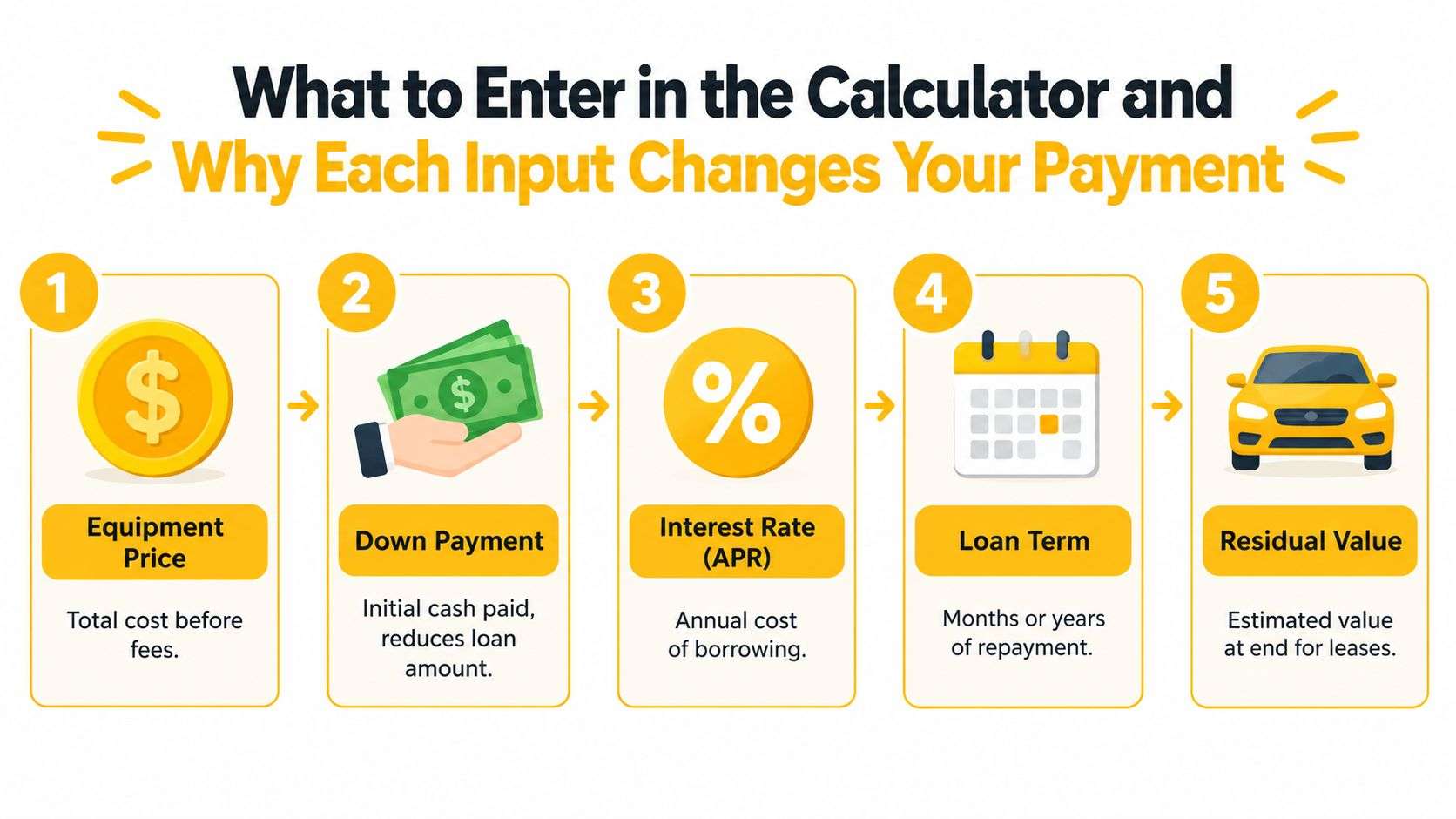
Start with the equipment price
Use the actual configuration under consideration, not a rough base price. Include the trailer and the equipment options that will be financed, then identify taxes, documentation charges, delivery, installation, and other costs separately if the calculator has no dedicated fields for them.
A lower equipment price reduces the amount financed and generally reduces both the periodic payment and total interest. Comparing different configurations without keeping the equipment specification consistent can produce a payment comparison that looks precise but isn't useful.
Enter the down payment
The down payment is the cash paid at the beginning. The financed amount equals the equipment cost minus that down payment, so increasing the down payment reduces the principal used in the amortization calculation.
Some recent equipment-finance calculator guidance places typical down payments in a range of 10% to 30%, with the actual requirement depending on the borrower, lender, asset, and deal structure. Equipment Calculators' construction-finance guidance emphasizes that down payment, credit quality, equipment age, resale strength, and other underwriting factors affect qualification.
Add the interest rate
Use the quoted rate from the lender, and confirm whether it's a nominal interest rate or an APR that includes fees. A calculator can model a clean rate, but it can't correct an input that doesn't match the lender's actual offer.
Rate ranges can vary widely. The same guidance cites roughly 6% to 18%+ APR bands depending on borrower quality and lender type, with wider spreads for newer businesses or weaker credit. Treat a single attractive rate as one scenario, not a promise.
Set the term and amortization type
The term controls how many payments you'll make. A longer term usually reduces the periodic payment because repayment is spread across more periods, but it can increase total interest and extend the obligation beyond the period when the trailer is generating its strongest returns.
Choose the amortization type supplied by the quote. Standard amortization applies scheduled principal and interest payments. Some structures include residual or balloon values, which change how much principal is paid during the regular schedule.
Select payment frequency
Many calculators support monthly, quarterly, semiannual, and annual payment schedules, and some allow users to enter the amortization type. FCSAmerica's equipment payment calculator resource illustrates why frequency matters for businesses whose revenue arrives seasonally or follows project milestones.
Match the schedule to cash generation where possible. A monthly payment may fit steady billing, while a less frequent schedule may require careful reserves before a large payment comes due.
Add residual or balloon value
A residual or balloon value represents an amount left for the end of the agreement. It can lower regular payments because the entire balance isn't amortized through the scheduled installments, but the final amount still needs a clear exit plan.
That plan might involve cash, refinancing, selling the equipment, or exercising a purchase option, depending on the contract. Never compare a balloon payment with a fully amortizing loan by looking only at the regular payment.
How the Payment Math Works With a Worked Example for ANTS Trailers
Most equipment-financing calculators use standard amortization math. The basic inputs are straightforward:
- Financed amount: Equipment cost minus down payment.
- Periodic rate: For monthly payments, the nominal annual rate divided by 12.
- Number of payments: The term multiplied by the number of payment periods per year.
- Payment: The principal, periodic rate, and number of payments run through the fixed-payment amortization formula.
For a standard loan, the formula is commonly written as:
M = P × [r(1 + r)^n] / [(1 + r)^n − 1]
Here, P is the financed principal, r is the periodic interest rate, and n is the number of payments. The calculator performs the repetitive math, but understanding the inputs helps you catch a wrong frequency, an omitted down payment, or a residual entered in the wrong field.
A transparent reference calculation
A published equipment-finance example uses a $60,000 loan, 0.625% monthly interest, and 60 months. The resulting payment is about $1,203 per month, with approximately $12,180 in total interest. The published amortization example provides the reference figures.
That example isn't a quote for a particular trailer. It's a way to verify that a calculator is applying standard amortization correctly. If your result differs, check whether the tool uses fees, a different payment frequency, a residual, or a different definition of rate.
Apply the method to trailer planning
For an ANTS Trailers configuration, enter the actual quoted equipment price, the proposed down payment, the lender's rate, and the repayment term. The 14/16 Live Bottom uses a walking-conveyor floor and can kneel and tilt, which may matter operationally when loading or unloading on uneven terrain. Those product functions don't change the amortization formula, but they can change the revenue opportunity and operating usefulness behind the financing decision.
The 7/12X Drop Deck has an empty weight of 2,660 lb and a load capacity of 5,340 lb, so the buyer should also confirm that the intended payload and towing setup match the operational plan before evaluating the payment. ANTS Trailers' heavy-duty flatbed trailer information provides the relevant product context.
| Scenario | Financed Amount | Rate and Term | Monthly Payment | Total Interest |
|---|---|---|---|---|
| Published amortization reference | $60,000 | 0.625% monthly, 60 months | About $1,203 | About $12,180 |
| ANTS trailer quote, standard loan | Enter quoted amount minus down payment | Enter lender quote and term | Calculator output | Calculator output |
| ANTS trailer quote, residual structure | Enter quoted amount minus down payment | Enter lender quote, term, and residual | Lower periodic output may result | Depends on contract and final amount |
A residual doesn't make the equipment cheaper. It changes when the principal is paid. Likewise, quarterly or annual payments don't eliminate the obligation. They change the timing, which can help or hurt depending on when customer receipts arrive.
Loan vs Lease vs Balloon Payments Compared on the Same Trailer
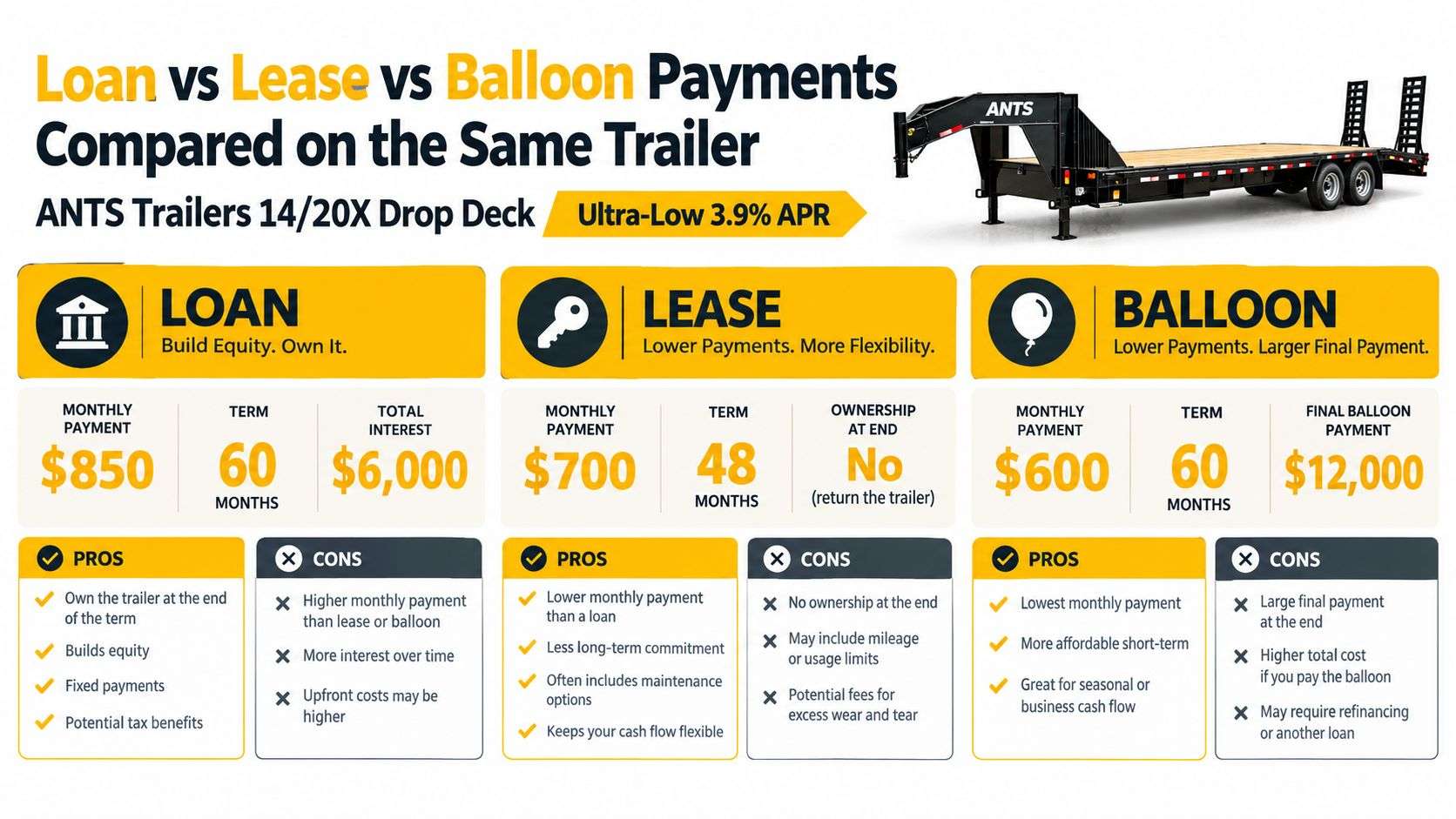
The fairest comparison uses one identical trailer configuration, one equipment price, and the same borrower assumptions. For this example, use the ANTS 14/20X Drop Deck, which has an ultra-low 3 degree bed angle and 9 degree ramp angle. Those angles are product features, while the financing structure determines how the purchase appears in the cash budget.
The three structures answer different business questions
A conventional loan is usually the clearest ownership path. The buyer makes scheduled payments and, subject to the agreement, owns the equipment after the balance is paid. The trade-off is that the regular payment may be higher than a structure that leaves value outstanding.
A lease can produce a lower periodic payment and may fit a business that values access, replacement flexibility, or a particular internal budget treatment. The buyer must inspect end-of-term conditions, purchase options, mileage or usage rules where applicable, and ownership treatment instead of assuming that a lower payment means a lower total cost.
A balloon structure leaves a final amount due. It can preserve cash during the regular schedule, but the buyer has to decide in advance how that final amount will be funded.
Compare the cash-flow shape, not just the headline
A payment comparison visual for the same 14/20X configuration shows an illustrative loan at $850 monthly for 60 months with $6,000 total interest, a lease at $700 monthly for 48 months with no ownership at the end, and a balloon structure at $600 monthly for 60 months followed by a $12,000 final balloon payment. The visual also labels the rate as 3.9% APR. Treat these as scenario figures for comparison, not as a financing offer.
| Structure | Regular payment profile | Ownership outcome | Main question |
|---|---|---|---|
| Loan | Higher scheduled payment in the illustration | Ownership follows the contract after repayment | Can the business carry the payment while building equity? |
| Lease | Lower scheduled payment in the illustration | No ownership at the end in the illustration | Are access and budget treatment more important than ownership? |
| Balloon | Lowest regular payment in the illustration | Final amount remains due | What will fund the balloon when it comes due? |
ANTS Trailers' financing options guide is useful when evaluating equipment financing for specialized trailers used to generate revenue. The payment frequency also deserves attention. Monthly, quarterly, semiannual, and annual schedules can produce different budgeting demands even when the underlying asset is identical.
Include costs the calculator may omit
A neutral equipment-finance guide advises comparing the same equipment configuration and adding costs that calculators often miss, including service contracts, consumables, installation, and end-of-life disposal or trade-in value. Those costs belong in the total-cost review because maintenance, downtime, and resale can materially change the economics of trailers and jobsite equipment.
Internal capital rules matter too. Some organizations require extra approval above a capital-expenditure threshold, and a lease may be considered because it keeps a purchase under that threshold. That accounting or approval question belongs with the finance team. The calculator can show payment, but it can't decide how your organization governs capital.
Common Gotchas That Make Calculator Estimates Misleading
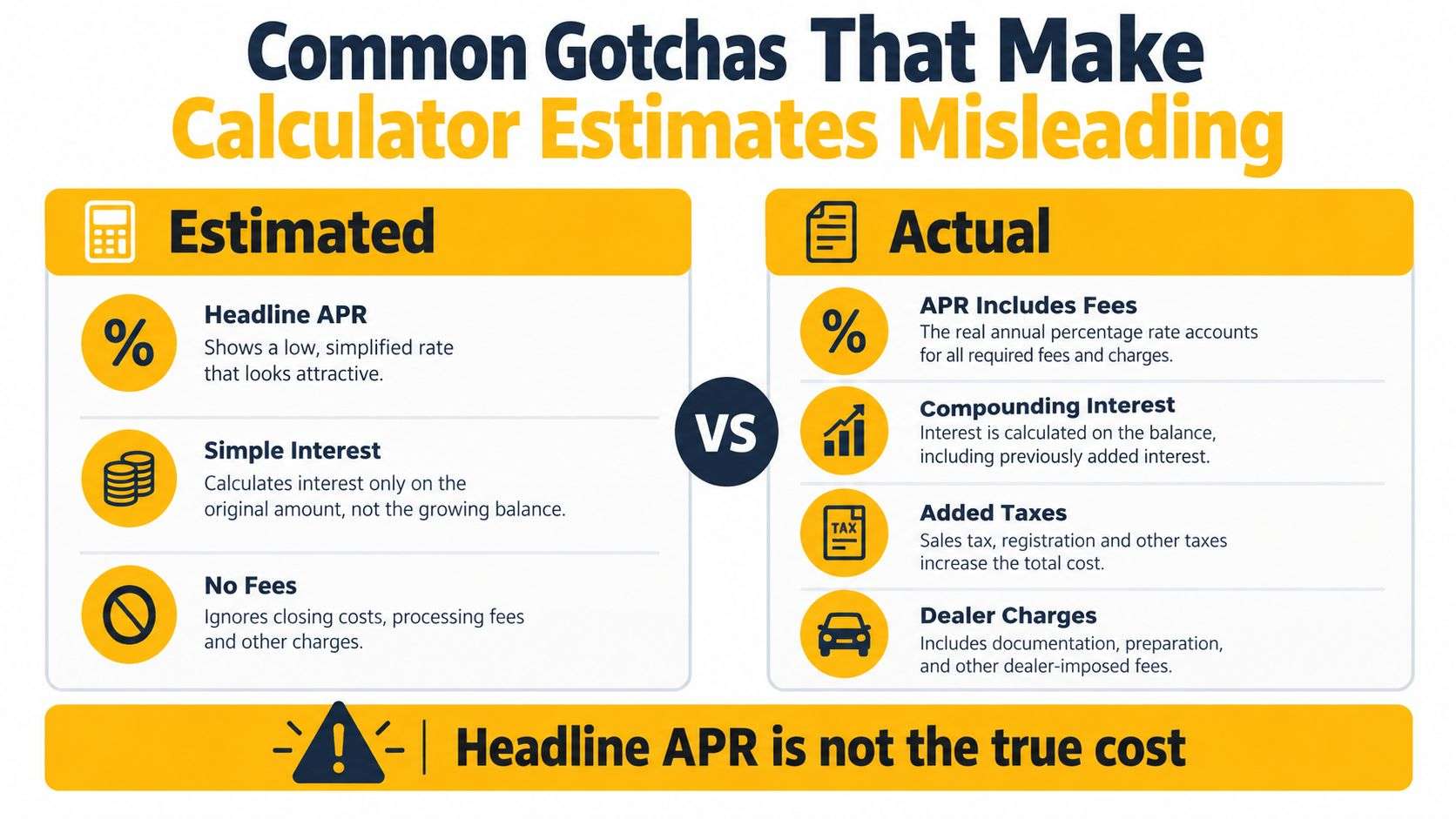
A calculator can produce an accurate answer to the inputs you give it and still produce an unrealistic estimate for your business. The largest error is treating a headline APR as though it were the rate you'll necessarily qualify for.
Underwriting can consider time in operation, credit score, loan-to-value, down payment, equipment age, and resale strength. These factors can affect both approval odds and the structure a lender offers. A newer business may face a different rate, down payment, term, or collateral expectation than an established borrower purchasing the same trailer.
Model a range, not a perfect scenario
Recent calculator guidance identifies typical down payments in the 10% to 30% range and rate bands of roughly 6% to 18%+ APR, depending on borrower quality and lender type. The qualification-focused construction calculator guidance supports using those figures as scenario boundaries, not as a universal offer.
Run several cases:
- Lower cash contribution: Shows whether preserving working capital creates an uncomfortable payment.
- Higher cash contribution: Shows how much liquidity the business gives up to reduce debt service.
- Shorter term: Tests faster payoff and potentially lower total interest.
- Longer term: Tests payment relief while exposing the cost of carrying debt longer.
- Less favorable rate: Tests whether the purchase still works without relying on ideal pricing.
If the trailer only works under the most favorable case, the deal isn't ready. Ask the lender what specific documentation or structure would move the application toward the preferred case.
Check the hidden amounts
Some calculators support taxes or fees, but others show only principal and interest. A lender may add documentation, origination, delivery, registration, dealer, or other transaction charges. Service, installation, consumables, maintenance, and downtime also affect ownership cost even when they don't appear in the loan schedule.
The equipment price itself can be misleading if the quoted configuration isn't the one the crew needs. Compare identical specifications and confirm what the payment includes. For a trailer with specialized loading or unloading functions, also account for whether those functions reduce handling time or avoid a separate piece of equipment. That operational value belongs in the business case, but it shouldn't be confused with a financing discount.
Material selection can affect long-term ownership considerations as well. Review the guide to hot-dip galvanizing costs when finish, corrosion exposure, and maintenance planning are relevant to the trailer's working environment.
Approval reality: The payment you can calculate isn't necessarily the payment a lender will approve. Qualification changes the inputs before it changes the arithmetic.
Tips to Get Favorable Terms and Move From Estimate to Approval
A calculator estimate is useful only when it survives a lender's review. Build a small decision grid instead of saving one payment screenshot. Test down payment and term combinations while protecting cash for payroll, fuel, insurance, repairs, and routine job costs. Compare each payment with the revenue the trailer is expected to support. If the deal works only under the most favorable case, it is not ready.
Prepare the file lenders review
A complete application reduces avoidable back-and-forth. Gather the equipment quote, business financial information, ownership details, time-in-business information, and requested credit documents before applying. Confirm whether the structure includes a residual, balloon, fees, or a payment frequency other than monthly.
Credit readiness matters, and so does the asset being financed. A durable, versatile trailer with a clear use case and credible resale strength gives the lender more context for evaluating the request. Underwriting still determines approval, but a precise operating plan shows how the payment fits the work.
Choose equipment that supports more than one job
ANTS Trailers are made in the USA and designed for high-quality, durable, versatile use. The live-bottom model uses a conveyor belt trailer bed, specifically a walking-conveyor floor. It can kneel, tilt, lower, or raise the trailer to support loading and unloading on uneven terrain. Those functions can matter to crews in grounds care, forestry, and public works whose work changes from site to site.
Manufacturer-direct parts and troubleshooting support also belong in the ownership review. A trailer that stays productive and remains supportable through its working life may present a clearer business case than a cheaper configuration that does not match the jobs.
For context on how debt and equity affect business capital decisions, AmbitionCFO's financing insights discusses the broader funding question. Keep that decision separate from the calculator result, then bring both into the approval discussion.

Before submitting an application, verify the equipment configuration, financed amount, down payment, rate basis, term, payment frequency, residual or balloon, taxes, fees, and expected operating costs. Recheck the payment under a less favorable qualification scenario. Then ask the financing partner to reconcile the calculator estimate with the formal offer.
Before you sign, run your final numbers through the calculator one more time, then talk to the ANTS Trailers team about the configuration and financing structure your business can carry.