
You're probably dealing with one of two trailer problems right now. Either the trailer you have can't keep up with the way your crew works, or you're about to spend real money on a replacement and you don't want to buy another unit that looks fine on paper but costs you time every week.
That's usually how trailer purchases get forced. A ramp angle is too steep for the equipment you load every day. Tools stay scattered across trucks instead of staying organized at the site. A dump setup handles bulk material, but it can't place it with much control. Or the trailer is sturdy enough, yet the layout fights the crew every morning.
The smartest contractors I've seen don't treat a trailer as just a tow-behind box. They treat it as part of production. If it cuts trips, reduces loading hassle, protects equipment, and keeps people moving, it earns its keep. If it slows setup, creates avoidable risk, or forces workarounds, it becomes overhead with wheels.
Table of Contents
- Why Your Next Work Trailer Is a Productivity Investment
- Matching the Trailer Type to Your Trade
- Key Specifications That Define Performance and Safety
- Real-World Use Cases for Specialized Work Trailers
- Ensuring Trailer Safety and Longevity on the Job
- Navigating Financing and Evaluating Dealer Support
- A Contractor's Checklist for Choosing the Right Trailer
Why Your Next Work Trailer Is a Productivity Investment
A weak trailer usually doesn't fail all at once. It bleeds you in smaller ways. One extra supply run. One machine that takes too long to load. One wet day where tools and paperwork end up exposed. One crew standing around while somebody rearranges cargo to reach what should've been accessible in the first place.
That's why a trailer purchase should be judged like any other capital decision. Ask what it does to labor, mobilization speed, equipment handling, and downtime. If it only moves cargo, you bought steel. If it helps the crew work faster and with less friction, you bought production capacity.
The broader market is moving in that direction. The global trailer market was valued at about USD 58.8 billion in 2023 and is projected to reach USD 97.5 billion by 2030, with growth tied to demand for load efficiency, durability, and jobsite flexibility according to industry reporting on contractor trailer benefits. Contractors feel that shift directly because trailers sit in the middle of tool movement, material flow, and equipment uptime.
The trailer affects more than transport
A good work trailer for contractors helps in ways that don't always show up on the quote sheet:
- Fewer wasted trips: Better organization and capacity reduce the odds that someone leaves the site for missing tools or materials.
- Safer loading: Bed height, ramp angle, and braking setup affect whether daily loading is routine or stressful.
- Better asset protection: Weather exposure, theft risk, and loose cargo damage all get worse when the trailer doesn't match the work.
- Cleaner scheduling: Crews start earlier and wrap cleaner when the trailer is already configured for the task.
Practical rule: If the trailer changes how your crew loads, unloads, stages, or stores equipment, it belongs in your productivity budget, not your miscellaneous equipment line.
There's also a business development angle many owners miss. If tighter operations help you take on more jobs without adding chaos, demand generation matters more. Teams trying to support field growth with steadier project flow can get useful ideas from this guide on effective lead gen for home service businesses, especially if your trailer investment is part of a broader capacity plan.
Matching the Trailer Type to Your Trade
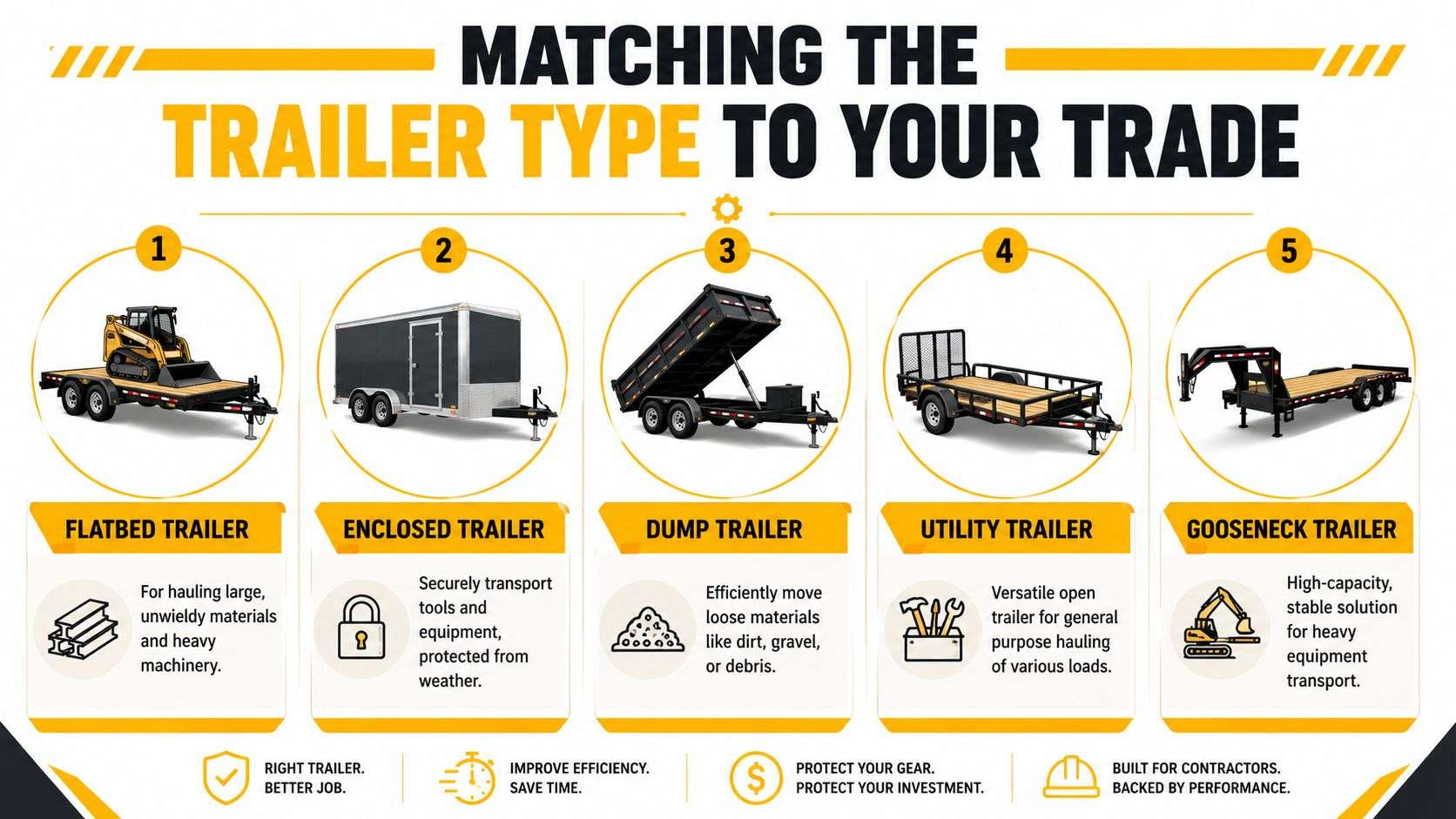
The wrong way to shop is by starting with brand, paint, or deck length. Start with the work. The trailer type has to match what you haul most often, how often you load, where you unload, and whether the trailer needs to double as storage, a mobile workspace, or a material handling tool.
The main trailer categories
Enclosed trailers fit crews that carry high-value tools, smaller equipment, consumables, documents, batteries, and chargers. They also solve a problem many public listings gloss over. They can serve as weatherproof storage and a mobile office for small crews, reducing travel time and downtime, as noted in this overview of enclosed trailers for mobile work and storage. If your jobs move frequently and supervisors need a clean place for paperwork, charging, and secure storage, enclosed starts making sense fast.
Flatbeds and open equipment trailers work when the load is awkward, oversized, or loaded from multiple sides. Lumber, palletized material, attachments, and compact machines are easier to handle on an open platform. The trade-off is exposure. You gain loading flexibility but give up weather protection and built-in security.
Dump trailers are built for loose material and debris. Dirt, gravel, demo waste, and storm cleanup are the obvious uses. They unload quickly, but they aren't always precise. If your crew needs controlled placement rather than simple dumping, a standard dump setup may create more shovel work than expected.
Utility trailers fill the daily-haul role. They're often the practical answer for lighter equipment, small material runs, and crews that need maneuverability in tighter streets or residential areas. They're useful because they're simple. They become limiting when loads get denser, security matters more, or daily loading angles become an issue.
Gooseneck trailers fit heavy hauling and long loads when stability and higher-capacity towing matter. They're usually the right answer when the trailer isn't just supporting the job but carrying core production equipment.
Then there are specialized designs. Low-angle drop decks help when machine clearance and operator comfort matter. Live-bottom conveyor trailers fit contractors who need to place material with more control than a dump body allows. If you move equipment one day and material the next, the category matters less than whether the design removes daily friction. Contractors comparing options in that lane can review equipment hauling trailer configurations to see how deck style changes the job.
Work trailer types at a glance
| Trailer Type | Primary Use Case | Pros | Cons |
|---|---|---|---|
| Flatbed Trailer | Large materials and equipment | Easy side loading, flexible deck access | Exposed to weather and theft |
| Enclosed Trailer | Tools, secure storage, mobile workspace | Security, weather protection, organized interior | Harder to load oversized items |
| Dump Trailer | Loose material and debris | Fast unloading, strong for bulk hauling | Limited control over material placement |
| Utility Trailer | General day-to-day hauling | Simple, maneuverable, practical for mixed light loads | Less secure, less specialized |
| Gooseneck Trailer | Heavy equipment transport | Stable towing, strong hauling capability | Needs the right truck and hitch setup |
A trailer should fit your most common week, not your occasional outlier job.
Key Specifications That Define Performance and Safety
Specs matter, but only if you translate them into jobsite consequences. Too many purchases happen because two trailers look similar in photos and both seem “heavy-duty.” Then one gets loaded in actual use and you realize the useful capacity, axle package, bed design, or braking setup isn't what the crew needed.
What the numbers really mean on a jobsite
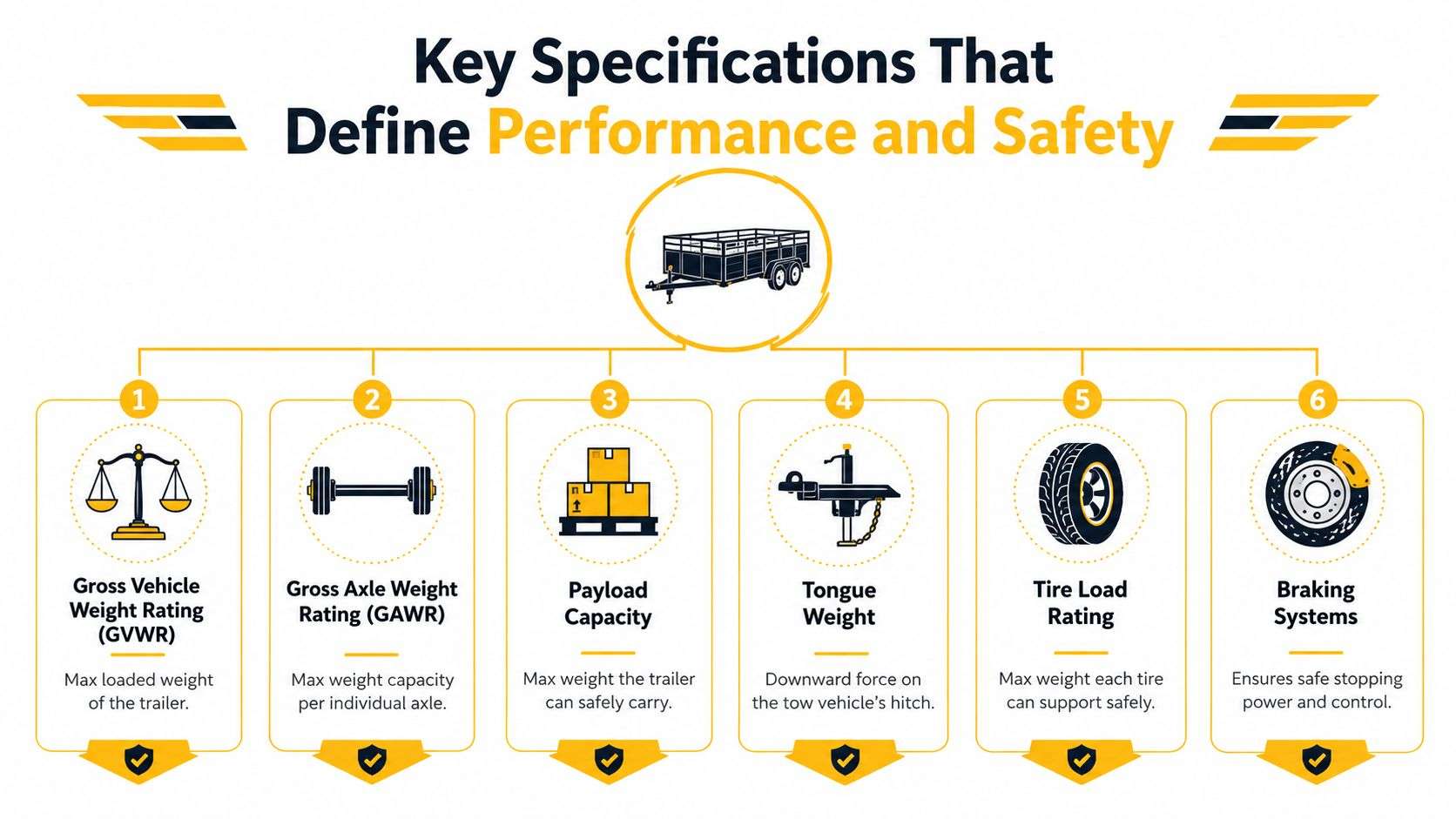
The first number to understand is GVWR, the maximum loaded weight of the trailer. The second is payload, which is what the trailer can carry after accounting for its own empty weight. On enclosed contractor trailers in major North American markets, published examples show GVWRs of 9,900 to 14,000 lb and usable load capacities of 5,850 to 10,400 lb, which is why spec verification matters so much when comparing units that look similar from the outside according to these published contractor trailer specifications.
That gap is where buyers get burned. Two trailers may share nearly the same footprint, but one may give you far more usable capacity. If you haul compact equipment, dense tools, palletized material, or mixed loads, that difference changes how often you can load once and go, instead of splitting work into multiple runs.
A few practical reminders make the spec sheet more useful:
- Axle rating matters with repeated use: A trailer that survives occasional heavy days may still wear poorly if daily loads push the axle and braking package too close to the limit.
- Tongue weight affects towing behavior: If the balance is wrong, the truck feels it immediately. Steering, braking feel, and stability all suffer.
- Tire load rating isn't an afterthought: Contractors often focus on deck and frame, but tire capacity has to support the actual work pattern.
- Brakes are part of productivity: Safe stopping gives the driver more confidence, especially when the schedule forces short urban moves mixed with highway towing.
When crews haul bulk material, they also need to think in volume, not only weight. If you're comparing body sizes, side heights, or material capacity, this plain-language explainer on what is a cubic metre is useful for converting loose material estimates into something you can plan around before the trailer shows up overloaded or underused.
Why advanced features can change the math
Work trailers for contractors stop being generic.
A lower loading angle can reduce the daily drama of getting mowers, compact machines, or wheeled equipment onto the deck. The benefit isn't theoretical. It affects undercarriage clearance, operator comfort, and whether one person can load smoothly without improvising boards, blocks, or multiple attempts.
A trailer that can lower or raise changes another practical issue. Jobsites aren't flat, and loading conditions aren't consistent. Adjustable ride height or kneeling capability helps the trailer adapt to the site instead of forcing the site to adapt to the trailer.
Then there's material control. A live-bottom conveyor bed handles jobs differently from a standard dump body. Instead of lifting the whole load and relying on gravity, it moves material out in a more controlled way. That matters when the crew wants placement instead of a pile, or when dumping clearance is limited.
If a feature removes a daily workaround, it's not a luxury feature. It's a labor feature.
One example in this category is ANTS Trailers, a USA-made manufacturer based in Michigan. Its lineup includes drop deck designs with very low load angles, trailers that can lower or raise to adapt to loading conditions, and a live bottom trailer bed with a conveyor system for controlled unloading. Buyers who want to understand how braking systems and equipment integration affect trailer performance can review scientific brake and equipment details.
Real-World Use Cases for Specialized Work Trailers
A specialized trailer earns its value when the crew uses its features without thinking about them. It just becomes the faster, safer way to get through the day.
Construction crews and managed tool control
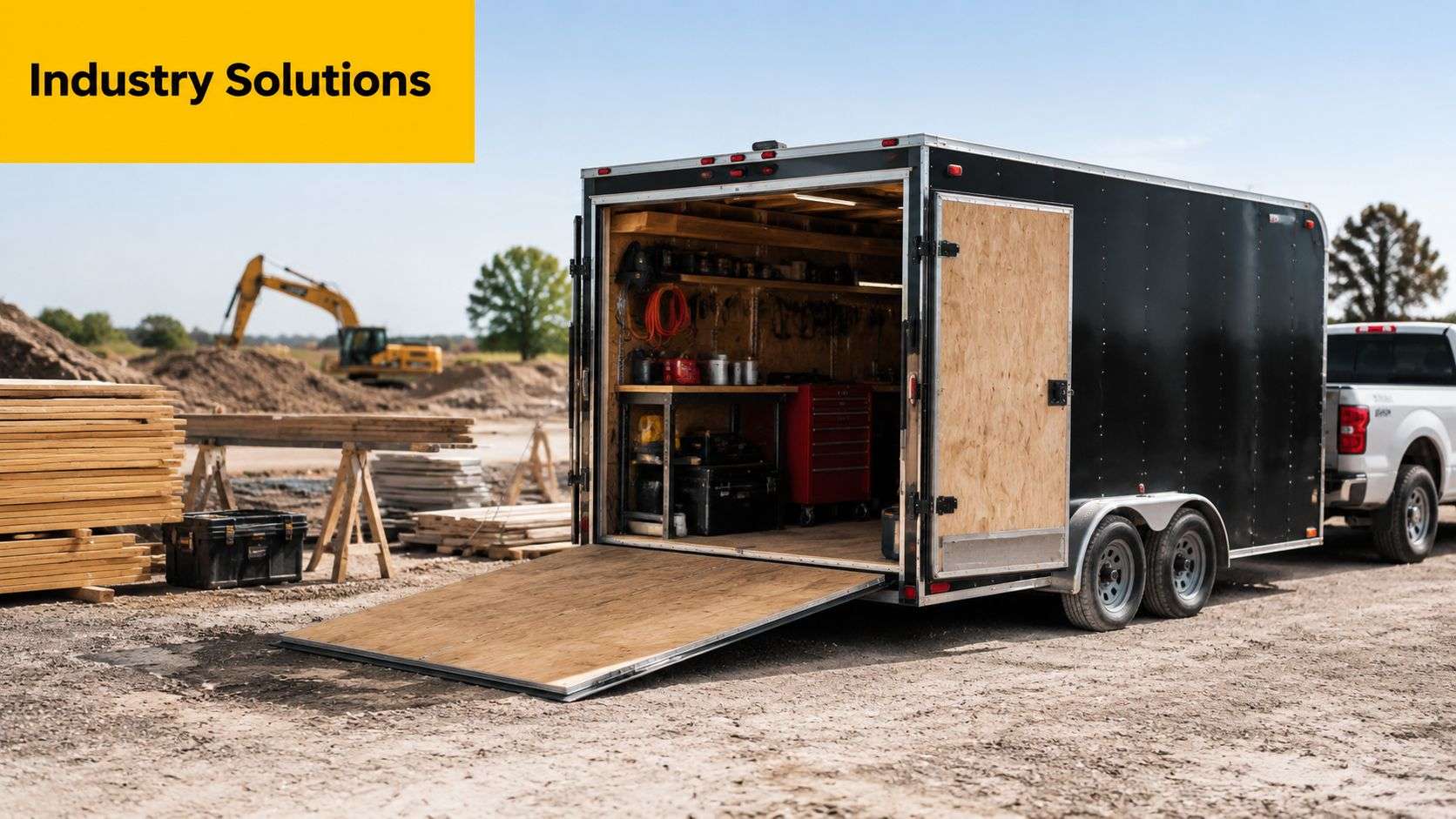
Construction is where trailer organization shows up most clearly. Managed tool trailers became a recognized productivity model in the early 2020s because crews could keep project-specific tools and consumables stocked on site, reducing off-site runs and improving inventory control, as described in this article on managed tool trailers and worksite productivity.
That approach works because it changes the trailer's job. It's no longer just transport. It becomes a mobile system for staging work. For a general contractor, that can mean dedicated shelving for fasteners, blades, batteries, and hand tools. For a concrete or sitework crew, it can mean keeping layout gear, consumables, and repair items at the point of use.
Three patterns tend to work well:
- Project-specific loading: Stock the trailer for the current phase, not for every possible future need.
- Access by sequence: Put first-use tools and materials at the doors, not buried behind low-frequency items.
- Assigned ownership: One foreman or lead should own inventory discipline, or the trailer turns into a rolling junk drawer.
Landscaping, forestry, and municipal work
Landscaping crews often deal with compact machines, hand-loaded material, and frequent stops. A low-angle trailer helps when loading zero-turn mowers, compact loaders, or small tracked units because the operator spends less time correcting approach and worrying about contact points. It also makes repetitive loading less tiring over a full day.
Forestry and vegetation management crews need versatility. They may haul saws, fuel, small equipment, protective gear, and uneven loads through rougher access roads. In that environment, a trailer that can adapt its stance and handle mixed cargo tends to outperform a one-purpose setup.
Municipal and public works crews often have another need. They work in active environments where the trailer may function as temporary field support. That pushes value toward secure storage, weather protection, and organized access. If the trailer can also place material with more control, the crew avoids turning a simple patch or repair into a cleanup problem.
The best trailer setups don't just carry what the crew needs. They present it in the order the crew needs it.
Ensuring Trailer Safety and Longevity on the Job
A trailer can be well designed and still become unreliable if ownership is sloppy. Safety and service life come from routine discipline. Most of the expensive trailer problems I've seen started as ignored basics. Tire condition, loose wiring, worn connectors, neglected brakes, damaged ramps, or cargo secured “well enough” until the day it wasn't.
What to inspect before every move
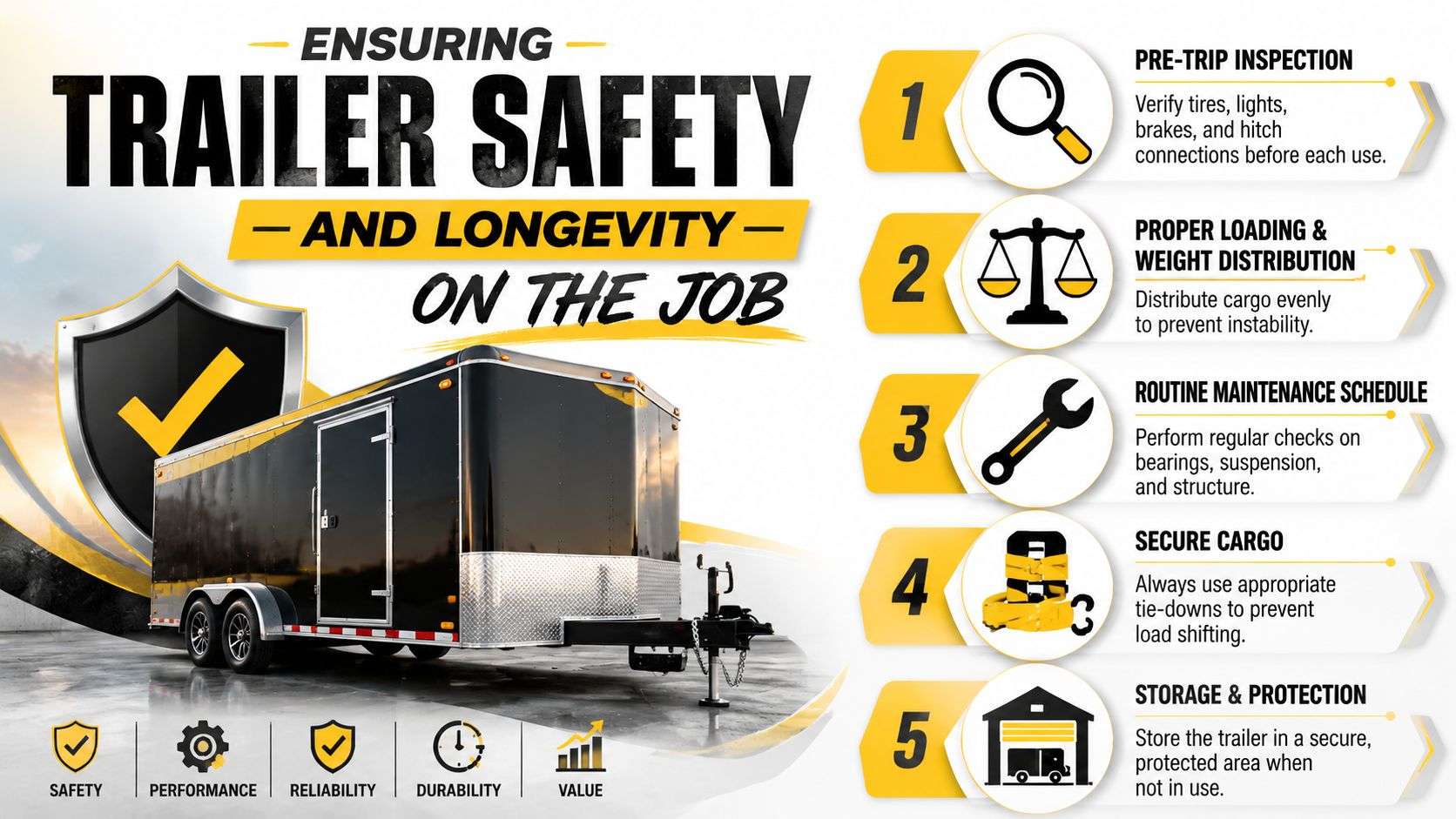
A pre-trip walkaround should be short enough that crews will perform it and detailed enough to catch what matters.
Use a routine like this:
- Tires and wheels: Check inflation, visible wear, sidewall damage, and lug security.
- Lights and wiring: Verify running lights, brake lights, turn signals, and connector condition.
- Brakes and breakaway gear: Make sure the system is functional and the emergency setup is intact.
- Hitch and coupler: Confirm engagement, safety chains, and jack position before moving.
- Deck and load securement: Look for damaged boards, loose hardware, ramp issues, and tie-down wear.
Storage matters too. A trailer left exposed, overloaded, or parked carelessly between jobs usually costs more to keep in service. Build quality helps, especially with durable USA-made construction, but maintenance habits still decide whether the trailer stays dependable.
Anchoring and site stability
Once a trailer becomes a jobsite structure, stability rules get stricter. NIPSCO specifies that jobsite trailers be secured with diagonal ties angled at least 40 degrees from vertical, with each tie rated for a working load of 3,125 lb, and tie count increases as trailer length increases according to these jobsite trailer setup safety requirements.
That has a practical consequence many crews underestimate. Longer trailer setups need more planning, not just more space. Anchor count, spacing, ground condition, and utility location all matter before anyone starts driving stakes or assuming a level pad is enough.
A simple ownership standard helps:
- Inspect before every tow
- Load within rating and distribute weight deliberately
- Secure cargo with the right hardware
- Document routine maintenance
- Plan site anchoring before setup, not during it
Safety problems usually start as convenience decisions.
Navigating Financing and Evaluating Dealer Support
Most trailer purchases feel expensive at signing and cheap later, or the reverse. The difference usually comes down to uptime. A trailer with the right support behind it can stay productive. A trailer that's hard to finance properly, hard to get parts for, or hard to troubleshoot becomes a distraction for the office and a bottleneck for the field.
Buy the trailer and the support system
Financing matters because it changes what you can buy now versus what you settle for. If the right trailer reduces labor waste, loading hassle, or material handling friction, spreading the cost may be smarter than buying the cheapest available unit and paying for its limitations every week.
That said, financing shouldn't distract from support quality. Before you commit, find out how the manufacturer and dealer handle parts, service questions, warranty issues, and technical troubleshooting. A strong support relationship is often worth more than a minor price difference, especially if the trailer does specialized work.
If you're reviewing payment structures, approval paths, or equipment purchase timing, it helps to look at trailer financing options alongside the trailer specs themselves.
Questions worth asking before you sign
Ask direct questions that reveal what ownership will feel like after delivery:
- Parts access: How quickly can common wear items and replacement components be sourced?
- Service path: Who handles diagnostics and repair if the trailer has specialized systems?
- Warranty clarity: What's covered, what isn't, and how claims are processed?
- Technical support: Can your team call someone who understands the actual product, not just the invoice?
- Dealer responsiveness: If the trailer is down, will somebody help you get it moving again?
A dependable support chain protects ROI. You're not just buying equipment. You're buying the time it stays available for work.
A Contractor's Checklist for Choosing the Right Trailer
By the time you're comparing quotes, most mistakes have already happened. Actual errors start earlier, when a contractor shops by appearance, broad category, or sticker price without defining what the trailer has to do every day.
The short list that prevents expensive mistakes
Use this checklist before you approve a purchase:
- Define the primary job: Is the trailer mainly for tools, machines, loose material, mixed cargo, or field operations support?
- List regular loads: Write down your heaviest regular equipment, not the occasional exception.
- Match the tow vehicle: The truck, hitch, and braking setup have to fit the trailer you're buying.
- Verify useful payload: Don't assume similar size means similar carrying capacity.
- Check loading geometry: Ramp angle, deck height, and machine clearance matter if you load often.
- Inspect build details: Look at welds, frame layout, wiring protection, door hardware, and tie-down placement.
- Decide on specialized functions: If lowering, raising, kneeling, or controlled material discharge would remove daily friction, price that against labor and time.
- Consider service life: Durable, USA-made construction can matter if the trailer will see rough daily use.
- Review support and financing together: Cheap financing on a hard-to-support trailer can still be the wrong deal.
Think in labor hours, not sticker price
The cleanest way to judge work trailers for contractors is to ask what they replace. Do they replace supply runs, awkward loading, weather delays, hand shoveling, disorganized tool storage, or unnecessary machine repositioning? If yes, the trailer has measurable business value even before you get into maintenance and resale.
A trailer should make the crew more consistent. It should reduce avoidable motion, protect what you haul, and simplify the work. If it does that, it's not an accessory. It's part of your operating system.
If you're weighing a new trailer purchase and want to look at designs built around jobsite efficiency, ANTS Trailers is worth a look. They build work trailers in the USA and offer configurations focused on durability, equipment handling, and specialized functions such as low-angle loading, adjustable trailer height, and live bottom conveyor unloading for material control.